Reported by Simon Daniel Yusuph l Journalist at Weng Global
A chieftain of the Peoples Democratic Party (PDP) in Ogun State, Segun Showunmi, has urged non-indigene associations and hunters’ groups across the state to mobilise support for President Bola Ahmed Tinubu ahead of the 2027 presidential election.
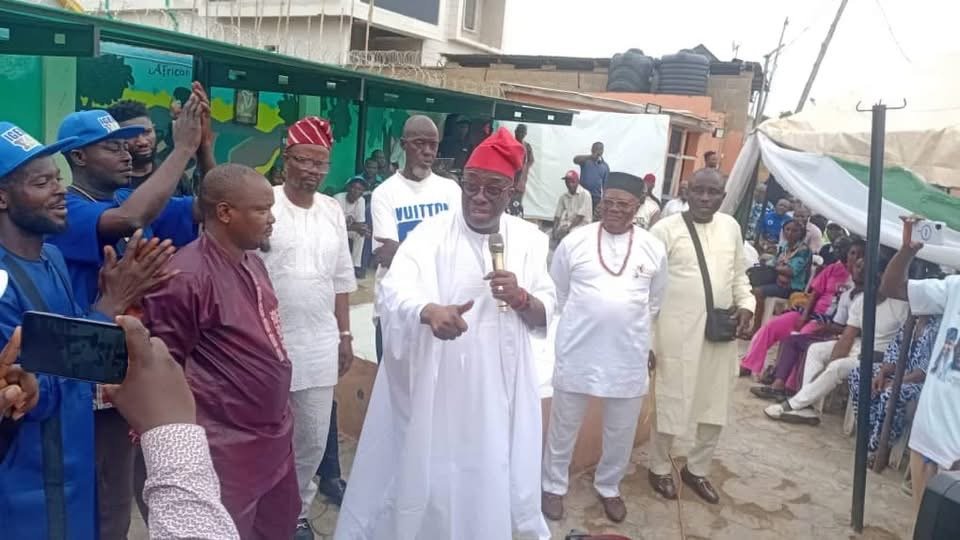
Showunmi made the call on Saturday, October 3, 2026, during a meeting with representatives of non-indigene communities and hunters’ groups in Abeokuta, the Ogun State capital.
Despite remaining a PDP chieftain, Showunmi has in recent months publicly supported Tinubu’s bid for a second term, arguing that the President should be allowed more time to implement his economic policies and that political continuity is important to national development.
His latest appeal adds another dimension to the increasingly active political mobilisation underway across Ogun State and the wider South-West ahead of the 2027 elections.
Showunmi calls for support for Tinubu
At the Abeokuta meeting, Showunmi urged non-indigenous residents and hunters to mobilise voters in their communities for Tinubu.
He described the 2027 presidential election as an opportunity to make what he characterised as a strong political statement about national inclusion and the future distribution of political power.
According to the report of the meeting, Showunmi told representatives of several non-indigene communities that included Igbo, Igede, Tiv, Calabar and Edo groups that patience and political maturity could contribute to an eventual Igbo presidency.
He argued that different regions should recognise the importance of political cooperation rather than approaching national politics solely through confrontation.
Showunmi also appealed to the groups to mobilise across Ogun Central, Ogun East and Ogun West.
His message was not limited to individual support. He called for coordinated political mobilisation capable of producing a substantial vote for Tinubu in Ogun State during the 2027 presidential election.
‘Ogun Tribe’ description
Showunmi also referred to non-indigenous residents living in Ogun State as part of what he called the “Ogun Tribe”.
The description was used in the context of his argument that non-indigenes play an important role in the state’s economic and social life.
Ogun is one of Nigeria’s most industrialised states and has significant commercial activity involving people from different parts of the country. Its proximity to Lagos, large manufacturing base and expanding urban centres have contributed to the movement of people into the state for business, employment and other economic opportunities.
Showunmi said non-indigenous residents should be protected against mistreatment and indicated that he would continue to stand with them when they faced such problems.
The issue of indigene and non-indigene relations has remained an important political and social question in Nigeria, particularly in states with substantial populations of residents who originate from other parts of the country.
For political campaigns, such communities can represent an important voting constituency, although their electoral preferences cannot be assumed to be uniform.
Appeal to different regions
Showunmi linked his appeal to a broader argument about political power-sharing in Nigeria.
He said overwhelming support for Tinubu from the South-West, South-South, South-East and North-Central would demonstrate that no single region was more important than another.
His argument reflects the continuing importance of regional calculations in Nigeria’s presidential politics, where candidates and political parties regularly seek to build coalitions that cross geographical and ethnic boundaries.
However, political mobilisation does not automatically translate into votes. The eventual outcome of the 2027 presidential election will depend on voter participation, candidate choices, party structures, campaign performance and the decisions made by individual voters.
Showunmi’s call is therefore a political appeal rather than evidence of a guaranteed electoral result.
Showunmi’s support for Tinubu
Showunmi’s latest position is consistent with a series of statements he has made in 2026 in support of Tinubu’s re-election.
In September, the Ogun PDP chieftain publicly urged his supporters to begin grassroots mobilisation for Tinubu, arguing that Nigeria needed policy continuity and sufficient time for the Federal Government’s economic programmes to produce results.
He said frequent changes in leadership could disrupt long-term policy implementation and argued that governments required time to pursue their programmes.
Showunmi has also maintained that his support for Tinubu does not necessarily mean he has left the PDP.
His political position is therefore unusual within Nigeria’s opposition landscape: he remains associated with the PDP while openly advocating a second term for the incumbent president, who is the leader of the ruling All Progressives Congress (APC).
Earlier prediction about Tinubu’s prospects
Showunmi has previously gone further in his assessment of Tinubu’s prospects.
In June 2026, he predicted that Tinubu could win about 22 states in the 2027 presidential election.
Speaking on Arise Television at the time, Showunmi described the election as likely to be a contest between Tinubu and former Vice-President Atiku Abubakar, while suggesting that political developments could improve Tinubu’s performance in several areas.
That prediction remains a political assessment rather than an established forecast.
The actual number of states won by any presidential candidate will only become known after the Independent National Electoral Commission conducts the election, counts the votes and announces the official results.
Health debate around Tinubu
Showunmi’s campaign for Tinubu has continued into October.
On October 1, he dismissed concerns about Tinubu’s health and fitness to seek another term, saying the President was healthy and capable of serving beyond 2027.
Showunmi made the comments during another grassroots engagement in Ijebu-Igbo, Ogun State, where he was canvassing support for Tinubu. His remarks came amid renewed political discussion about the President’s health following his absence from the 81st United Nations General Assembly in New York, where Vice-President Kashim Shettima represented Nigeria.
The comments demonstrate that Showunmi’s campaign activity has expanded beyond a single meeting or constituency.
His position within the PDP
Showunmi’s political activities also come against the background of his own ambitions within Ogun politics.
In April 2026, he declared his intention to contest the 2027 Ogun State governorship election.
He made the declaration during a visit to the Inter-Party Advisory Council secretariat in Abeokuta and called for collaboration among political parties. He also criticised what he described as the “coronation” of candidates ahead of the election.
The development created an interesting political situation because Showunmi subsequently became increasingly vocal in support of Tinubu at the presidential level while remaining active in Ogun politics.
The PDP itself has also been preparing for the 2027 Ogun governorship election. In September, the party formally commenced its campaign for the state governorship contest, with Ladi Adebutu as its governorship candidate.
This means Showunmi’s support for Tinubu exists alongside a separate political contest in Ogun in which the PDP is seeking to regain control of the state.
Why non-indigene voters matter
The mobilisation of non-indigenous residents is significant because Nigeria’s electoral politics often extend beyond traditional ethnic and regional identities.
People who live outside their states of origin participate in political, commercial and community life in their places of residence. Their voting decisions can therefore matter in closely contested elections.
Ogun’s position within the South-West makes it particularly important in presidential politics.
The state shares a boundary with Lagos and has developed into a major destination for industries, businesses and residential communities. Abeokuta, Sagamu, Ijebu-Ode, Ota and other urban centres have attracted residents from different parts of Nigeria.
For political organisers, this creates a broad network of community associations that can potentially be reached through grassroots mobilisation.
However, membership of a non-indigene association does not mean members will necessarily vote as a bloc. Individual voters remain free to choose their preferred candidates.
Ogun and the 2027 political contest
The 2027 political contest in Ogun is expected to involve both presidential and governorship-level mobilisation.
At the presidential level, Tinubu’s supporters are seeking to consolidate the South-West, while opposition parties are working to challenge the ruling party’s influence.
At the governorship level, political competition has also intensified.
Showunmi’s own declaration of interest earlier in the year demonstrated the fluidity of the political landscape. Several political parties have shown interest in his political profile, while he has continued to identify with the PDP.
His support for Tinubu at the presidential level therefore exists within a more complicated political environment at the state level.
The wider zoning debate
Showunmi’s comments about a future Igbo presidency also touch on Nigeria’s longstanding debate over regional rotation and political zoning.
Supporters of zoning argue that political power should rotate among Nigeria’s major regions to promote inclusion and reduce perceptions of permanent exclusion from the presidency.
Critics, however, often argue that electoral competition should be based primarily on competence, policies and the constitutional right of citizens to choose their leaders.
Showunmi’s argument appears to combine both considerations. He is calling for support for Tinubu now while suggesting that political cooperation could help create conditions for an Igbo presidency in the future.
Whether voters accept that argument will ultimately depend on individual political preferences and broader developments before the election.
The 2.5 million-vote target
Showunmi also called for Ogun State to deliver close to 2.5 million votes for Tinubu.
Such numerical targets are increasingly appearing in political mobilisation ahead of the 2027 election, but they should be treated as campaign objectives rather than guaranteed electoral outcomes.
The final number of votes a candidate receives will depend on voter registration, turnout, accreditation, ballots cast and the official count.
Political parties and campaign groups can set targets, but only the election itself can establish how many votes each candidate receives.
The target nevertheless demonstrates the importance Showunmi attaches to Ogun State in Tinubu’s re-election campaign.
Reactions and political significance
Showunmi’s intervention is likely to attract attention because of his position within the PDP and his increasingly open support for Tinubu.
His political stance differs from the conventional expectation that a prominent member of an opposition party should campaign against the incumbent party.
Yet Showunmi has publicly explained his position in terms of policy continuity and his assessment of Tinubu’s administration.
In September, he defended the Federal Government’s economic direction and argued that the administration should be given more time to implement its policies.
His argument has therefore been presented as a political judgement about governance rather than merely a party endorsement.
For the PDP, however, such cross-party support can raise questions about party cohesion and the relationship between individual political ambitions and broader party strategy.
What happens next
Showunmi is expected to continue his grassroots mobilisation efforts across Ogun State as the 2027 election approaches.
His recent engagements indicate an emphasis on community organisations, non-indigene groups, hunters and other grassroots networks rather than relying exclusively on television appearances or social media.
He previously described himself as a grassroots politician and said political mobilisation should extend to polling-unit structures.
The effectiveness of that strategy will become clearer as political parties intensify their campaigns and voters begin making decisions about the presidential and governorship contests.
For now, Showunmi’s latest message is clear: he wants non-indigenous residents and hunters in Ogun State to participate actively in the 2027 election and support Tinubu.
His appeal, however, remains part of the wider political campaign and should not be interpreted as evidence of how those communities will ultimately vote.
Why it matters
The development matters because Ogun State occupies an important position in the South-West and because the 2027 presidential contest is already generating extensive grassroots mobilisation.
Showunmi’s position also illustrates the increasingly complex alliances emerging ahead of the election.
A politician can remain formally associated with one political party while publicly supporting another party’s presidential candidate, particularly in a political environment where local and national interests do not always align.
His appeal to non-indigenes also highlights the importance of communities whose political influence extends beyond their states of origin.
As Nigeria moves closer to the 2027 general elections, such groups are likely to become increasingly important targets for political parties and campaign organisations seeking to build broad electoral coalitions.
The final test, however, will come at the ballot box.
Weng Global – Stories beyond borders
Sources
AFP News Agency
Punch
TheCable
The Guardian
Channels Television