Reported by Simon Daniel Yusuph l Journalist at Weng Global
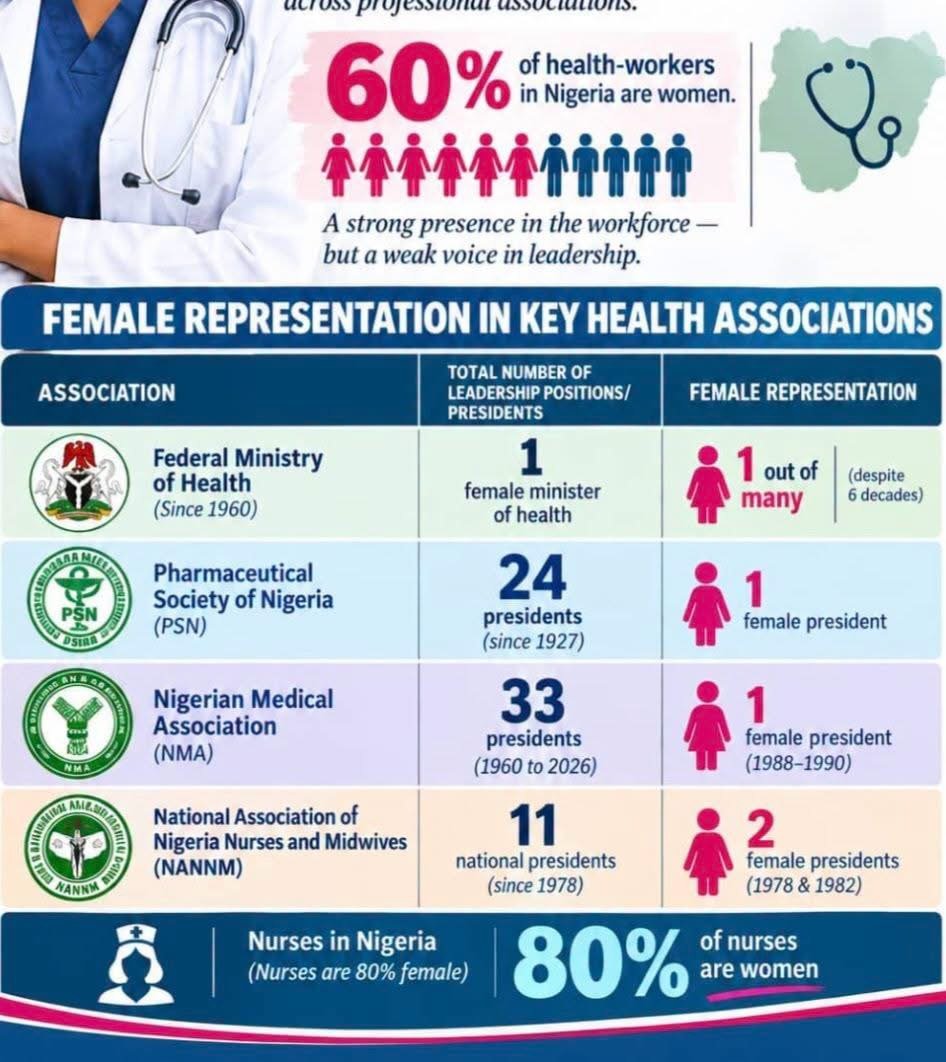
Women make up more than 60 per cent of Nigeria’s health workforce, yet their presence at the highest levels of professional and health-sector leadership remains disproportionately low, exposing a persistent gap between women’s contribution to healthcare and their influence over decisions affecting the sector.
A report published by PUNCH Healthwise on October 4, 2026, highlights how women in medicine, nursing and pharmacy continue to encounter gender stereotypes, resistance, demanding leadership responsibilities and work-life pressures as they seek elected and senior positions in their professional associations.
The issue extends beyond professional associations. Research on women’s leadership in Nigeria’s health sector has documented significant disparities in senior positions across government institutions, medical training organisations, tertiary healthcare facilities and other parts of the health system.
For a country whose healthcare system relies heavily on women professionals, the imbalance raises questions about who makes decisions, who controls resources and whose experiences are represented when health policies are developed.
Women’s Numbers Do Not Translate Into Leadership
The numerical strength of women in Nigeria’s health workforce has not translated into equivalent representation in leadership.
Women in Global Health Nigeria says women account for more than 60 per cent of Nigeria’s health workforce but are less equitably represented in sought-after professional and leadership positions. The organisation has identified gender inequality in health leadership as a continuing structural challenge.
The imbalance is particularly visible across different health professions.
A Nigeria health workforce profile cited in research by WomenLift Health found that women accounted for about 35 per cent of medical doctors, 44 per cent of dentists and 87 per cent of nurses and midwives. The same research found that women’s representation in health-sector leadership did not correspond with their representation in the workforce.
The figures demonstrate an important distinction: having large numbers of women working in healthcare does not necessarily mean that women have an equal voice in the institutions governing the profession.
A Doctor’s Experience Illustrates the Challenge
The PUNCH Healthwise report highlighted the experience of Dr Ime Okon, who sought the position of secretary of the Nigerian Medical Association’s Lagos State chapter in 2020.
According to the report, Okon encountered attempts to discourage her from contesting, including people who told her that the position was too demanding for a woman and should be left to men.
Her experience reflects one of the barriers identified in wider research on women’s leadership in Nigeria’s health sector: the perception that leadership positions are incompatible with women’s family responsibilities or professional roles.
Such assumptions can influence whether women decide to contest positions in the first place and whether colleagues view them as suitable candidates.
The problem is therefore not necessarily limited to formal rules that prevent women from becoming leaders. Informal expectations, workplace culture and social attitudes can also affect access to leadership.
Nursing Has a Particularly Wide Representation Gap
The disparity is especially striking in nursing and midwifery, professions where women constitute the overwhelming majority of the workforce.
Research cited by PUNCH Healthwise puts women’s share of Nigeria’s nursing and midwifery workforce at approximately 85 to 87 per cent, yet senior leadership remains largely male dominated.
This creates a notable contradiction.
Women constitute most of the professionals providing nursing and midwifery services, but men continue to occupy a significant share of influential leadership positions within the profession.
The situation demonstrates why workforce representation alone cannot be used as a measure of gender equality.
Leadership determines priorities, professional policies, resource allocation and the direction of institutions. When women are heavily represented at operational levels but less represented where major decisions are made, the benefits of their experience may not be fully reflected in policy.
Medicine Also Has a Leadership Gap
Women remain underrepresented in senior medical leadership despite increasing participation in the profession.
Research on Nigeria’s health-sector leadership has found that women are poorly represented across senior positions in government ministries, medical training institutions and tertiary health organisations. It also found that women represented only 11 per cent of members of the National Council on Health in 2022, despite their much larger share of the wider health workforce.
The leadership gap can also be seen among federal government-owned hospitals.
According to the PUNCH Healthwise report, only a small number of the 76 medical directors of federal government-owned hospitals are women. Among those identified are Prof Idia Ize-Iyamu of the University of Benin Teaching Hospital, Dr Mercy Anugwu of the Federal Medical Centre, Onitsha, and Dr Aisha Adamu of the Federal Medical Centre, Jalingo.
These appointments demonstrate that women are reaching senior positions, but their numbers remain small compared with their overall participation in healthcare.
Pharmacy Shows Both the Problem and Signs of Change
The Pharmaceutical Society of Nigeria provides another example of the uneven representation of women in professional leadership.
According to the organisation’s president, Prof Ayuba Tanko, the PSN has had 24 presidents since its establishment, but only one woman has occupied the top position.
Tanko nevertheless said women’s participation in the association was increasing.
He noted that a woman contested against him in the 2024 presidential election and that women now occupy four of the 12 elected positions on the association’s National Executive Council. Women also lead one of the association’s four technical groups and three of its four interest groups.
The development suggests that representation can improve when women increasingly participate in professional governance.
However, the long history of male dominance at the highest level shows how difficult it can be for participation to translate into the most senior elected office.
Gender Stereotypes Remain a Major Barrier
Gender stereotypes are among the most frequently identified obstacles to women’s advancement.
WomenLift Health’s analysis of Nigeria’s health sector identifies gender bias, cultural and religious norms, work-life balance, a lack of role models and the perception of leadership as inherently male as barriers to women’s advancement.
These barriers can reinforce one another.
A woman may have the professional qualifications required for a leadership position but hesitate to seek election because of expectations about family responsibilities. Colleagues may also judge her differently from a male candidate, particularly when leadership requires long hours, travel or public confrontation.
Over time, these pressures can create a cycle in which relatively few women seek senior positions, resulting in fewer female role models and making leadership appear even more male dominated.
Work and Family Responsibilities
The challenge of balancing professional and family responsibilities is another recurring factor.
Leadership positions in medical associations, hospitals and other professional bodies can require extensive meetings, travel, networking, administrative work and public engagement.
For health workers who already face demanding clinical schedules, adding leadership responsibilities can create significant pressure.
WomenLift Health’s Nigeria analysis specifically identifies work-life balance as one of the factors limiting women’s progression into leadership.
This does not mean women are inherently less willing or able to lead.
Rather, it raises questions about whether institutions are structured in ways that allow professionals with family responsibilities to compete fairly for leadership.
Flexible working arrangements, mentorship, leadership training and institutional support can therefore influence who is able to pursue senior positions.
Personal Choice Is Also Part of the Debate
Not every instance of underrepresentation can automatically be attributed to discrimination.
The PUNCH Healthwise report also includes the perspective that personal choice and women’s own level of interest in leadership can influence representation. The PSN president, for example, pointed to apathy among women at the broader societal level as one factor contributing to low representation in his association.
That perspective is important because a balanced discussion must distinguish between barriers imposed by institutions and decisions made by individuals.
Some professionals may prefer clinical practice, research, teaching or family responsibilities to organisational politics.
However, personal choice becomes more difficult to assess where social expectations and institutional cultures influence the choices available to women.
The central question is therefore not simply whether women are willing to lead, but whether those who want leadership have an equitable opportunity to pursue it.
Women Are Already Demonstrating Leadership Capacity
Nigeria’s health sector also has examples of women occupying influential positions.
The Medical Women’s Association of Nigeria currently has Dr Zainab Kwaru Mohammad-Idris as its national president, according to the association’s official website. MWAN describes itself as a non-political, non-profit organisation representing female medical and dental practitioners in Nigeria and says it has more than 30 state branches and the Federal Capital Territory.
The association’s work demonstrates that women professionals are already organising, managing institutions and participating in health advocacy.
Other women also occupy senior positions in hospitals, regulatory institutions, academia and healthcare organisations.
At a 2026 healthcare leadership event in Lagos, stakeholders similarly called for greater representation of women in healthcare leadership and policy-making, arguing that women remain significantly underrepresented despite constituting a large share of the health workforce.
The debate, therefore, is not about whether women have leadership capacity. It is about whether the health system provides enough pathways for that capacity to influence decisions at the highest levels.
Why Women’s Leadership Matters
Women’s representation in health leadership has implications beyond equality.
Healthcare decisions affect women, children, families and communities, and women professionals bring experiences that can help institutions understand gaps that may otherwise receive less attention.
WomenLift Health has argued that women leaders are more likely to prioritise research and action involving women, children and marginalised populations and that women’s leadership can contribute to innovation and stronger health outcomes.
This does not mean women leaders will automatically make better decisions than men.
Rather, a leadership system that includes people with different experiences and perspectives can strengthen the range of issues considered when policies are designed.
For Nigeria, where healthcare challenges include maternal health, workforce shortages, migration, financing and unequal access to services, diverse leadership could help ensure that decision-making reflects the realities of different groups.
The Wider Gender Gap in Nigeria
The health sector’s leadership imbalance exists within a broader national gender gap.
According to the 2026 Global Gender Gap Report cited by PUNCH Healthwise, Nigeria ranked 143rd out of 145 countries on the political empowerment sub-index.
That wider context helps explain why leadership disparities in healthcare cannot be viewed entirely in isolation.
Professional associations operate within the same social environment as other Nigerian institutions. Cultural expectations about women’s roles, access to networks, economic power and political participation can influence professional leadership as well.
Addressing the problem therefore requires more than simply encouraging individual women to contest elections.
Calls for More Inclusive Leadership
Women’s health and professional organisations have increasingly called for greater representation in decision-making.
Women in Global Health Nigeria says its goal includes increasing gender parity in health leadership and empowering women through mentorship and leadership development.
The organisation also identifies the need to address structural barriers and create supportive networks for women working across Nigeria’s health sector.
Similarly, the Women in Healthcare Network advocates gender equality in healthcare leadership and promotes mentorship, networking and professional development for women across medicine, nursing, pharmacy, physiotherapy, wellness, mental health and other fields.
Such initiatives point to one possible route forward: developing leadership pipelines rather than waiting until women reach senior positions before offering support.
What Needs to Change?
Improving women’s representation in health leadership will likely require action at several levels.
Professional associations can strengthen transparent electoral processes, encourage wider participation and provide leadership development opportunities for younger professionals.
Health institutions can also ensure that promotion and appointment systems are based on clear professional criteria and are not influenced by gender stereotypes.
Mentorship can help emerging women professionals understand how organisational leadership works and build the networks often required to compete for senior positions.
Workplace policies can also make leadership more accessible by addressing the practical difficulties of balancing demanding professional responsibilities with family obligations.
Most importantly, women who seek leadership should be assessed on competence, experience and their ability to serve—not on assumptions about whether leadership is appropriate for their gender.
What Happens Next
The underrepresentation of women in Nigeria’s health leadership is unlikely to be resolved through a single policy or election.
The evidence points instead to a longer process involving professional associations, government institutions, healthcare employers and women themselves.
Progress will depend on whether more women are encouraged and supported to contest leadership positions, whether institutions remove unnecessary barriers and whether professional bodies create credible pathways from local and state-level leadership to national office.
The growing number of women participating in professional governance provides some evidence of movement, particularly in pharmacy and other areas of healthcare. But the continued dominance of men in many senior positions shows that the gap remains significant.
For Nigeria’s health system, the central issue is not simply how many women work in healthcare. It is whether the women who make up such a substantial part of the workforce also have a meaningful voice in deciding how that system is governed.
Weng Global – Stories beyond borders
Sources
- PUNCH Healthwise
- Women in Global Health Nigeria
- WomenLift Health
- The Guardian Nigeria
- Medical Women’s Association of Nigeria
- Women in Healthcare Network