Reported by Weng Patrick Atokor l Journalist at Weng Global
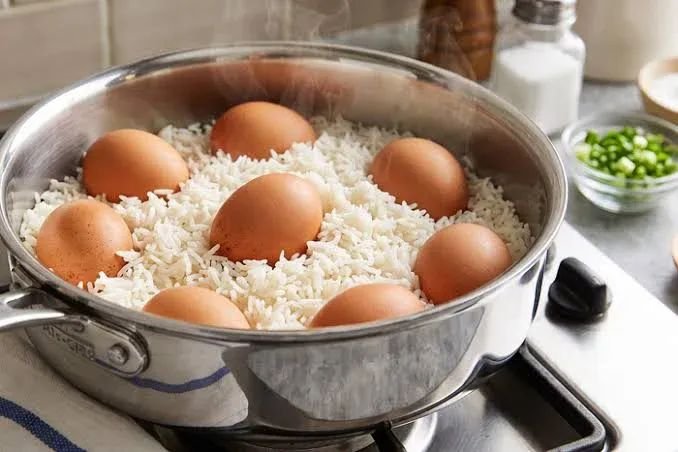
A common cooking practice in many Nigerian homes has recently attracted renewed attention: placing eggs in the same pot while rice is cooking.
The practice is often used to save cooking time, gas and effort. But recent reports have cited food-safety concerns, particularly the possibility that bacteria on eggshells could contaminate food.
So, should Nigerians stop boiling eggs and rice together?
The short answer is that the concern is real, but the issue requires more explanation than simply saying the practice is dangerous.
Eggs can carry harmful bacteria, including Salmonella, and raw eggs should be handled carefully. However, properly cooking eggs and maintaining good kitchen hygiene are the main measures recommended by food-safety authorities.
Why are eggs associated with Salmonella?
Salmonella is a group of bacteria that can cause foodborne illness. Eggs can become contaminated in different ways, including during formation inside the hen or through contamination of the shell after the egg is laid.
The United States Department of Agriculture says shell eggs can contain Salmonella Enteritidis and that bacteria can contaminate eggs before the shell is formed or after the egg is laid.
The presence of Salmonella, however, does not mean that every egg is contaminated or that eating a properly cooked egg will make someone sick.
Food-safety authorities focus heavily on proper handling, preventing cross-contamination and cooking eggs thoroughly.
What is the concern about cooking eggs with rice?
The concern is primarily about hygiene and cross-contamination.
The US Centers for Disease Control and Prevention advises people to follow four basic food-safety principles: clean, separate, cook and chill. It specifically identifies raw or undercooked eggs as foods that can contain harmful germs and advises people to wash their hands after handling uncooked eggs.
If an eggshell is contaminated and is handled improperly, microorganisms can potentially be transferred to hands, utensils, kitchen surfaces or other food.
This is why food-safety specialists emphasise preventing contact between raw foods and foods that are ready to eat.
However, there is an important distinction.
The claim that bacteria from an eggshell will automatically make rice dangerous simply because both are placed in the same cooking pot is too broad.
Cooking is itself a major control for foodborne bacteria.
Does boiling kill Salmonella?
Heat can destroy Salmonella when food reaches an adequate temperature for sufficient time.
The FDA advises consumers to cook eggs until both the yolk and white are firm. It also recommends cooking egg-containing dishes to 160°F (about 71°C).
USDA guidance similarly recommends thoroughly cooking eggs, with an internal temperature of 160°F (71°C) for eggs and egg dishes.
Research has also examined the inactivation of Salmonella during egg boiling and found that bacterial numbers decline as the temperature rises, with rapid inactivation occurring at higher temperatures.
This means the presence of bacteria on an egg does not automatically mean those bacteria will survive proper cooking.
The bigger food-safety issue is whether raw contamination is spread around the kitchen before or during preparation and whether the food is adequately cooked.
What about the eggshell?
An eggshell is not necessarily sterile.
USDA explains that eggs can be exposed to Salmonella through several routes, including contamination associated with the hen and the environment.
This is why people should handle eggs carefully.
Cracked eggs deserve particular attention because microorganisms on the shell can more easily enter the edible portion through cracks. CDC guidance for eggs from backyard poultry specifically advises throwing away cracked eggs and cooking eggs until both the white and yolk are firm.
The safest approach is therefore not to assume that an egg is completely free of microorganisms simply because its shell looks clean.
Should Nigerians wash eggs before cooking them?
This is another area where people should be careful about applying advice from one country or egg-production system universally.
USDA guidance for commercially processed grocery-store eggs says consumers should not wash them again because washing can increase the possibility of cross-contamination and can remove the protective coating applied during commercial processing.
For eggs obtained directly from backyard poultry, CDC guidance is different: it advises against washing them with cold water because this can potentially draw germs into the egg, while recommending that dirt be removed carefully and cracked eggs discarded.
The important lesson for Nigerian households is to understand the source and handling conditions of the eggs rather than assuming that washing automatically makes them safe.
Using soap or detergent on eggs is also not a substitute for proper food-safety practices.
Is boiling eggs and rice together poisonous?
There is no established basis for describing the practice itself as poisonous.
Some recent reports have warned Nigerians about boiling eggs and rice in the same pot because of possible bacterial contamination. However, food-safety guidance does not say that eggs and rice become poisonous simply because they share cooking water.
The more accurate explanation is that raw eggs can be a source of foodborne pathogens, and poor handling can create opportunities for cross-contamination.
Once food is adequately cooked, heat can destroy many harmful microorganisms.
That distinction matters because exaggerated health claims can create unnecessary fear while distracting people from the practices that actually reduce foodborne illness.
So, is it safer to cook them separately?
Cooking eggs separately from rice can be a sensible hygiene practice because it reduces direct contact between the eggshell and the cooking food.
It is particularly reasonable when eggs are visibly dirty, cracked, poorly handled or obtained from an uncertain source.
But separating the two should not be presented as the only scientifically recognised way to make eggs safe.
The fundamental precautions remain:
- Handle raw eggs carefully.
- Wash hands after handling raw eggs.
- Keep raw foods and ready-to-eat foods separate.
- Avoid using cracked eggs.
- Keep kitchen utensils and surfaces clean.
- Cook eggs thoroughly.
- Do not rely on appearance alone to determine whether food is safe.
The CDC recommends the broader “clean, separate, cook and chill” approach to preventing food poisoning.
What should households actually do?
For Nigerians who prefer to cook eggs and rice separately, there is little reason to change that habit. Separate cooking can make food handling easier and reduce opportunities for cross-contamination.
For households that cook intact eggs in the same pot as rice, the important issue is proper handling and adequate cooking rather than fear that the combination itself creates a toxic food.
Eggs should be intact, appropriately handled and thoroughly cooked.
If an egg cracks into the rice during cooking, the food should be handled carefully and cooked thoroughly rather than assuming that the problem is automatically solved simply because the rice is hot.
People preparing food for young children, older adults or people with weakened immune systems should be particularly careful because these groups can face a higher risk of serious illness from foodborne infections.
The bigger lesson: food hygiene matters more than the cooking shortcut
The debate over eggs and rice highlights a broader issue in household food preparation.
Food safety is not only about what foods are combined. It is also about how ingredients are handled before, during and after cooking.
An egg can be nutritious and safe when properly handled and cooked. Rice can also be part of a healthy diet. The problem arises when harmful microorganisms are allowed to spread through poor hygiene, inadequate cooking or unsafe storage.
For Nigerian households, therefore, the most useful message is not simply “never boil eggs with rice.”
It is to understand the actual risk.
Eggs can carry harmful bacteria. Raw eggs should be handled carefully. Cross-contamination should be prevented. And eggs and egg-containing foods should be cooked thoroughly.
Cooking eggs separately from rice is one way of reducing contact between the two foods, but the evidence does not support describing the ordinary practice of cooking intact eggs with rice as inherently poisonous.
The safest kitchen is ultimately one where people understand how contamination occurs and consistently practise good food hygiene.
What Nigerians should remember
The controversy can be reduced to four simple points:
First, eggs can carry Salmonella and other microorganisms.
Second, raw eggs can spread germs through contaminated hands, utensils and surfaces.
Third, adequate cooking is a critical step in destroying harmful bacteria.
Fourth, separating eggs from rice can reduce opportunities for cross-contamination, but the combination itself should not automatically be described as poisonous or inherently unsafe.
For Nigerian households, good food hygiene remains more important than whether two ingredients share the same cooking pot.
Weng Global – Stories beyond borders
Sources
- U.S. Food and Drug Administration (FDA), What You Need to Know About Egg Safety.
- U.S. Centers for Disease Control and Prevention (CDC), Preventing Food Poisoning.
- U.S. Department of Agriculture Food Safety and Inspection Service (USDA-FSIS), Shell Eggs from Farm to Table.
- USDA-FSIS, Can Shell Eggs Contain Bacteria?
- CDC, Preventing Salmonella Infection.
- International Journal of Food Microbiology, Inactivation of Salmonella Enteritidis during boiling of eggs.