Reported by Simon Daniel Yusuph l Journalist at Weng Global
Germany will be without Jamal Musiala and Kai Havertz for Sunday’s UEFA Nations League clash against Greece after both players suffered muscular problems during the team’s opening match against the Netherlands.
Germany head coach Jürgen Klopp confirmed after the 1-1 draw in Amsterdam that the two attacking players were unlikely to be available for the Greece fixture, with both undergoing medical examinations. The German Football Association subsequently confirmed that the pair would miss the match.
The injuries leave Klopp facing two significant selection issues as Germany prepares for its second Group A2 fixture of the 2026/27 Nations League campaign.
Musiala injured before Netherlands match
Musiala’s injury emerged before Germany’s match against the Netherlands in Amsterdam on Thursday.
The Bayern Munich midfielder experienced muscular discomfort in his thigh during the warm-up and was withdrawn from the starting lineup shortly before kick-off. Nadiem Amiri replaced him in the starting XI.
Klopp later described the problem as a normal football injury and said it was unrelated to Musiala’s previous medical issues. The coach expressed hope that the player would recover quickly and return to club football without a lengthy absence.
Musiala’s late withdrawal meant Germany began Klopp’s first competitive match in charge without one of its most prominent attacking players.
Havertz forced off against Netherlands
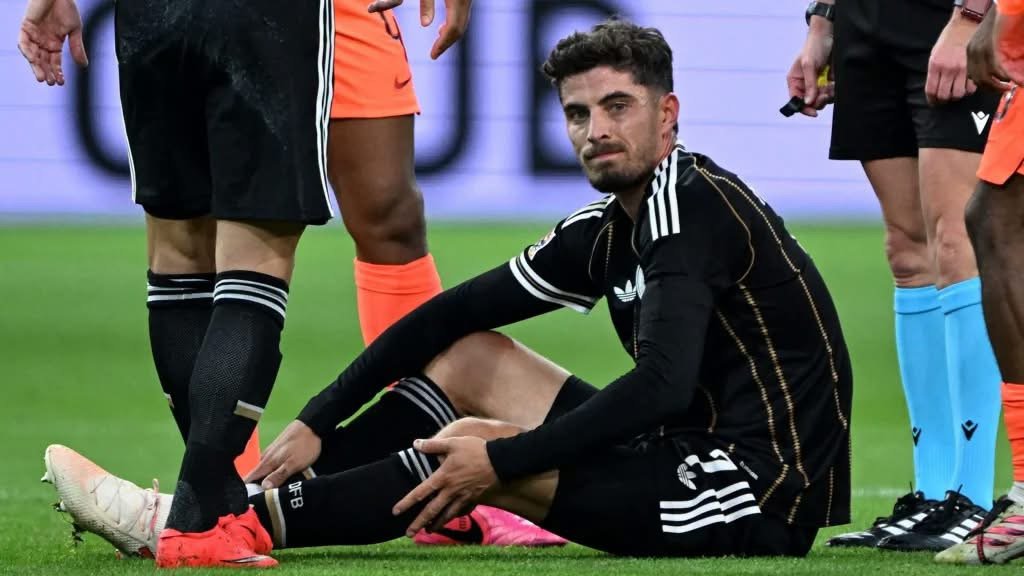
Havertz was able to start the match but lasted only around half an hour.
The Arsenal forward suffered discomfort in his thigh after an incident involving Netherlands defender Quinten Timber. Havertz initially continued after receiving treatment but subsequently indicated that he could not carry on.
He was replaced in the first half by Younes Ebnoutalib, who made his Germany debut. Reports from German football coverage identified the problem as muscular, with Havertz undergoing further assessment alongside Musiala.
The injuries meant Germany lost two important attacking options during its opening Nations League fixture.
Klopp faces selection changes
The absence of Musiala and Havertz means Klopp will have to adjust his attacking options for the meeting with Greece.
German football reports indicated that Jonathan Burkardt and Nick Woltemade were among the players who could receive greater consideration following the injuries. Both had originally been associated with another Germany squad during the international window.
The situation also highlights the unusual squad-management approach adopted by Klopp for his first international window as Germany coach.
Reuters reported earlier this week that Klopp had selected two separate groups of players for Germany’s first four Nations League matches, with the arrangement designed to manage the demanding football calendar and reduce the physical burden on players.
Germany held by Netherlands
The injury concerns came after Germany opened its Nations League campaign with a 1-1 draw against the Netherlands in Amsterdam.
Germany took the lead through Felix Nmecha, but the Netherlands equalised late in the match to share the points.
The result gave both teams one point from the opening Group A2 fixture, while Greece began its campaign with a 2-1 victory over Serbia.
The standings and results make the upcoming Germany-Greece meeting an important early fixture in the group, although the Nations League campaign remains at its opening stage.
Greece also arrives with a positive start
Greece will travel to face Germany after securing three points in its opening match against Serbia.
The Greeks defeated Serbia 2-1 on September 24, putting them in a strong position at the beginning of Group A2.
Germany, meanwhile, has one point following the draw in Amsterdam.
The two teams are scheduled to meet on Sunday, September 27, in Germany, with the fixture forming part of the second matchday of the Nations League league phase. UEFA lists Germany, Greece, the Netherlands and Serbia together in Group A2.
A busy Nations League schedule
The Greece match is the second of a demanding series of fixtures for Germany during the September and October international windows.
After facing Greece on September 27, Germany will play Serbia on October 1 before travelling to Greece for the return fixture on October 4.
The team will later face Serbia again in November before completing the league phase against the Netherlands.
The schedule means Germany must manage its squad carefully, particularly with several players involved in demanding club schedules before and after international duty.
For Klopp, the immediate challenge is to maintain attacking options while avoiding further injuries.
What Musiala and Havertz’s absence means
Musiala and Havertz occupy different roles but both provide Germany with attacking quality and experience.
Musiala has become one of Germany’s leading creative players, capable of operating between midfield and attack and creating opportunities in tight areas.
Havertz offers versatility across the forward line and has experience playing both centrally and from wider attacking positions.
Their absence therefore reduces Klopp’s available options for the Greece match, although Germany has several other attacking players within its wider squad.
The situation also provides an opportunity for other members of the squad to take on greater responsibility during the match.
Germany’s home debut under Klopp
The Greece match will be particularly significant because it will be Klopp’s first home game as Germany’s national-team coach.
Klopp took charge of the national side in 2026 and began his tenure with the 1-1 draw against the Netherlands.
UEFA described the Netherlands match as Klopp’s debut as Germany coach, with the former club manager beginning his international tenure in the 2026/27 Nations League.
The Greece fixture will therefore give German supporters their first opportunity to see Klopp lead the national team on home soil in a competitive match.
The coach will now have to prepare for that occasion without two of his leading attacking options.
Injuries remain under assessment
Although Germany has confirmed that Musiala and Havertz will miss the Greece match, the full extent of their injuries and their expected recovery periods remain separate issues.
Klopp initially said he hoped both players would return quickly to their clubs after undergoing medical examinations.
That means the immediate confirmation concerns their availability for Germany rather than a definitive long-term prognosis.
For their clubs, the next question will be when the players can safely resume training and competitive action.
What happens next
Germany will face Greece on Sunday, September 27, in the second round of UEFA Nations League Group A2 fixtures.
The match is scheduled for 8:45 p.m. Central European Time, according to UEFA’s fixture list. Germany will then host Serbia on October 1 before travelling to Greece on October 4.
Klopp must now decide how to reorganise his attack following the confirmed absences of Musiala and Havertz.
For Germany, the match provides an opportunity to respond after dropping points against the Netherlands. For Greece, it represents a chance to build on its opening victory over Serbia.
The immediate focus, however, will also be on Germany’s squad management as the team navigates injuries during the early stages of Klopp’s tenure.
Weng Global – stories beyond borders
Sources
- UEFA
- German Football Association
- Reuters
- Sportschau
- ZDF
- Sky Sport
- AFP