Reported by Weng Patrick Atokor l Journalist at Weng Global
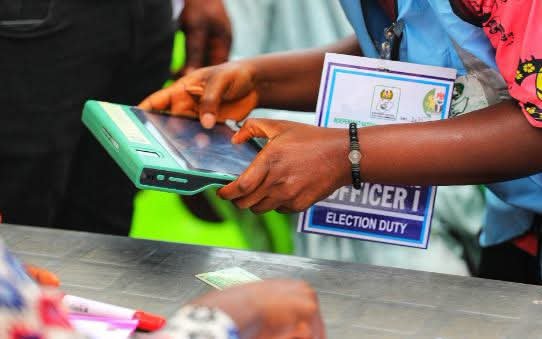
Nigeria’s Independent National Electoral Commission (INEC) has dismissed a viral social media video claiming that the Bimodal Voter Accreditation System (BVAS) can be remotely logged out before the conclusion of voting, describing the allegation as false and misleading.
The commission said only the polling official operating a BVAS device has the authority to log in or log out during voter accreditation and the subsequent uploading of polling unit results.
INEC issued the clarification on Monday, November 16, 2026, following the circulation of a video on Instagram in which a man claiming to have served as a presiding officer alleged that voters could be logged out of the system before the official closing time for voting.
The development has renewed public attention on the reliability of Nigeria’s election technology as political parties, electoral stakeholders and citizens prepare for the 2027 general elections.
In its response, INEC urged Nigerians to disregard the video, warning against the circulation of unverified information about the operation of the electoral system.
INEC Explains How BVAS Login Credentials Work
According to the commission, every polling unit is assigned unique login credentials, which are issued to the presiding officer on the eve of an election.
These credentials enable the designated polling official to access the BVAS device for voter accreditation on election day and subsequently upload the polling unit result sheet after voting concludes.
INEC rejected the suggestion that an external individual or authority could remotely terminate the device’s session before the completion of accreditation and voting.
The commission maintained that the login and logout functions are controlled by the polling official operating the device, adding that its established procedures do not provide for remote logout by an external authority.
The clarification is particularly significant because BVAS plays a central role in Nigeria’s electronic voter accreditation process.
By addressing the allegation publicly, INEC sought to reassure voters and other electoral stakeholders that the system operates according to established procedures rather than the remote interference described in the circulating video.
INEC Dismisses Claims That Offline Election Results Can Disappear
Beyond the remote logout allegation, the commission also addressed another claim in the circulating video concerning the storage and transmission of election results.
The video reportedly warned prospective polling officials against uploading result sheets offline, suggesting that such results could disappear before reaching the INEC Result Viewing Portal (IReV).
The individual in the video reportedly advised polling officials to take screenshots of results and wait until internet connectivity was available before uploading them.
INEC rejected this assertion, explaining that the IReV application had been upgraded to support offline uploads following difficulties encountered during the 2023 general elections.
According to the commission, the offline upload feature was introduced to address situations in which polling officials could not transmit result sheets because of poor or unavailable internet connectivity.
INEC explained that polling officials in areas with limited or no network coverage could upload polling unit result sheets offline in the presence of stakeholders.
The commission maintained that once uploaded, the result sheet remains securely stored on the BVAS device while awaiting successful transmission.
It further explained that when polling officials move from their polling units to ward collation centres and their devices regain internet connectivity, the stored result sheets are automatically transmitted to the IReV portal.
The process, according to INEC, does not require additional manual intervention after connectivity is restored.
This clarification addresses concerns about whether poor network coverage could prevent the electronic transmission of polling unit results or result in the loss of documents already uploaded through the offline function.
Lessons From Nigeria’s 2023 General Elections
The latest clarification comes against the background of difficulties associated with election technology during Nigeria’s 2023 general elections.
BVAS and IReV were important components of INEC’s efforts to improve voter accreditation and make polling unit results more accessible to the public.
BVAS was designed to authenticate voters through biometric verification, using fingerprint and facial recognition technology, while also supporting the electronic capture and uploading of polling unit result sheets.
IReV, on the other hand, provides a public platform through which citizens, political parties, election observers and other stakeholders can view uploaded polling unit result sheets.
INEC’s 2023 General Election Report identifies BVAS as a technology developed to strengthen voter verification, authentication and accreditation. The commission also documented the challenges experienced during the nationwide deployment of its electoral technology. INEC Nigeria +1
The 2023 elections, however, exposed significant operational difficulties, particularly concerning the timely uploading of presidential election results to IReV.
The delayed appearance of polling unit result sheets on the portal generated public criticism and raised questions about the commission’s preparedness to manage electronic results transmission during a nationwide election.
INEC subsequently acknowledged technical difficulties associated with scaling up the IReV platform from managing off-season elections to handling a nationwide general election.
The commission’s latest explanation suggests that the offline upload capability is part of its effort to address connectivity-related challenges experienced during previous elections.
It is important, however, to distinguish between offline storage and successful public transmission. A result sheet stored on a device is not necessarily the same as a result sheet already visible on the public IReV portal.
That distinction makes it important for electoral officials and stakeholders to understand how the different stages of result handling operate.
Why the BVAS Clarification Matters Ahead of the 2027 Elections
The credibility of an election depends not only on the voting process but also on the transparency, security and public confidence surrounding the management of results.
For Nigeria, where election-related controversies have frequently generated political tension, clear communication about the technology used during voting is particularly important.
The BVAS system is intended to reduce opportunities for voter impersonation and multiple voting by requiring biometric authentication during accreditation.
Its use alongside IReV also provides a mechanism for making polling unit result sheets available for public scrutiny.
However, the effectiveness of these technologies depends on several factors, including reliable equipment, adequate training of polling officials, functioning internet infrastructure, effective technical support and transparent procedures.
The 2023 experience demonstrated that deploying election technology does not automatically eliminate operational challenges or public concerns about electoral credibility.
Consequently, INEC’s latest clarification should be viewed as part of the wider conversation about electoral preparedness ahead of the 2027 elections.
For voters, the important issue is not simply whether BVAS has remote logout functionality. It is also whether the commission can ensure that the system performs consistently across polling units, including communities with limited network coverage.
Political parties, election observers and civil society organisations also have an interest in understanding how accreditation records and polling unit result sheets are handled.
Clear explanations of these procedures can help reduce misinformation and enable stakeholders to assess the electoral process using accurate information.
Public Confidence and Electoral Transparency
INEC’s response highlights the importance of public education in protecting the credibility of Nigeria’s electoral process.
False or misleading information about election technology can create unnecessary suspicion, particularly when it circulates widely without sufficient evidence.
At the same time, public confidence cannot depend solely on assurances from the electoral commission. It also requires transparency, accountability and the willingness of the institution to explain how its systems work.
Independent observers and relevant stakeholders will therefore have an important role in monitoring the performance of BVAS and IReV during future elections.
The commission’s clarification provides its official position on the remote logout allegation and offline result storage. However, continued public scrutiny of election technology remains necessary to strengthen confidence in the electoral process.
INEC Urges Nigerians to Ignore Unverified Information
INEC urged Nigerians to disregard the viral video and avoid creating or circulating unverified information about its electoral systems.
The commission also encouraged members of the public to rely on its official communication channels for accurate information about BVAS operations and result uploads.
It reaffirmed its commitment to transparency, accountability and the conduct of free, fair and credible elections.
What Happens Next?
With the 2027 general elections approaching, attention will increasingly focus on INEC’s preparations, particularly its ability to deploy reliable technology and address weaknesses identified during previous elections.
The commission will need to maintain public awareness of its procedures, strengthen technical preparedness and demonstrate that its electoral systems can operate effectively across different parts of the country.
For Nigerian voters, understanding how BVAS accreditation and IReV result uploads work is an important part of participating in an informed electoral process.
INEC’s latest clarification settles its position on the specific allegation circulating online, but the broader test will be how effectively the commission implements its procedures during future elections.
Weng Global – Stories beyond borders
Sources
- Independent National Electoral Commission (INEC) – Official clarification on BVAS operations and offline result uploads, November 16, 2026.
- Punch Newspapers – BVAS remote log-out claim false, INEC declares.
- The Guardian Nigeria – No one can remotely log out BVAS before voting ends, INEC clarifies.
- INEC – Report of the 2023 General Election.
- Channels Television – INEC’s explanation of IReV technical challenges during the 2023 elections.