Reported by Weng Patrick Atokor l Journalist at Weng Global
Nigerian businessman and Heirs Holdings Chairman Tony Elumelu has called for a stronger shift from traditional aid towards trade, investment and private-sector partnerships as Africa seeks more sustainable economic growth.
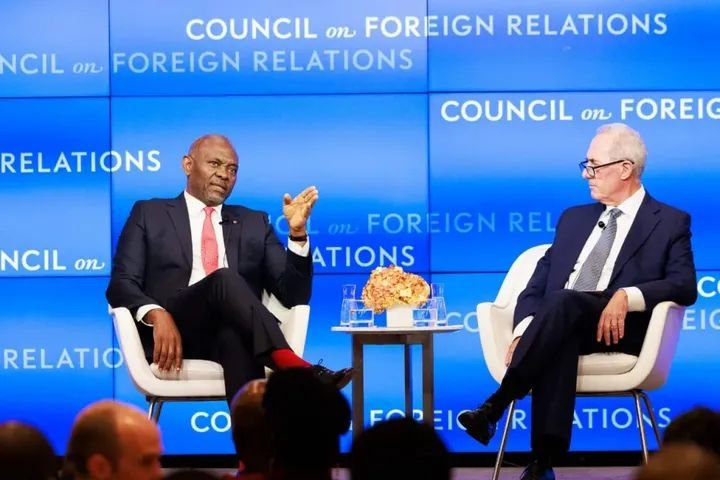
Elumelu made the call during a fireside chat on the sidelines of the 81st United Nations General Assembly (UNGA) in New York, where he addressed international investors and policy leaders on Africa’s economic prospects and the future of U.S.-Africa relations.
Elumelu Calls for New Approach to Africa’s Economic Development
According to a statement reported by Punch, Elumelu argued that Africa’s development should increasingly be driven by trade, entrepreneurship and domestic private capital rather than long-term dependence on external assistance.
He said international investors should look beyond broad perceptions of Africa as a single high-risk market and instead recognise the differences and opportunities across the continent’s 54 countries.
Elumelu said strategic partnerships with credible African businesses could help international investors access commercial opportunities while supporting local economic development.
The remarks were made during the Council on Foreign Relations’ Darryl G. Behrman Lecture on Africa Policy, moderated by CFR President Michael Froman.
Africapitalism at the Centre of Elumelu’s Argument
Elumelu also reaffirmed his support for Africapitalism, an economic philosophy centred on the role of Africa’s private sector in driving social and economic transformation.
He argued that while foreign aid can provide short-term relief, sustainable development requires investment capable of strengthening productive capacity, infrastructure and businesses within African economies.
He called on international venture funds, pension managers and development finance institutions to work more directly with African financial institutions to finance infrastructure, including energy corridors and major trade hubs.
The argument places private investment and entrepreneurship at the centre of Africa’s development challenge, particularly as governments and businesses seek ways to expand employment and productive capacity.
Youth Entrepreneurship and Jobs
Elumelu also linked economic development with employment and security, highlighting the role of young entrepreneurs in Africa’s future.
He pointed to the Tony Elumelu Foundation’s entrepreneurship programme as an example of how relatively small amounts of seed funding can be used to support entrepreneurs and businesses.
According to the report, the foundation committed $100 million to train and fund young African entrepreneurs, with $5,000 in non-refundable seed capital forming part of its support model.
The Tony Elumelu Foundation has continued its entrepreneurship programme in 2026, with the foundation stating that it plans to empower 3,200 entrepreneurs through four cohorts during the year.
For Elumelu, the issue goes beyond business creation. He argued that high youth unemployment can contribute to irregular migration and social instability, making employment and entrepreneurship issues with wider international implications.
Energy Access Remains a Major Challenge
Elumelu also addressed Africa’s energy needs, arguing that economic and industrial expansion will remain difficult without reliable electricity.
He cited more than 600 million Africans as lacking access to basic electricity and argued that energy shortages pose a significant constraint on industrialisation and digital development.
He called for a pragmatic approach to the continent’s energy transition, including the use of natural gas as a transition fuel while renewable energy infrastructure is developed.
The position reflects a broader debate over how African countries can expand electricity access while also pursuing long-term climate and energy-transition goals.
Call to Strengthen African Trade
Elumelu also called for changes to existing commercial frameworks between Africa and international partners.
He specifically pointed to the African Growth and Opportunity Act, known as AGOA, arguing that future arrangements should focus more directly on reducing production and freight costs for African exporters.
He also highlighted the African Continental Free Trade Area, or AfCFTA, saying its implementation should help deepen regional supply chains, increase local manufacturing and reduce regulatory barriers to trade between African countries.
The UN’s 81st General Assembly is taking place from September 18 to 28, 2026, with the high-level general debate running from September 22. The UN says the session is focused on revitalising international cooperation and addressing global challenges, including sustainable development and economic transformation.
Why the Trade Argument Matters
The debate over aid, trade and investment is significant because Africa’s development needs extend beyond short-term humanitarian and development assistance.
Trade and investment can potentially support longer-term productive capacity by connecting African businesses to markets, capital, technology and supply chains. However, expanding trade also depends on factors such as reliable infrastructure, access to finance, regulatory stability, energy availability and the ability of businesses to compete internationally.
Elumelu’s argument therefore places greater emphasis on partnerships that connect international capital with African enterprises and institutions rather than treating the continent primarily as a recipient of development assistance.
His call also comes as African policymakers continue to pursue greater regional economic integration through AfCFTA and seek increased investment in infrastructure, manufacturing, energy and technology.
What Happens Next
The effectiveness of the shift advocated by Elumelu will depend on how governments, investors and African businesses translate such proposals into commercial partnerships and investment.
For AfCFTA, continued implementation remains central to efforts to expand intra-African trade and regional supply chains. International commercial arrangements such as AGOA will also remain important to discussions about Africa’s access to major export markets.
At the same time, addressing electricity shortages, infrastructure gaps, financing constraints and youth unemployment will remain important to determining how effectively African economies can convert trade and investment opportunities into broader economic gains.
Elumelu’s UNGA intervention has therefore placed entrepreneurship, private capital, energy access and African trade at the centre of his call for a different approach to the continent’s economic relationship with the rest of the world.
Weng Global – Stories beyond borders
Sources
- PUNCH — report on Tony Elumelu’s UNGA 81 fireside chat and call for a shift from aid to trade.
- United Nations — General Assembly High-level Week 2026 and the 81st session.
- Tony Elumelu Foundation — 2026 Entrepreneurship Programme information.