Reported by Simon Daniel Yusuph l Journalist at Weng Global
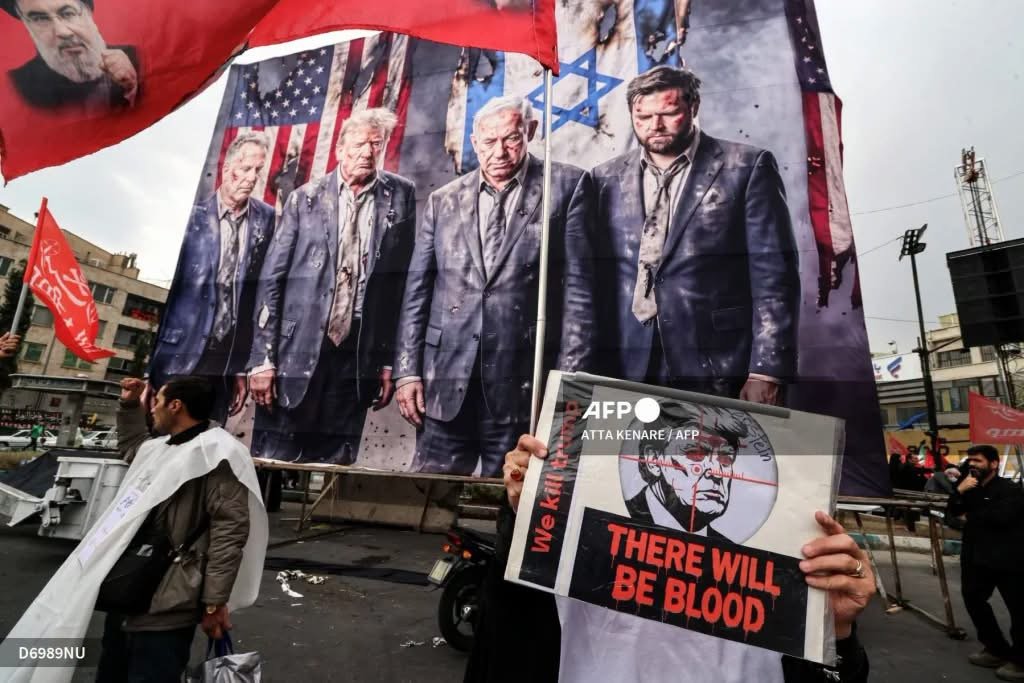
Iran has unveiled a massive billboard in Tehran carrying an explicit threat against United States President Donald Trump, intensifying anti-American messaging as tensions between Washington and Tehran continue amid the ongoing conflict between the two countries.
The billboard, displayed at the busy Enghelab Square in the Iranian capital on Tuesday, November 3, 2026, features an image of Trump behind bars with his head bowed alongside the words, “We will kill Trump”.
The display is part of a growing series of public installations, banners and political artworks in Tehran expressing hostility towards the American president and calling for revenge following the killing of Iran’s former Supreme Leader, Ayatollah Ali Khamenei, in US-Israeli military strikes.
The latest development comes amid renewed diplomatic efforts to prevent further escalation of the conflict, which has disrupted regional stability and contributed to uncertainty in international energy markets.
According to reporting by Agence France-Presse (AFP), the billboard represents another escalation in the increasingly aggressive political messaging appearing across Tehran since the outbreak of the war.
Tehran Intensifies Anti-American Messaging
The billboard at Enghelab Square is among several public displays targeting Trump since the conflict began on February 28, 2026.
Its message is direct, explicitly threatening the American president’s life while presenting him in an image associated with imprisonment and humiliation.
The installation reflects the increasingly confrontational atmosphere surrounding relations between Iran and the United States.
In addition to the billboard, other displays have appeared in different parts of Tehran, including exhibitions featuring paintings and political illustrations portraying Trump in violent or humiliating situations.
At Tajrish Square in northern Tehran, an open-air exhibition featured several paintings of the American president.
One artwork depicted Trump lying on the ground with a bloodied face while another showed a bomb obscuring his face, drawing on imagery associated with the famous surrealist painting, The Son of Man, by Belgian artist René Magritte.
A life-sized replica of a prison cell was also displayed nearby, with an actor impersonating Trump spending time inside it.
A screen beside the installation reportedly showed images of destruction caused by American military strikes in Iran.
These displays demonstrate how public spaces in Tehran are increasingly being used to communicate political messages, reinforce national narratives and express hostility towards foreign adversaries.
Killing of Ayatollah Ali Khamenei Fuels Calls for Revenge
The renewed threats against Trump are closely connected to the killing of Iran’s former Supreme Leader, Ayatollah Ali Khamenei, during US-Israeli military strikes on February 28.
Khamenei’s death marked a major turning point in the conflict and intensified anti-American sentiment among sections of Iran’s population and political establishment.
The former supreme leader had occupied Iran’s highest political and religious position for decades, exercising considerable influence over the country’s domestic and foreign policies.
His killing generated widespread public anger and calls for retaliation against those considered responsible.
Reuters previously reported that thousands of Iranians participated in funeral processions for Khamenei and four family members in Tehran, with mourners displaying threatening messages directed at Trump and other American and Israeli political figures.
Iran’s United Nations mission also indicated that the attacks had generated deep anger and a desire for vengeance among Iranians.
The latest billboard therefore forms part of a wider campaign of retaliatory messaging that has developed since the beginning of the conflict.
However, public threats and political displays should be distinguished from evidence of an operational assassination plan. The appearance of threatening imagery does not independently establish that an attack has been organised or that a specific operation is underway.
Iran Accuses Washington of Attacking Civilian Sites
The growing hostility has also been accompanied by Iranian accusations that American military operations have deliberately targeted civilian infrastructure.
Tehran has accused the Trump administration of responsibility for attacks affecting civilian locations, including a school and a wedding ceremony, with dozens of people reportedly killed.
These accusations form part of Iran’s broader criticism of the American military campaign.
The allegations have further intensified public anger and provided additional material for political messaging directed against Washington.
However, claims concerning specific attacks, responsibility and casualty figures require independent verification and should not automatically be treated as established facts.
The conflict has also created wider humanitarian concerns, particularly over the protection of civilians and the destruction of infrastructure.
The use of violent imagery in public exhibitions reflects the depth of hostility surrounding the conflict, although it does not necessarily represent the views of every Iranian citizen.
Diplomatic Efforts Continue Despite Escalating Rhetoric
The latest billboard appeared at a time when diplomatic efforts were reportedly underway to prevent another phase of military confrontation between Iran and the United States.
According to AFP reporting published on November 3, discussions and diplomatic contacts had intensified as both sides faced pressure to prevent the conflict from escalating further.
Iran had also indicated a willingness to discuss reopening the Strait of Hormuz under strict conditions.
The strategic waterway is one of the world’s most important shipping routes, particularly for international oil and gas transportation.
Any prolonged disruption to maritime traffic through the strait could affect global energy supplies, increase shipping costs and place additional pressure on economies that depend heavily on imported fuel.
The conflict has already contributed to uncertainty in international markets, demonstrating how military confrontations in the Middle East can have consequences far beyond the immediate region.
Trump has indicated that an agreement with Tehran could be possible, although major disagreements remain between the two countries.
The latest diplomatic developments suggest that negotiations remain an important consideration even as political rhetoric continues to harden.
The simultaneous presence of diplomatic contacts and threatening public displays illustrates the complicated nature of the confrontation.
Trump’s Position and Previous Warnings
Trump has previously warned Iran against attempting to assassinate him, indicating that any such attempt would trigger a severe American response.
His warnings have formed part of a broader exchange of hostile statements between Washington and Tehran.
The American president has faced threats from Iranian figures and supporters of the Islamic Republic in recent years, particularly following the 2020 killing of Iranian military commander Qassem Soleimani in a US drone strike.
Tensions intensified further after the February 2026 military strikes that killed Khamenei and other senior Iranian figures.
In July 2026, another billboard in Tehran depicted Trump lying inside an open coffin alongside the English and Persian message, “We will kill Trump”.
That installation attracted international attention because of its explicit imagery and the timing of its appearance during the conflict.
The November display demonstrates that the campaign of public threats and political humiliation directed at Trump has continued.
Nevertheless, there is an important distinction between propaganda imagery, public expressions of anger and verified intelligence concerning an actual threat to a political leader.
The latest installation should therefore be understood within the context of Iran’s political messaging and the wider confrontation rather than as independent proof of an imminent assassination attempt.
Iran’s Use of Billboards as Political Communication
Political billboards and murals have long played an important role in Iran’s public communication system.
Since the 1979 Islamic Revolution, public spaces across the country have frequently featured large political illustrations celebrating revolutionary figures, commemorating military personalities and communicating the government’s positions on international affairs.
The United States and Israel have historically been major targets of such displays.
These installations are often designed to communicate political messages to domestic audiences while attracting international attention.
Their visibility in major public spaces allows political messaging to become part of everyday urban life.
The latest displays targeting Trump demonstrate how this approach has increasingly incorporated imagery associated with the ongoing military confrontation.
Rather than relying exclusively on official speeches and diplomatic statements, the use of prominent billboards and exhibitions provides another platform for communicating political hostility.
The displays also attract international media coverage, extending their influence beyond Iran’s borders.
However, the presence of these messages should not be interpreted as evidence that every Iranian citizen shares the same political position.
Iranian society contains diverse political opinions, and government-aligned messaging does not necessarily represent the views of the entire population.
Why the Threats Matter to International Relations
The renewed threats against Trump carry implications for the already fragile relationship between Iran and the United States.
Although political propaganda and military action are different, explicit threats against a sitting American president could complicate diplomatic efforts and increase tensions between the two governments.
They also raise questions about the security of political leaders during periods of international conflict.
For Washington, threats against the president are matters of national security and could influence diplomatic calculations, intelligence assessments and protective arrangements.
For Tehran, the displays form part of a wider political narrative centred on resistance to American military pressure and demands for retaliation over the killing of senior Iranian leaders.
The confrontation also presents challenges for neighbouring countries and international organisations seeking to prevent further regional instability.
A renewed military escalation could affect shipping routes, energy markets, regional security arrangements and the humanitarian situation in affected areas.
African countries, including Nigeria, could also feel indirect consequences through fluctuations in international oil prices, transportation costs and broader economic uncertainty.
This is particularly important for economies that depend significantly on imported refined petroleum products and remain exposed to movements in global energy markets.
Consequently, developments between Washington and Tehran deserve attention beyond the Middle East because their economic and security implications can extend internationally.
What Happens Next?
The latest billboard has added another dimension to the political confrontation between Iran and the United States.
For now, the immediate question is whether diplomatic engagement can prevent the increasingly hostile atmosphere from translating into another round of military action.
The November 3 reporting indicates that diplomatic efforts remain ongoing, while Iran’s public messaging continues to reflect anger over the killing of Khamenei and the wider military campaign.
No independently verified evidence accompanying the billboard establishes that Iran has launched a new assassination operation against Trump.
Similarly, the public display does not, by itself, establish a new government policy or military decision.
The coming days will be important in determining whether diplomatic contacts produce progress towards an agreement or whether disagreements over security, military operations and regional interests lead to further confrontation.
For the international community, the priority remains preventing additional civilian casualties, protecting critical infrastructure and supporting diplomatic efforts capable of reducing tensions.
The developments also reinforce the importance of distinguishing political propaganda from verified security intelligence when reporting on threats involving world leaders.
As Iran continues to use public displays to communicate its anger towards Washington, the broader challenge will be whether both countries can prevent hostile rhetoric from undermining opportunities for diplomatic engagement.
The latest billboard may be a public expression of Iran’s anger, but its significance extends beyond the image itself. It reflects the depth of the confrontation between two countries whose decisions continue to influence regional stability and the wider international economy.
Weng Global – stories beyond borders
Sources
- Agence France-Presse (AFP) – Reporting on Iran’s November 3, 2026, billboard unveiling and anti-Trump displays in Tehran.
- Reuters – Reporting on Iranian calls for vengeance during Ayatollah Ali Khamenei’s funeral procession, July 6, 2026.
- Malay Mail – Iran Unveils Billboard Threatening to Kill Trump Amid War With US, November 3, 2026.
- Iran International – Reporting on Tehran’s political billboards targeting American leaders, July 17, 2026.