Reported by Simon Daniel Yusuph l Journalist at Weng Global
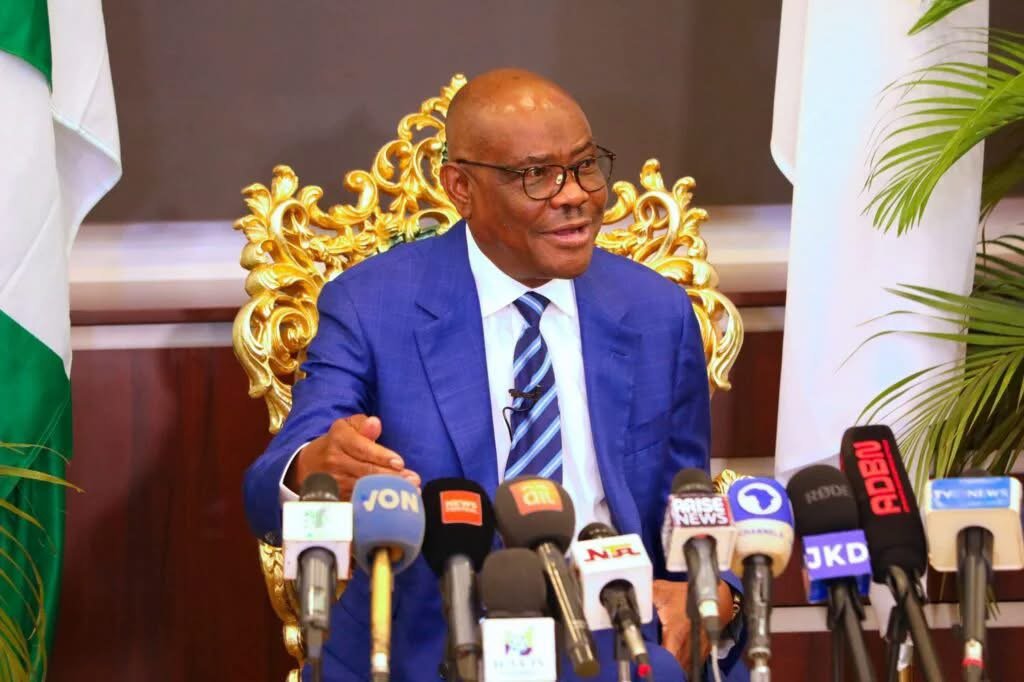
Federal Capital Territory (FCT) Minister Nyesom Wike has defended the Rainbow Coalition supporting President Bola Ahmed Tinubu’s re-election bid, dismissing concerns that the political arrangement could deepen divisions within the ruling All Progressives Congress (APC) ahead of Nigeria’s 2027 general elections.
Wike made the remarks on Tuesday, October 13, 2026, during a media parley in Abuja, where he explained that the coalition was designed to bring together APC members and supporters of the President from other political parties to strengthen Tinubu’s chances of securing a second term.
The minister maintained that the initiative was not intended to weaken the APC or replace its political structure but to broaden support for Tinubu beyond the membership of the ruling party.
The latest defence comes amid disagreements between Wike and APC governors over how political groups outside the party should participate in efforts to secure the President’s re-election while retaining their independence in state and legislative elections.
Wike Explains Purpose of Rainbow Coalition
Speaking during the media engagement, Wike argued that the coalition should be understood as a platform for cooperation between APC members and supporters of Tinubu who belong to other political parties.
He explained that the arrangement was intended to unite individuals with different political affiliations around the common objective of supporting the President in the 2027 presidential election.
According to Wike, the existence of the coalition should not automatically be interpreted as evidence of a plan to undermine the APC.
The minister said the initiative was about mobilising support for Tinubu rather than creating a competing political organisation that would challenge the ruling party.
“If you see that word, PBT/APC, it means those who are supporting the president who are not members of the party, together with the party, are working together to achieve that purpose,” Wike said during the media parley, according to Punch Newspapers.
He also stressed that the President remained the central focus of the coalition’s political activities.
“The major thing is Mr President. Whatever we are going to do, whoever has any idea or anything to contribute is to the success of Mr President. That is the whole thing,” he said.
Wike’s position reflects his argument that political supporters do not necessarily need to belong to the same party to cooperate in a presidential election.
However, this approach has raised questions among APC leaders about the relationship between a cross-party coalition and the ruling party’s own campaign structures.
The disagreement centres on whether political groups supporting Tinubu should also support APC candidates in governorship, National Assembly and state assembly elections or retain the freedom to back candidates from other parties.
For Wike, supporting the President does not automatically mean abandoning other political affiliations or surrendering the right to participate in elections through different platforms.
For some APC leaders, however, the priority is to ensure that arrangements intended to strengthen Tinubu’s re-election do not weaken the party’s candidates elsewhere on the ballot.
Why APC Governors Are Concerned
The dispute over the Rainbow Coalition emerged from concerns expressed by governors elected on the APC platform about political arrangements that could operate independently of the ruling party ahead of the 2027 elections.
On September 14, 2026, the Progressive Governors Forum, chaired by Imo State Governor Hope Uzodimma, warned against alliances that could undermine Tinubu’s re-election bid, weaken the APC or adversely affect its candidates.
Uzodimma communicated the governors’ position after a meeting in Abuja, making clear that the forum would not support political arrangements that could damage the party’s electoral interests.
The position highlighted a fundamental difference between the coalition approach promoted by Wike and the strategy favoured by APC governors.
While Wike has argued that Tinubu can attract support from politicians across party lines, the governors have emphasised the importance of protecting the APC as the President’s political platform and maintaining support for its candidates at different levels of government.
Their concerns extend beyond the presidential election.
Nigeria’s general elections involve contests for the presidency, governorships, the National Assembly and state houses of assembly. Although these elections take place within the same broader electoral cycle, voters may support candidates from different parties for different offices.
Consequently, a coalition that attracts support for a presidential candidate without requiring supporters to back the same party in legislative or governorship elections could produce different outcomes across the ballot.
For APC governors, such an arrangement raises questions about whether the ruling party could benefit from presidential support while losing ground in other contests.
Wike, however, has rejected the idea that his coalition should be judged by whether it delivers victories for APC candidates in every state.
His argument is that the coalition’s specific purpose is to support Tinubu’s re-election, while political parties and their members retain their separate interests in other elections.
The disagreement therefore concerns both the structure of political mobilisation and the extent to which support for a presidential candidate should translate into support for the candidate’s political party across the country.
Neither side’s position automatically establishes what voters will do in 2027. The coalition’s effectiveness and the APC’s ability to maintain support across different contests will depend on political organisation, candidates, local alliances and voters’ decisions.
Wike Says Political Differences Should Not Prevent Cooperation
Wike has consistently maintained that politicians from different parties can work together to support a presidential candidate without abandoning their political identities.
In September, he said the Rainbow Coalition was not established to help individuals secure victories in their respective states but to mobilise support for Tinubu’s second-term ambition.
He also argued that political actors should address their local political challenges without using the President’s re-election campaign to create unnecessary disagreements.
The minister’s position rests on the distinction between national political objectives and local electoral interests.
A politician may support a presidential candidate while remaining committed to another party’s candidate in a governorship or legislative contest. Under Wike’s approach, these positions can coexist, provided the participants agree on the presidential objective.
He has cited the 2023 general elections as an example of how Nigerian voters and political actors can separate their choices across different offices.
During that election cycle, Wike and other members of the Group of Five, commonly known as the G5, supported Tinubu’s presidential bid while remaining associated with the Peoples Democratic Party (PDP).
The group consisted of five PDP governors who opposed the party’s presidential candidate, Atiku Abubakar, amid disagreements over the party’s internal leadership and power-sharing arrangements.
Wike has drawn on that political experience to argue that supporting Tinubu in 2027 does not require him to promise that the PDP will refrain from fielding candidates for other offices.
In comments reported by Premium Times in September, he said he had not promised that the PDP would abandon contests for governorships, the National Assembly or state houses of assembly.
His position is that the presidential election should be treated as a distinct contest, even when the participating politicians maintain separate political interests elsewhere.
That approach could allow the coalition to attract supporters who favour Tinubu but remain unwilling to join the APC or support its candidates in every other election.
However, it also creates a potential challenge for the ruling party: the interests of the coalition and those of APC candidates may not always align.
The political question is whether the different groups can cooperate on the presidential contest without allowing disagreements over other offices to undermine their shared objective.
Rainbow Coalition and the Role of Opposition Party Members
One of the most distinctive aspects of the Rainbow Coalition is its effort to mobilise support for a sitting president across party lines.
Wike remains associated with the PDP while serving as minister in the federal government led by Tinubu of the APC.
His position illustrates the political complexity surrounding the coalition: its supporters may agree on the presidential candidate without sharing the same party membership or supporting the same candidates in other elections.
The coalition’s appeal, as described by Wike, is that it offers a way for people outside the APC to contribute to Tinubu’s re-election campaign.
This could include politicians and supporters who agree with the President’s candidacy but intend to retain their membership of other political parties.
The arrangement is different from a conventional party campaign in which the party seeks to mobilise support for its presidential candidate and other candidates running under its banner.
Under the approach Wike has described, the coalition’s immediate objective is the presidency, while other electoral contests remain open to competing political interests.
That distinction could become particularly important in states where the political balance differs from the national picture.
A party may have considerable influence in a state without necessarily commanding the same level of support in the presidential election. Similarly, a presidential candidate may attract voters who prefer a different party for governorship or legislative representation.
The Rainbow Coalition’s strategy seeks to use those differences to build a broader presidential support base.
Nevertheless, the arrangement depends on political trust and coordination. Participants must agree on the purpose of their cooperation and understand how their activities relate to the interests of the parties to which they belong.
Without clear coordination, supporters could face competing demands from the coalition, their party organisations and local political leaders.
For the APC, the concern is whether such an arrangement can strengthen Tinubu’s position without creating rival centres of political mobilisation.
For Wike, the coalition provides an opportunity to organise support beyond the boundaries of a single party.
The competing positions reflect a wider question in Nigerian politics: whether a presidential campaign should prioritise the broadest possible coalition of supporters or remain closely tied to the electoral interests of the candidate’s political party.
The answer could influence how parties and political groups organise themselves as the country approaches the 2027 general elections.
Political Reactions Reveal a Continuing Disagreement
The debate surrounding the Rainbow Coalition has drawn responses from APC governors and other political stakeholders.
Zamfara State Governor Dauda Lawal, who has criticised the coalition arrangement, previously insisted that Wike should clarify his political position.
In comments reported by Channels Television on September 25, Lawal argued that Wike could not simultaneously support the APC and other political parties without addressing questions about where his political allegiance lay.
Lawal also indicated that APC governors intended to maintain their position on the matter.
His comments reflected the broader concern among some ruling-party leaders that a separate coalition could create uncertainty over political loyalty and the coordination of Tinubu’s re-election campaign.
The disagreement has also attracted attention because Wike occupies a federal cabinet position under an APC-led administration while remaining a prominent PDP figure.
His relationship with Tinubu has been an important feature of the political landscape since the 2023 elections, when Wike and members of the G5 supported the APC presidential candidate despite their continued association with the opposition party.
That history provides context for the current dispute but does not resolve the concerns raised by APC governors.
The governors’ position is that political cooperation should not come at the expense of the party’s candidates or organisational strength.
Wike, by contrast, has maintained that support for Tinubu can be organised through a coalition that includes politicians outside the APC.
The two positions demonstrate that agreement on a presidential candidate does not necessarily eliminate competition between political organisations.
They also show that the debate involves more than personalities. It concerns how parties manage alliances, define political loyalty and protect their interests across multiple elections.
As the 2027 elections approach, further clarification from the coalition’s organisers and the APC leadership could help determine whether the disagreement can be managed or becomes a more significant source of political friction.
No evidence presented in the reported remarks establishes that the coalition has already caused a split within the APC. The immediate issue is the disagreement over its purpose, structure and potential implications for the party’s candidates.
Wike Cites State-Level Political Realities
Wike has also argued that political circumstances differ from one state to another and should be considered when building a national coalition.
In his view, political actors should be allowed to work within their local realities while contributing to the broader objective of supporting Tinubu.
This argument reflects the diversity of Nigeria’s political environment, where party influence, candidate popularity and local alliances vary across the 36 states and the Federal Capital Territory.
A political arrangement that works in one state may not produce the same outcome elsewhere.
Local political disputes, party structures, relationships between candidates and voters’ preferences can all influence the results of elections.
A coalition that seeks to attract supporters across party lines must therefore accommodate differences without losing sight of its stated objective.
Wike’s approach suggests that support for Tinubu should not require uniform political arrangements at every level of government.
For example, a politician could participate in efforts to mobilise presidential support while continuing to campaign for a candidate from another party in a state-level contest.
However, that flexibility may also complicate campaign coordination. Political groups may have to negotiate how they share resources, organise supporters and communicate their positions without creating confusion among voters.
The APC’s concerns reflect the possibility that independent political structures could compete with party organisations for influence and mobilisation.
Whether those concerns translate into electoral disadvantages remains uncertain.
The eventual outcome will depend on how the coalition operates, whether it attracts meaningful support and how APC leaders respond to political actors who favour Tinubu without fully aligning with the party.
For voters, the most important consideration will be the clarity of the candidates and political platforms seeking their support.
The existence of a coalition does not determine electoral outcomes by itself. Its influence will depend on its organisation, public appeal and ability to translate political endorsements into votes.
Why the Dispute Matters Ahead of Nigeria’s 2027 Elections
The disagreement between Wike and APC governors matters because it highlights competing strategies for securing Tinubu’s re-election.
The President’s supporters face the challenge of building a sufficiently broad electoral coalition while managing differences among politicians with separate ambitions and party affiliations.
Wike’s approach prioritises the mobilisation of supporters beyond the APC. The governors’ approach emphasises the need to protect the ruling party’s organisational strength and the prospects of its candidates.
Both concerns relate to the same election cycle, but they do not necessarily produce identical political strategies.
A cross-party coalition could expand the pool of people willing to support a presidential candidate. At the same time, a coalition that operates independently of a party could complicate coordination where its participants back different candidates in other contests.
The political consequences will depend on how these competing interests are managed.
For Nigeria’s electorate, the dispute also raises questions about the relationship between political parties, individual politicians and electoral accountability.
Voters may support a presidential candidate for reasons different from those influencing their choices for governor or legislator. Their decisions are not automatically determined by party membership or endorsements from political leaders.
Consequently, the coalition’s ability to influence the election will depend on whether it can persuade voters rather than simply assemble prominent political figures.
The disagreement also illustrates the importance of transparent political communication. If coalition organisers and party leaders present conflicting messages about candidates, alliances or electoral objectives, supporters may struggle to understand what the different groups are seeking to achieve.
Clear communication could help voters distinguish between support for Tinubu’s presidential bid and support for APC candidates in other elections.
Ultimately, the 2027 elections will test whether the Rainbow Coalition can translate its cross-party approach into meaningful electoral support and whether the APC can maintain unity while accommodating politicians who support the President without fully aligning with the party.
Neither outcome can be taken for granted at this stage.
What Happens Next?
Wike’s latest comments reaffirm that he intends to continue promoting the Rainbow Coalition as a vehicle for supporting Tinubu’s re-election.
The immediate challenge is whether the coalition can operate alongside the APC’s campaign structures without deepening disagreements with the party’s governors and other leaders.
Further discussions between the coalition’s organisers, APC stakeholders and other political actors could clarify the relationship between the two structures.
The APC governors’ position indicates that they remain concerned about alliances that could weaken the party or affect its candidates in the 2027 elections.
Wike, meanwhile, has maintained that the coalition’s purpose is to support Tinubu and that other political parties should remain free to participate in state and legislative contests.
The practical test will be how these positions are reflected in political organisation, candidate selection and campaigning as the elections approach.
Developments to watch include whether the coalition expands its participation across states, how APC leaders respond to its activities and whether political stakeholders agree on arrangements that protect their respective interests.
Voters will ultimately determine the effectiveness of the competing strategies through their decisions at the ballot box.
For now, Wike’s defence makes clear that the Rainbow Coalition intends to remain part of the political conversation ahead of 2027, despite concerns expressed by some APC governors.
The dispute is not simply about whether politicians from different parties can support the same presidential candidate. It is also about how that support should be organised and whether a shared presidential objective can coexist with competing interests in other elections.
Weng Global will continue to follow developments surrounding the Rainbow Coalition, the APC’s position and the wider political calculations ahead of Nigeria’s 2027 general elections.
Weng Global – stories beyond borders
Sources
- Punch Newspapers — Report on Wike’s defence of the Rainbow Coalition on October 13, 2026.
- Voice of Nigeria — Report on Wike’s explanation of the coalition’s purpose, October 13, 2026.
- Premium Times — Reports on Wike’s position on the coalition and the 2027 presidential election, September 15 and 21, 2026.
- Channels Television — Report on Governor Dauda Lawal’s response to the Rainbow Coalition, September 25, 2026.
- TheCable — Report on the Progressive Governors Forum’s position on political alliances ahead of the 2027 elections, September 15, 2026.
- The Guardian Nigeria — Reporting on the political disagreement between Wike and APC governors over the Rainbow Coalition, September 2026.