Reported by Simon Daniel Yusuph l Journalist at Weng Global
Political instability, insecurity and sudden government interventions are exposing a significant weakness in Nigeria’s business risk environment: many companies may have insurance against conventional losses while remaining vulnerable to financial damage caused by political violence, civil unrest, terrorism, government action and prolonged operational disruption.
The issue has gained renewed attention following the political crisis in Rivers State, where President Bola Ahmed Tinubu declared a state of emergency on March 18, 2025, suspending the governor, deputy governor and members of the state House of Assembly for an initial six months. The emergency rule was lifted in September 2025, restoring the elected government. The crisis had also coincided with concerns over attacks on oil infrastructure and the continuity of economic activity in one of Nigeria’s most important oil-producing states.
For businesses, the Rivers episode illustrated that political instability can become an economic risk long before a company suffers direct physical destruction.
A shop can lose revenue when streets become inaccessible. A manufacturer can lose production when workers cannot reach a facility. A contractor can face delays when government operations are disrupted. An investor can suffer when political uncertainty affects the value or continuity of an investment.
Yet conventional insurance does not necessarily respond to every loss associated with such events.
That gap is becoming more important as Nigerian businesses operate in an environment already shaped by insecurity, inflation, infrastructure constraints, high financing costs and policy uncertainty.
Political Risk Is Becoming a Business Risk
Political risk is sometimes treated as a concern reserved for multinational corporations, oil companies or foreign investors.
In Nigeria, however, its effects can reach much further.
Political risk can emerge from changes in government policy, political violence, civil unrest, terrorism, government intervention, restrictions on business operations or other events connected to the political environment.
Specialised political risk insurance exists precisely because conventional commercial insurance does not automatically cover every such exposure.
The National Association of Insurance Commissioners in the United States, for example, defines political risk insurance as a tool businesses can use to manage risks arising from government actions or inactions. Such policies can cover specific risks including expropriation, war, insurrection, terrorism, sovereign payment default and certain government actions that interfere with business operations.
The Nigerian challenge is therefore not simply whether businesses have insurance.
It is whether they have the right insurance for the risks they actually face.
That distinction can determine whether a company survives a major disruption or absorbs the loss itself.
The Rivers State Warning
The Rivers crisis provides a useful case study.
President Tinubu declared the state of emergency after a prolonged political dispute involving Governor Siminalayi Fubara and the state legislature. In announcing the intervention, the President cited what he described as a paralysis of governance and concerns over vandalisation of oil pipelines.
The Federal Government subsequently argued that the political situation had threatened vital oil and gas installations and national economic security.
The consequences extended beyond political institutions.
BusinessDay reported during the emergency period that uncertainty was already affecting economic activity in Rivers State, with businesses facing weaker confidence and difficulties in planning. Business owners also reported declining sales and slower cash flow as uncertainty affected everyday commercial activity.
Those effects demonstrate why political risk cannot be viewed solely through the lens of government and elections.
Businesses operate within political systems.
When those systems become unstable, commercial activity can be affected even where a company’s building, machinery and inventory remain physically intact.
When the Property Is Safe but the Business Is Not
This is one of the most important distinctions for Nigerian businesses.
Consider a manufacturing company whose factory is insured against fire and physical damage.
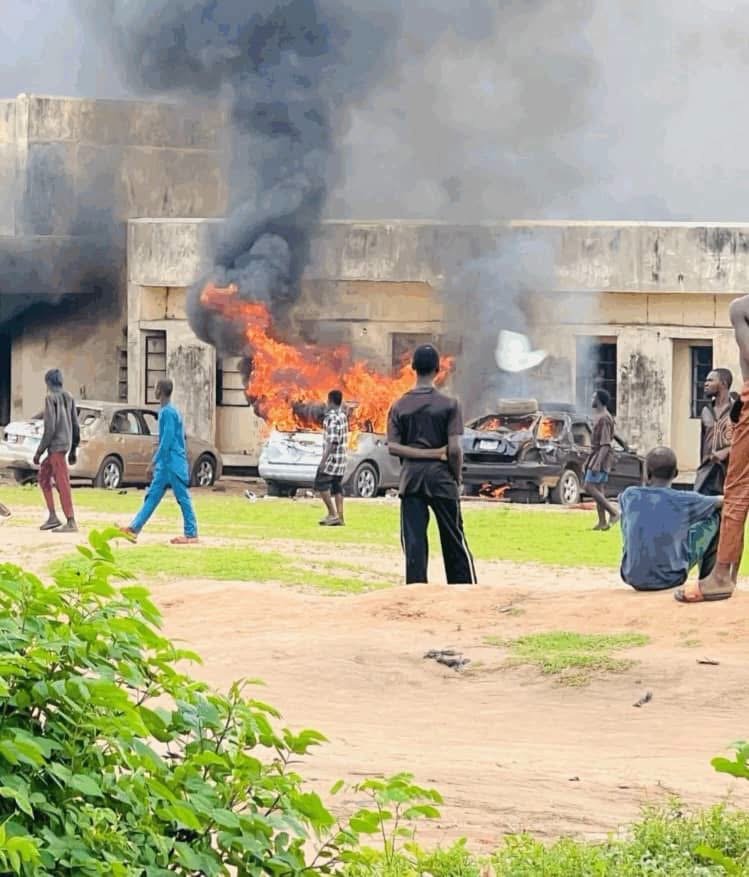
If political unrest prevents employees from reaching the factory for several days, the company could lose production and revenue without the building suffering any physical damage.
Similarly, a transport company may have insurance covering its vehicles but still experience significant financial losses when roads become inaccessible because of unrest.
A hotel may remain structurally intact but lose customers because travellers avoid an area affected by political instability.
A contractor may have insured equipment but face losses when a government project is suspended or delayed because of political intervention.
These examples do not mean every such loss is automatically insurable.
The opposite is true: the policy wording becomes crucial.
Business interruption insurance can provide protection against loss of income in specified circumstances, but the extent of protection depends on the terms, exclusions and triggering event contained in the policy.
Political violence, civil disturbance, terrorism and government intervention can be treated differently from ordinary accidental losses.
For companies operating in high-risk sectors, that distinction can have major financial consequences.
Nigeria’s Wider Insurance Protection Gap
The political-risk problem exists within a much broader insurance gap.
Nigeria’s insurance industry has historically had relatively low penetration compared with the size of the economy and population.
NAICOM said in 2025 that insurance penetration was about 0.5 per cent, describing the sector as significantly underdeveloped compared with larger insurance markets.
More recent industry data show that the market itself is growing.
NAICOM currently reports more than ₦1.4 trillion in gross premiums for 2025, while an independent 2026 insurance industry assessment by Agusto & Co. estimated insurance revenue at about ₦1.9 trillion for the year ended December 2025.
The growth is encouraging.
But a larger insurance market does not automatically mean that Nigerian businesses are adequately protected.
The important question is what risks are being insured, how much coverage businesses purchase, what exclusions are contained in policies and whether claims can be paid promptly when losses occur.
The protection gap is particularly serious among smaller enterprises.
A September 2026 report by The Guardian, citing Insurance Sector Strengthening Programme data, said only about 3.17 million of an estimated 39.65 million Nigerian micro, small and medium enterprises had insurance coverage, leaving approximately 36.4 million without adequate protection against risks such as fire, flood and theft.
If millions of small businesses remain inadequately insured against conventional risks, their exposure to specialised political and security risks is likely to be even greater.
Insecurity Adds Another Layer
Political instability is only one component of the risk environment.
Businesses across Nigeria also contend with terrorism, banditry, kidnapping, communal violence, vandalism and other forms of insecurity.
For companies operating in agriculture, construction, logistics, telecommunications, energy, manufacturing and other capital-intensive sectors, these risks can affect both physical assets and business continuity.
The challenge for insurers is equally complex.
Higher-risk environments can generate greater demand for insurance, but they can also make underwriting more expensive and technically difficult.
Insurers must determine the probability and potential severity of losses, establish appropriate premiums and maintain enough capital to meet claims.
That is why insurance products for high-risk political and security environments cannot simply be expanded without considering affordability and underwriting capacity.
Insurance Reform Creates an Opportunity
Nigeria’s insurance sector is itself undergoing major structural change.
The Nigerian Insurance Industry Reform Act 2025 replaced several older laws and created a new legal framework intended to modernise regulation, strengthen policyholder protection and improve the competitiveness of the sector.
In August 2026, NAICOM announced the completion of the sector’s recapitalisation exercise, describing it as a major step towards building stronger and more resilient insurance institutions.
The regulator said the exercise should provide a stronger foundation for risk-based supervision and better align regulatory capital with the nature and scale of insurers’ risks.
That development could become important for political-risk coverage.
Specialised risks can require substantial financial capacity, sophisticated underwriting and effective reinsurance arrangements.
Stronger insurers are better positioned to develop products for businesses facing increasingly complex risks.
But recapitalisation alone will not close the protection gap.
Insurance products must also be understandable, accessible and appropriately priced.
Businesses need to know what they are buying.
The New Regulatory Framework
The reforms also place greater emphasis on protecting policyholders.
NAICOM has established the Insurance Policyholders’ Protection Fund under NIIRA 2025, with the regulator saying the mechanism is intended to strengthen confidence and provide protection if an insurer becomes insolvent.
NAICOM has also been working towards a risk-based capital framework designed to strengthen financial stability and policyholder protection across the industry.
These measures address an important part of the insurance equation: the ability of insurers themselves to withstand losses.
But there is another side.
Businesses must also become more sophisticated in identifying their own exposures.
A company cannot assume that purchasing a general business policy means every possible disruption is covered.
The policyholder must understand the risks included, exclusions, deductibles, limits, waiting periods and conditions attached to business-interruption or related coverage.
The Problem of Policy Exclusions
Insurance is ultimately a contract.
The fact that an event causes a business loss does not necessarily mean an insurer is legally required to compensate the company.
The event must fall within the scope of the policy.
This is particularly important for political and security risks.
A business may have coverage for theft but not political violence.
It may have property insurance but no adequate business-interruption protection.
It may have business-interruption insurance but face exclusions relating to certain forms of civil unrest or terrorism.
It may also have coverage that is too small relative to the scale of its potential loss.
These are technical issues, but they have very practical consequences.
The lesson from periods of instability is therefore not simply that businesses need more insurance.
They need better risk assessment and more appropriate coverage.
Small Businesses Face the Greatest Vulnerability
Large corporations can employ risk managers, insurance brokers, lawyers and consultants to examine their exposure.
Small businesses often cannot.
A small manufacturer or retailer may focus primarily on fire, theft or motor insurance without considering how political events could interrupt operations.
Yet smaller businesses can be less capable of absorbing temporary losses.
A large company may survive several weeks of disruption through cash reserves or diversified operations.
A small business dependent on daily sales may not.
This makes the insurance gap an economic development issue as well as an insurance-sector issue.
When businesses close after an uninsured shock, employees can lose income, suppliers lose customers and local economic activity declines.
In areas already affected by insecurity or political tension, repeated uninsured losses can weaken entrepreneurship and discourage investment.
The Broader Economic Consequences
Political risk can also influence investment decisions.
Investors consider not only expected returns but also the predictability of the environment in which their capital will operate.
The Rivers crisis demonstrated how political uncertainty can generate questions about governance, public spending, infrastructure and continuity.
The President himself described the crisis as a threat to national economic security because of its potential implications for oil and gas infrastructure.
This makes political-risk management relevant to Nigeria’s broader ambition of attracting domestic and foreign investment.
A stronger insurance market can help investors transfer some risks that would otherwise remain entirely on their balance sheets.
But insurance cannot eliminate political risk.
It can only provide financial protection against specified risks.
The more fundamental solution remains stable institutions, predictable regulation, effective security and respect for the rule of law.
What Businesses Should Be Asking
The growing discussion around political-risk insurance should encourage Nigerian companies to ask several practical questions.
What happens to the business if unrest prevents employees from reaching the premises?
What happens if a government project is suddenly suspended?
What happens if civil disorder damages company property?
What happens if political violence interrupts production?
Does the existing business-interruption policy respond to the relevant event?
Are terrorism and political violence excluded?
Is there adequate cover for supply-chain interruption?
How long can the company survive if operations stop?
And, critically, what losses remain uninsured?
These questions belong within corporate risk management rather than being considered only after a crisis occurs.
What the Insurance Industry Must Do
Insurers also face responsibilities.
Nigeria’s changing risk environment requires products that reflect the realities businesses face.
NAICOM reported in March 2026 that the organised private sector had engaged the regulator over the development of sector-specific insurance products, particularly in maritime and petroleum activities. The initiative was aimed at addressing longstanding gaps in compensation and risk transfer.
That kind of engagement could be expanded.
Insurers, brokers, regulators and business associations could work together to develop clearer products for business interruption, political violence, terrorism, infrastructure disruption and other emerging risks.
The challenge will be balancing protection with affordability.
Premiums that are too expensive will discourage businesses from purchasing cover.
Premiums that do not properly reflect risk could weaken insurers and threaten their ability to pay claims.
The solution therefore requires better data, professional underwriting, stronger reinsurance capacity and transparent policy terms.
Why It Matters
The political-risk debate is ultimately about the resilience of Nigeria’s private sector.
Businesses are essential to employment, tax revenues, investment and economic growth.
When political instability disrupts them, the consequences extend beyond individual companies.
Workers can lose jobs. Governments can lose tax revenue. Consumers can face shortages. Investors can postpone projects. Communities can lose economic activity.
Insurance cannot prevent political instability, but effective insurance can reduce the financial shock when specified risks materialise.
That makes insurance part of a broader national resilience strategy.
Nigeria’s current insurance reforms provide an opportunity to build such resilience, but the industry will need to move beyond expanding premium volumes and focus increasingly on whether products actually protect policyholders against the risks they face.
What Happens Next
The immediate task for Nigerian businesses is to review their insurance arrangements rather than assume they are adequately protected.
Companies operating in politically sensitive, security-challenged or infrastructure-dependent areas may need specialist advice from licensed insurance brokers and risk professionals to identify exposures that conventional policies do not address.
For insurers, the challenge is to develop commercially viable products that respond to Nigeria’s changing risk landscape without transferring unaffordable costs to businesses.
For NAICOM, the continuing implementation of NIIRA 2025, risk-based capital requirements and policyholder-protection mechanisms will be important tests of whether the sector can become stronger and more trusted.
The wider economy will also determine how quickly the market develops.
Greater political stability, stronger institutions and improved security would reduce some risks while making the remaining risks easier to assess and insure.
Conclusion
Nigeria’s political and security environment is forcing businesses to reconsider what it means to be adequately insured.
The Rivers State crisis showed that political instability can disrupt economic activity even when the damage cannot be reduced to a conventional property loss. Businesses can lose revenue, contracts, production time and investor confidence simply because uncertainty makes normal operations difficult.
At the same time, Nigeria still has a significant insurance protection gap. Millions of businesses remain without adequate conventional coverage, while specialised political-risk protection requires greater awareness, technical capacity and financial depth.
The country’s insurance reforms offer a potential opportunity to change that situation.
But the success of those reforms should not be measured only by stronger insurers, higher premiums or new licences.
It should ultimately be measured by whether Nigerian businesses can recover when serious risks occur.
For companies, the lesson is clear: having an insurance policy is not the same as having adequate protection.
For insurers, the challenge is to build products around the risks businesses actually face.
For regulators, the task is to create an environment where insurers are financially strong, policyholders are protected and coverage becomes more accessible.
And for Nigeria’s wider economy, the fundamental requirement remains political and institutional stability.
Insurance can transfer financial risk.
It cannot insure away uncertainty created by weak governance, insecurity or political instability.
Weng Global – stories beyond borders
Sources
- National Insurance Commission (NAICOM)
- Nigerian Insurance Industry Reform Act 2025
- State House, Abuja
- Punch
- BusinessDay
- The Guardian
- International Monetary Fund
- National Association of Insurance Commissioners