Reported by Simon Daniel Yusuph l Journalist at Weng Global
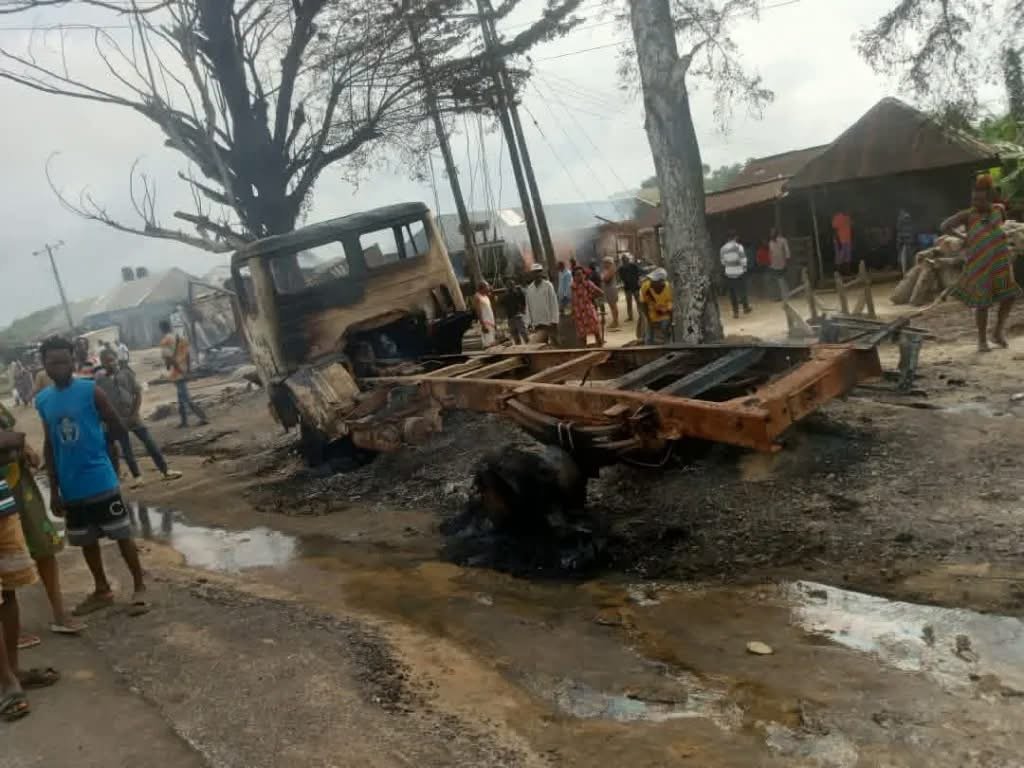
A petrol tanker carrying petroleum products crashed and overturned in Odukpani Local Government Area of Cross River State on Sunday, October 4, 2026, triggering a fire that spread to nearby shops and buildings.
The incident occurred opposite or near the Odukpani Local Government Secretariat and prompted an emergency response involving the police and fire service.
The tanker driver, who was caught in the fire, was rescued and taken to a hospital for medical treatment, according to the Cross River State Police Command.
At the time of the latest police update available to Weng Global, no death had been officially confirmed, although reports indicated that shops, vehicles and other property had been affected by the blaze.
Tanker Overturns After Road Crash
The fire followed a road traffic accident involving the petroleum tanker.
According to preliminary information released by the Cross River State Police Command, the tanker was involved in a road crash and overturned before the fire started.
The blaze subsequently spread beyond the tanker, affecting nearby shops and buildings.
The incident occurred in an area with commercial activity, raising concerns about the potential impact on traders, motorists and other residents in the immediate vicinity.
Police officers from the Odukpani Division were deployed to the scene to secure the area, maintain public safety and prevent further harm.
The command also alerted the Fire Service to respond and contain the fire.
The police urged members of the public to stay away from the immediate area and allow emergency responders to operate without obstruction.
Driver Rescued From Inferno
The tanker driver was reportedly caught in the fire after the crash.
Police said he was rescued and transported to a hospital for medical attention.
His condition had not been publicly detailed in the latest police update available at the time of reporting.
The rescue of the driver was one of the immediate priorities following the accident as emergency responders worked to prevent the situation from causing further casualties.
Because petroleum products are highly flammable, overturned tankers can pose significant risks to people and property even after the initial collision.
Emergency responders therefore typically need to secure the surrounding area, prevent members of the public from approaching the tanker and control possible sources of ignition while the fire is being contained.
Shops and Vehicles Affected
The fire reportedly spread to nearby commercial premises and affected a number of vehicles.
CrossRiverWatch reported that shops and goods worth millions of naira were destroyed in the incident, while the police confirmed that several shops and vehicles had been affected.
The full extent of the property damage was not immediately established.
Authorities are expected to assess the affected structures and vehicles after the fire has been brought fully under control.
The damage is likely to create additional difficulties for traders and other people whose businesses or vehicles were caught in the incident.
For businesses located close to major roads, tanker crashes can have consequences that extend beyond the immediate fire.
A shop can be damaged by flames, smoke or heat, while surrounding businesses may also be forced to close temporarily when emergency responders secure the area.
Death Report Requires Further Verification
Some initial reports have circulated suggesting that one person died and another was injured in the incident.
However, the latest police account available to Weng Global stated that no death had been confirmed at the time of its update.
The distinction is important because casualty figures in emergencies can change as rescue workers gain access to affected areas and hospitals receive injured victims.
Weng Global will therefore not present an unconfirmed death figure as an established fact.
The police said further information would be made available as verified details emerge.
Any subsequent confirmation of fatalities or additional injuries will be important in establishing the final human toll of the accident.
Emergency Response Underway
The Cross River State Police Command said its personnel were already at the scene following the accident.
Their responsibilities included maintaining security, controlling access to the affected area and preventing members of the public from entering dangerous zones.
The Fire Service was also alerted to deploy personnel and equipment to tackle the blaze.
The emergency response is particularly important because tanker fires can spread quickly when petroleum products are involved.
Keeping residents and motorists away from the scene also reduces the risk of secondary incidents and gives firefighters, police officers and medical personnel the space required to carry out rescue and containment operations.
Authorities urged members of the public to cooperate with emergency responders rather than attempting to approach the tanker or affected structures.
Odukpani and the Risk of Tanker Accidents
The latest crash has renewed attention on road safety risks involving petroleum tankers in Cross River State.
Odukpani is located along important transportation routes connecting Cross River with neighbouring parts of the South-South and South-East regions.
The area also experiences significant movement of commercial vehicles, trucks and other heavy-duty vehicles.
In May 2026, the Federal Road Safety Corps in Cross River announced a renewed clampdown on reckless truck drivers, particularly along the Odukpani–Itu highway, following a series of fatal crashes recorded on the route.
The FRSC urged motorists to prioritise safety and called for greater responsibility among drivers and transport operators.
The agency also stressed that passengers and other road users should speak up when drivers engage in dangerous behaviour.
The latest tanker crash demonstrates why those concerns remain relevant.
Tanker Safety Remains a National Concern
Petroleum tanker accidents remain a recurring road-safety challenge in Nigeria.
When a tanker overturns, the risks can be significantly greater than those associated with an ordinary road crash because of the possibility of fuel leakage, ignition and fire.
The danger is particularly high when an accident occurs near shops, homes, markets, fuel stations or areas with heavy pedestrian activity.
Nigeria has experienced several major tanker-related fires over the years, including previous incidents in Cross River.
Odukpani itself witnessed a major petrol tanker disaster in January 2019, when an overturned tanker caught fire after residents gathered around leaking fuel. The exact death toll was disputed in early reports, underscoring the importance of relying on verified casualty figures during emergencies.
The history of such incidents shows why communities must avoid approaching fallen tankers, particularly when fuel is leaking.
Why Public Caution Matters
A major danger following a tanker accident is the temptation for members of the public to approach the scene.
People may gather out of curiosity, attempt to assist without protective equipment or, in some cases, attempt to collect spilled petroleum products.
Such behaviour can dramatically increase the risk of additional injuries or deaths if the fuel ignites.
Authorities have repeatedly advised members of the public to stay away from tanker crash sites and allow trained emergency responders to manage the situation.
The police warning in Odukpani is therefore not simply a crowd-control measure.
It is a safety precaution designed to reduce the possibility of further casualties while firefighters, police officers and medical personnel respond to the emergency.
Need for Stronger Road Safety Measures
The accident also raises broader questions about the safety of petroleum product transportation in Nigeria.
Tanker operators, drivers, regulators and road-safety agencies all have roles to play in reducing the frequency and consequences of such crashes.
Vehicle roadworthiness, driver competence, speed control, proper maintenance, safe loading practices and enforcement of traffic regulations are among the factors that can influence tanker safety.
Road conditions are another important consideration.
Heavy trucks place significant pressure on road infrastructure, while potholes, damaged shoulders, inadequate drainage and poorly managed traffic can increase risks for commercial vehicles.
Effective road-safety management therefore requires cooperation between federal and state authorities, transport operators and emergency agencies.
Property Damage Adds Economic Pressure
Although the immediate priority is to protect lives, the destruction caused by tanker fires can have serious economic consequences.
A trader whose shop is damaged may lose stock accumulated over years.
Vehicle owners can also face substantial losses when cars or commercial vehicles are caught in fires.
For small businesses operating on narrow margins, even temporary closure can affect household income and employees who depend on daily commercial activity.
A proper assessment of the Odukpani incident will therefore need to consider not only the physical damage but also the impact on affected businesses and residents.
What Happens Next?
The immediate priority is to fully extinguish the fire, secure the affected area and ensure that no additional lives are placed at risk.
Emergency agencies will also need to assess the condition of nearby buildings, vehicles and other infrastructure affected by the blaze.
The condition of the tanker driver and any other injured persons will be important to establishing the final casualty situation.
Authorities are also expected to investigate the circumstances surrounding the crash.
That investigation may help determine how the tanker lost control, the condition of the road and vehicle, and whether any safety or traffic regulations were breached.
The final casualty and damage figures should only be established after emergency agencies have completed their assessment.
Why the Incident Matters
The Odukpani tanker crash is a reminder of the potentially severe consequences of transporting petroleum products through densely populated and commercially active areas.
The immediate incident may be contained, but the wider road-safety challenge remains.
Cross River has already recorded concerns about heavy-vehicle crashes along the Odukpani–Itu corridor, making continued enforcement and preventive measures important.
For residents and motorists, the incident reinforces the need to keep away from overturned tankers and other dangerous crash scenes.
For authorities, it highlights the importance of rapid emergency response, effective traffic enforcement and continued monitoring of heavy-duty vehicles.
For businesses located along major transport routes, it also demonstrates the vulnerability of commercial property to road accidents involving hazardous cargo.
Weng Global Perspective
The Odukpani tanker crash shows how quickly a road accident involving petroleum products can become a wider public safety emergency.
The driver was rescued and taken for medical treatment, while police and emergency responders moved to secure the scene and contain the danger.
Although some early reports have circulated with casualty claims, the latest police information available to Weng Global had not confirmed a death at the time of reporting.
That distinction matters.
In emergencies, accurate information can protect the public from unnecessary panic and prevent unverified casualty figures from becoming accepted as fact.
The immediate task is to ensure the fire is fully controlled, injured people receive appropriate medical attention and affected businesses and residents are properly assessed.
The longer-term challenge is preventing similar incidents.
Stronger enforcement of road-safety standards, responsible tanker operations, safer roads and rapid emergency response will remain essential if Nigeria is to reduce the human and economic cost of tanker accidents.
For Odukpani residents, the priority now is safety and recovery.
For Cross River authorities, the incident should also serve as another reminder that preventing tanker-related disasters requires action before crashes occur, not only emergency intervention after the fire has started.
Weng Global – stories beyond borders
Sources
Cross River State Police Command
CrossRiverWatch
Swift Reporters
Cross River State Ministry of Information
Federal Road Safety Corps