Reported by Simon Daniel Yusuph l Journalist at Weng Global
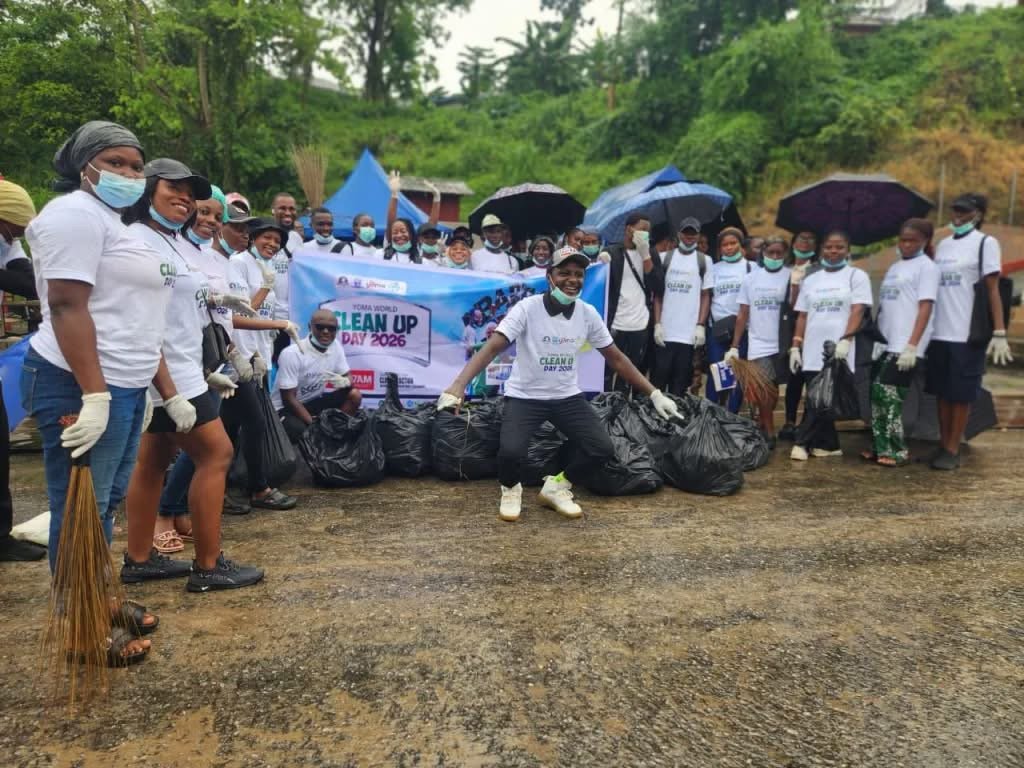
More than 1,000 young people in Calabar, Cross River State, defied heavy rainfall on Saturday to participate in a youth-led environmental clean-up across three locations in the state capital.
The exercise, organised under the 2026 YOMA World Clean Up initiative, took place at Marian Market, Beach Market in Calabar South and White House Street, where volunteers cleared refuse and plastic waste from public spaces.
The initiative brought together young people and youth-led organisations in an effort to promote cleaner communities, encourage responsible waste disposal and demonstrate the role young Nigerians can play in addressing environmental challenges.
Youths Turn Out Despite Rainfall
The clean-up exercise took place against the backdrop of rainfall in Calabar, but organisers and volunteers continued with the planned environmental activities.
About 1,000 youths participated across the three designated locations, according to Freedom Bassey, the Cross River State Coordinator of the Young African Leaders Initiative.
The volunteers worked in markets and surrounding streets, removing refuse and plastic waste that had accumulated in the areas.
Their participation reflected the central objective of the YOMA initiative: creating opportunities for young people to contribute directly to their communities through practical social-impact activities.
Rather than limiting youth participation to awareness campaigns, the exercise gave participants an opportunity to carry out physical environmental work in areas used daily by traders, residents, commuters and other members of the public.
UNICEF and UNICROSS Support the Exercise
The exercise was organised in collaboration with UNICEF and the University of Cross River State, also known as UNICROSS.
The university’s participation was particularly significant because its Student Affairs Division was involved directly in the initiative for the first time.
Dr Victor Ndifon, Acting Dean of Student Affairs at UNICROSS, said the exercise provided an opportunity for students and other young people to contribute to the development of the state.
He noted that the university has students across Cross River’s three senatorial districts who are willing to participate in similar environmental initiatives.
Ndifon also said the university would explore discussions with UNICEF on extending comparable activities to other parts of the state.
The involvement of an institution of higher learning gives the campaign an additional dimension, linking environmental action with youth education, civic responsibility and community engagement.
Focus on Plastic and Waste Management
A major focus of the exercise was the removal of refuse and plastic waste.
Plastic waste is a persistent environmental challenge in many Nigerian cities, particularly where drainage systems and public spaces become blocked by indiscriminate disposal.
In Calabar, the issue has received sustained attention from the state government, which has repeatedly warned residents and traders against improper waste disposal.
The Cross River State Ministry of Information reported in September that the state’s environmental sanitation programme had recorded active participation in Calabar Municipal and Calabar South Local Government Areas.
The ministry also raised concerns about indiscriminate dumping around major commercial areas and stressed the need for market leaders and residents to work with government agencies to improve sanitation.
The youth-led clean-up therefore took place within a wider effort to improve environmental conditions across the state.
Why Plastic Waste Matters in Calabar
The environmental significance of the exercise extends beyond the appearance of streets and markets.
When waste is left on roadsides, in markets or around drainage channels, it can obstruct the movement of stormwater and increase the risk of flooding during periods of heavy rainfall.
Plastic waste can also remain in the environment for long periods and may enter waterways, creating risks for aquatic ecosystems and public health.
Calabar’s location in a high-rainfall environment makes effective drainage and waste management particularly important.
Regular removal of waste can help reduce the amount of refuse entering drainage channels, although clean-up exercises alone cannot solve the problem.
Long-term improvement requires regular waste collection, adequate disposal infrastructure, enforcement of environmental regulations and sustained changes in public behaviour.
Youth Participation Goes Beyond Cleaning
The organisers presented the exercise as more than a sanitation activity.
It was also designed to encourage young people to take responsibility for the condition of their communities.
Freedom Bassey said the young participants were demonstrating that they were prepared to take practical action rather than simply wait for government intervention.
That approach reflects the broader philosophy behind YOMA, the Youth Agency Marketplace associated with UNICEF’s Generation Unlimited initiative.
UNICEF describes YOMA as a digital platform that connects young people with social-impact tasks, learning opportunities and pathways towards skills and employment.
The model is built around giving young people opportunities to participate in activities that produce measurable community impact while developing experience and skills.
The Calabar clean-up provides an example of how that model can be applied to environmental action.
YOMA and Youth-Led Environmental Action
YOMA has increasingly been used to connect young people with environmental and climate-related activities.
The YOMA platform currently lists environmental tasks in Nigeria, including the 2026 YOMA World Cleanup Day initiative, which encouraged young Nigerians to participate in waste collection and community environmental action.
UNICEF and Generation Unlimited have also promoted youth participation in green activities in Nigeria.
In an earlier account of youth-led environmental work in Cross River and Enugu states, UNICEF reported that young people had been involved in tree planting, mangrove restoration and plastic waste removal.
The organisation said the initiative had helped young people understand the relationship between environmental protection, flooding, water quality and community wellbeing.
This wider context places the Calabar exercise within a broader effort to encourage young people to become active participants in environmental protection.
UNICROSS Seeks Wider Environmental Engagement
Ndifon’s remarks suggest that UNICROSS sees potential for expanding the partnership beyond the October clean-up.
The university’s student population provides a potential network of young volunteers who could participate in environmental activities across different parts of Cross River.
With students drawn from different communities and the state’s three senatorial districts, similar initiatives could potentially reach areas outside Calabar.
However, any expansion would require coordination, equipment, waste evacuation arrangements and partnerships with local authorities and environmental organisations.
A clean-up is most effective when collected waste is promptly evacuated and when measures are put in place to prevent the same locations from quickly becoming dumping grounds again.
Calabar’s Broader Sanitation Challenge
The latest youth exercise comes amid sustained government efforts to improve sanitation in Calabar.
The Cross River State Ministry of Environment has previously raised concerns about indiscriminate waste disposal, street trading and poor sanitation around major markets.
In September, the ministry said it planned to engage market leaders across the Calabar metropolis on establishing regular sanitation arrangements within markets.
The government has also emphasised the need for residents and businesses to comply with environmental regulations.
Earlier in August, the state’s Commissioner for Environment, Bassey Offiong Mensah, said the government was working to restore the sanitary standards for which Cross River had previously been known.
He also stressed that cleanliness should be treated as a daily responsibility rather than an activity undertaken only during official sanitation exercises.
The continued attention to sanitation shows that the challenge cannot be addressed through occasional clean-up events alone.
Markets Remain Critical Environmental Pressure Points
The choice of Marian Market and Beach Market for the exercise is also significant.
Markets generate large quantities of waste because of the concentration of food sellers, traders, consumers and commercial activities.
Organic waste, packaging materials and plastics can accumulate quickly when collection systems are inadequate or when traders and customers dispose of waste improperly.
Marian Market has previously featured in environmental enforcement activities in Calabar.
In July, the Cross River State Government reported arrests of environmental offenders and enforcement operations around several commercial areas, including Marian Market. The government said the operations were intended to address indiscriminate waste disposal and other.
The involvement of young volunteers in cleaning such locations therefore complements, rather than replaces, the responsibility of government agencies, market authorities, businesses and residents.
Community Action and Government Responsibility
The success of environmental campaigns depends on cooperation between citizens and government.
Government authorities have responsibility for providing appropriate waste-management systems, enforcing environmental laws and ensuring that collected waste is properly evacuated.
Residents and businesses, meanwhile, have a responsibility to use designated waste-disposal facilities and avoid practices that undermine public sanitation.
The Calabar exercise demonstrates the potential value of community participation, but it also highlights the need for institutional support.
If waste is collected during a clean-up and then allowed to accumulate again because collection systems are inadequate, the immediate environmental gains may not last.
Sustained improvement therefore requires both citizen participation and effective public infrastructure.
Why the Youth Role Matters
Young people constitute a major part of Nigeria’s population, making their participation important to environmental policy and community development.
Youth-led initiatives can provide practical manpower while also changing attitudes towards environmental responsibility.
Participants who take part in cleaning public spaces may be more likely to recognise the consequences of indiscriminate waste disposal and encourage others to adopt better practices.
There is also an educational component.
Students and young volunteers can gain practical experience in teamwork, civic participation, environmental stewardship and community mobilisation.
Those skills can become useful beyond the immediate clean-up exercise.
What Happens Next?
The next challenge is maintaining the environmental gains made during the exercise.
UNICROSS has indicated an interest in engaging UNICEF on the possibility of extending similar activities to other parts of Cross River.
If that collaboration develops, future programmes could potentially involve students and other young people across additional communities.
The organisers and relevant government agencies will also need to ensure that waste collected during such exercises is properly evacuated and disposed of.
For the state government, continued enforcement of sanitation regulations and engagement with market leaders will remain important.
For young participants, the longer-term test will be whether Saturday’s mobilisation develops into sustained community action rather than remaining a one-day event.
Weng Global Perspective
The participation of more than 1,000 youths in a Calabar clean-up exercise despite rainfall offers a practical example of young people contributing directly to their communities.
The initiative also demonstrates how environmental action can be linked with youth engagement, skills development and social responsibility.
But a cleaner Calabar cannot depend on volunteers alone.
The city will require consistent waste collection, functioning disposal systems, effective drainage management, responsible behaviour from residents and traders, and enforcement of environmental laws.
Youth-led programmes such as the YOMA clean-up can complement those systems by encouraging citizens to take ownership of their surroundings.
The most important outcome will therefore not be the amount of waste removed on a single day, but whether the exercise helps build lasting habits around waste disposal and environmental responsibility.
For Cross River, the message from the young volunteers is straightforward: environmental cleanliness is not solely a government responsibility. It is a shared civic duty, and young people are demonstrating that they are prepared to play their part.
Weng Global – stories beyond borders
Sources
Daily Lamp
UNICEF Nigeria
Generation Unlimited
YOMA
Cross River State Ministry of Information