Reported by Simon Daniel Yusuph l Journalist at Weng Global
North Korea said on Saturday, October 3, 2026, that it had tested an intermediate-range strategic missile incorporating artificial intelligence technology, claiming the weapon can alter its flight path at low altitude and make tracking and interception more difficult.
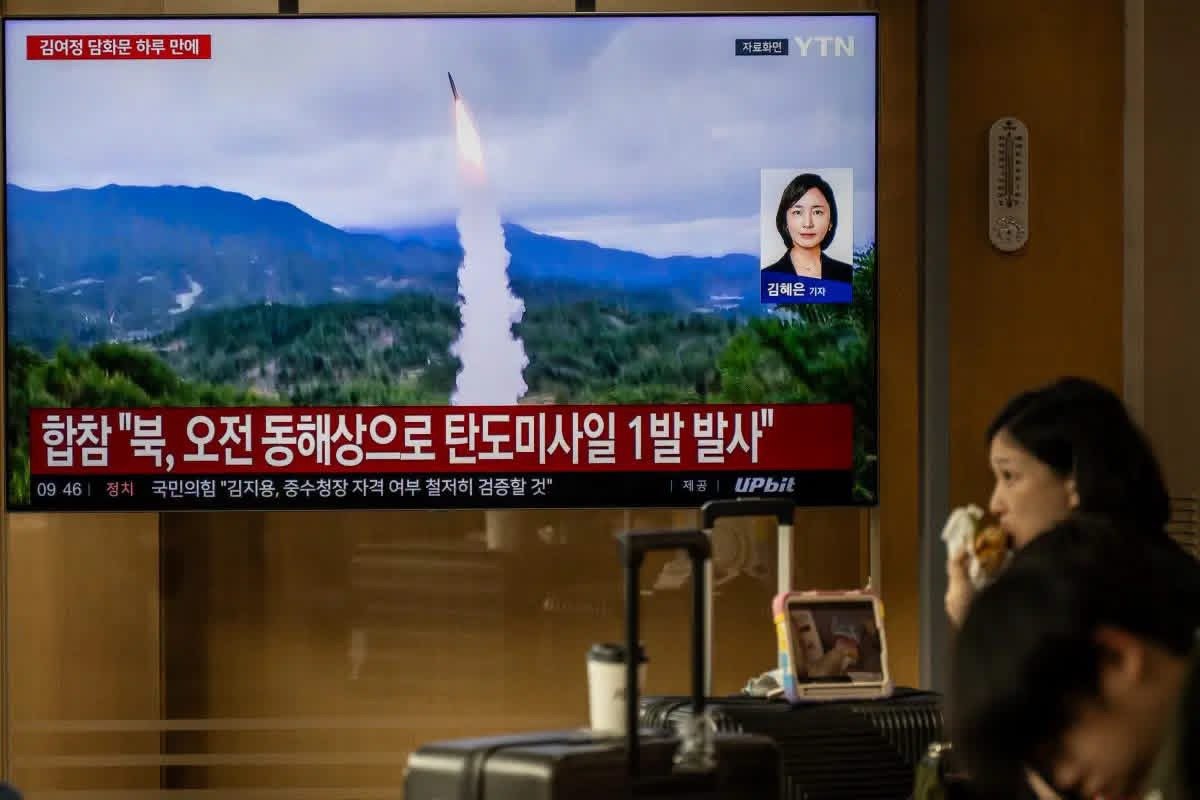
The announcement followed the detection of a ballistic missile launch by South Korea earlier the same day. Seoul’s Joint Chiefs of Staff said the missile was fired from the Wonsan area on North Korea’s east coast at about 6:30 a.m. local time and travelled more than 700 kilometres towards the East Sea.
North Korean leader Kim Jong Un personally oversaw what Pyongyang described as a firing drill involving an intermediate-range strategic missile, according to a statement attributed to his sister, Kim Yo Jong, and carried by the country’s state media.
The claim about artificial intelligence, however, comes from North Korean authorities and has not been independently demonstrated through publicly available technical evidence.
Missile Launch Detected by South Korea
South Korea’s military was the first to publicly report the launch, saying it had detected at least one ballistic missile travelling towards the East Sea.
The Joint Chiefs of Staff said the projectile flew more than 700 kilometres before falling into the sea. South Korean and US intelligence authorities tracked the launch from an early stage and were working together to determine the missile’s precise characteristics.
Japan’s Defence Ministry gave a somewhat different estimate of the flight. Japanese authorities said the missile reached a maximum altitude of approximately 90 kilometres and travelled about 680 kilometres before falling outside Japan’s exclusive economic zone.
Japan said there were no immediate reports of damage to aircraft or vessels following the launch.
The difference between the South Korean and Japanese estimates is relatively small, but it illustrates why technical assessments of North Korean missile tests can change as intelligence agencies analyse data collected from radar, satellites and other monitoring systems.
Pyongyang Describes the Weapon as an Intermediate-Range Strategic Missile
Kim Yo Jong, a senior North Korean official and the sister of Kim Jong Un, said the missile used in the drill was an intermediate-range strategic weapon.
According to her statement, the launch involved what North Korea described as a special firing unit operating under a particular mission. Kim Jong Un was said to have supervised the exercise.
Kim Yo Jong also referred to a missile flight mode involving a wave-like trajectory. She claimed that when this mode was used, opposing forces had difficulty tracking the missile from its initial skip points.
Those claims have not been independently verified.
Reuters reported that Kim did not provide evidence for her assertion that South Korean and Japanese tracking systems had failed to follow the missile throughout its flight. She also did not disclose the missile’s speed.
The distinction is important because North Korea regularly presents its weapons tests through state-controlled media, while South Korea, Japan and the United States conduct separate technical assessments of the launches.
North Korea Claims AI Was Integrated Into the Missile
The most notable element of Saturday’s announcement was Pyongyang’s claim that artificial intelligence had been incorporated into the missile system.
Kim Yo Jong said the weapon was capable of changing its flight orbit at low altitude using AI technology. She further said the missile system had recently incorporated the technology and that different flight-orbit modes could be selected depending on the intended purpose and target.
North Korea has increasingly highlighted artificial intelligence and autonomous or precision-guidance technologies as part of its broader military modernisation programme.
In May 2026, North Korean state media also reported tests involving AI-guided precision cruise missiles alongside tactical ballistic missiles and artillery systems. Reuters reported at the time that Pyongyang described the weapons as part of efforts to modernise its conventional military capabilities.
The latest announcement therefore appears to fit into a broader North Korean effort to demonstrate the integration of newer guidance and control technologies into its weapons programmes.
However, the existence of an AI-related claim should not automatically be treated as independent confirmation of the technical performance being asserted by Pyongyang.
What AI-Guided Flight Could Mean
If independently confirmed, the ability of a missile to adjust its flight path at low altitude could present additional challenges for missile-defence systems.
Traditional ballistic missiles generally follow predictable trajectories after launch, although modern missiles can incorporate manoeuvring capabilities. A weapon capable of making controlled changes to its trajectory could make prediction and interception more difficult, depending on its speed, altitude, manoeuvrability, guidance system and the capabilities of the defending system.
Artificial intelligence could potentially be used for tasks such as processing sensor information, selecting among flight paths or adjusting guidance decisions during flight.
However, the precise role of AI in North Korea’s latest missile remains unclear.
There is no publicly available independent technical assessment establishing exactly what North Korea means by “AI” in this particular weapon, how autonomous the system is, or whether the claimed technology performed as described during the October 3 test.
That distinction matters because military systems can use algorithms, automated guidance and sensor-processing technologies without necessarily representing the kind of advanced autonomous artificial intelligence commonly associated with civilian AI applications.
Kim Yo Jong Says Missile Could Be Difficult to Intercept
Kim Yo Jong used the missile test to argue that the weapon’s flight characteristics could make it difficult for South Korea and Japan to defend against.
She said the missile could change its flight orbit at low altitude and argued that its capabilities meant there was effectively no way to avoid the attack.
Such statements are part of North Korea’s public messaging surrounding its weapons programme and should be distinguished from independent assessments of actual missile-defence performance.
South Korea, Japan and the United States maintain extensive surveillance and missile-warning systems designed to detect North Korean launches. The three countries also share information on missile activity.
Japan’s Defence Ministry said its authorities were continuing to analyse the launch in cooperation with the United States and South Korea.
Test Comes Amid Rising Inter-Korean Tensions
The missile launch occurred against the backdrop of worsening tensions between North and South Korea.
A major source of the latest dispute is a landmine explosion in the Demilitarized Zone that injured three South Korean soldiers on September 21.
South Korean authorities and the United Nations Command have been investigating the incident. Seoul has said evidence points towards North Korean mines, while Pyongyang has rejected responsibility.
Reuters reported that South Korea and the United Nations Command launched a joint investigation into the explosion, with investigators examining evidence from the scene.
The dispute has added another layer of tension to already strained relations between the two Koreas.
North Korea has rejected South Korea’s demands for an apology, while Seoul has continued to call for accountability over the incident.
The latest missile test therefore comes at a time when military and political communication between the two sides remains deeply strained.
A Continuing Pattern of Missile Development
Saturday’s launch is also part of a wider pattern of North Korean weapons testing during 2026.
Reuters reported that North Korea had conducted more than 10 missile tests during the year by the time of the October 3 launch. Pyongyang has used some of these tests to demonstrate new or improved weapons systems.
The country has continued to develop ballistic missiles, cruise missiles and other weapons while maintaining its nuclear weapons programme.
In previous tests, North Korean authorities have highlighted improvements in manoeuvrability, precision and battlefield applications.
The emphasis on AI in the latest test adds another technological dimension to that programme.
It also reflects a broader global trend in which militaries are exploring artificial intelligence for surveillance, targeting, decision-support, autonomous systems and weapons guidance.
United Nations Restrictions on North Korea’s Ballistic Missile Programme
North Korea’s missile activities remain subject to United Nations Security Council restrictions.
The UN Security Council has repeatedly demanded that the Democratic People’s Republic of Korea refrain from launches using ballistic missile technology and suspend activities related to its ballistic missile programme.
Security Council resolutions adopted under Chapter VII have also established sanctions relating to North Korea’s nuclear and ballistic missile programmes.
The UN’s sanctions framework includes restrictions designed to prevent the transfer of materials, equipment and technology that could contribute to North Korea’s prohibited nuclear and ballistic missile programmes.
As a result, ballistic missile tests by Pyongyang continue to have implications beyond the immediate security environment of the Korean Peninsula.
Regional Security Implications
For South Korea and Japan, the development of missiles capable of manoeuvring at lower altitudes could raise additional questions about the effectiveness and response time of existing missile-defence systems if the North Korean claims are eventually confirmed.
For the United States, the issue is also relevant because Washington maintains military forces in South Korea and Japan and has security commitments to both countries.
The three countries regularly conduct surveillance and military exercises in response to North Korean weapons activity.
At the same time, the latest test demonstrates the continuing difficulty of reducing military tensions on the Korean Peninsula.
South Korean President Lee Jae Myung has recently called for renewed dialogue with North Korea while also supporting measures to strengthen South Korea’s defence capabilities. Reuters reported on October 1 that Lee urged Pyongyang to restore trust and dialogue but outlined plans to strengthen South Korea’s military capabilities, including missile-defence technologies.
This creates a complicated security environment in which diplomatic outreach continues alongside military preparedness.
What Happens Next
South Korea, Japan and the United States are expected to continue analysing data from the October 3 launch to determine the missile’s precise characteristics, trajectory and capabilities.
The immediate focus will include determining whether the weapon was genuinely an intermediate-range system as described by North Korea, what type of propulsion and guidance technologies it used, and whether its claimed manoeuvrability and AI-assisted functions can be independently established.
Further intelligence assessments could also clarify the missile’s maximum altitude, speed, trajectory and point of impact.
North Korea, meanwhile, is likely to continue using missile tests to demonstrate military capabilities and signal its strategic intentions.
The key unresolved issue is the extent to which the latest claims about artificial intelligence represent a demonstrated technological advance rather than a statement intended primarily to communicate military capability.
For now, the independently established facts are that North Korea launched a ballistic missile from the Wonsan area on October 3, that South Korea detected the launch and reported a flight of more than 700 kilometres, and that Japan assessed the missile’s flight at approximately 680 kilometres and outside its exclusive economic zone. North Korean authorities have additionally claimed that the weapon was an intermediate-range strategic missile equipped with AI-related capabilities.
Why It Matters
The test matters because it combines two major areas of contemporary security competition: missile technology and artificial intelligence.
North Korea’s claim, if eventually supported by independent technical assessments, would indicate another step in its efforts to improve the survivability and manoeuvrability of its missile forces.
But the available evidence at the time of publication does not independently establish all of Pyongyang’s technical claims.
For regional governments, intelligence agencies and military planners, the immediate task will therefore be to determine what the missile actually demonstrated rather than relying solely on North Korea’s description of the test.
The launch also highlights the continuing security tensions surrounding the Korean Peninsula, where weapons development, military exercises, border incidents and diplomatic disputes remain closely connected.
Weng Global – stories beyond borders
Sources
Reuters
Associated Press
Yonhap News Agency
Japan Ministry of Defense
United Nations Security Council
Agence France-Presse (AFP)