Reported by Weng Patrick Atokor l Journalist at Weng Global
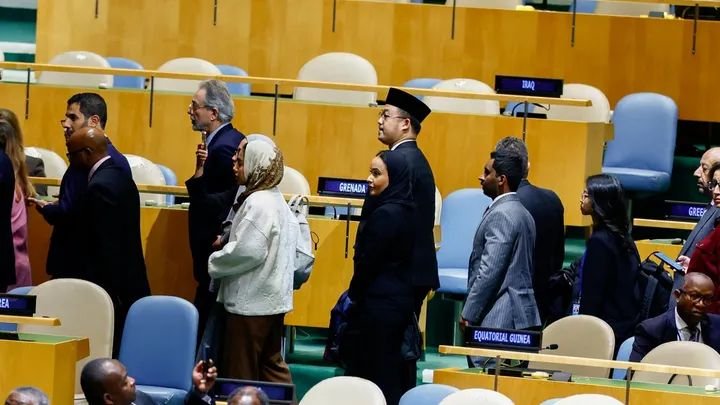
Israeli Prime Minister Benjamin Netanyahu faced a mass walkout at the United Nations General Assembly on Thursday, September 24, 2026, as dozens of delegates left the chamber when he began his address at the 81st session in New York.
Among the countries reported to have had delegates walk out or leave empty seats during the speech were Saudi Arabia and Iran, alongside several Arab, Muslim and other nations. The Palestinian Mission to the United Nations had encouraged delegations to leave the chamber in protest against Netanyahu’s address.
The walkout created a dramatic start to Netanyahu’s speech, with many seats in the General Assembly hall becoming empty as the Israeli prime minister approached the podium.
Netanyahu responded by describing the departing delegates as “moral cowards” and challenged those who remained to leave as well.
Netanyahu Defends Israel’s Military Actions
Netanyahu used the UN platform to defend Israel’s military actions and reject international criticism of its conduct in Gaza and its wider confrontation with Iran.
He argued that Israel’s military operations were necessary for the country’s security and said the decision to strike Iran’s nuclear facilities was among the easiest decisions he had made as prime minister.
Netanyahu also accused Iran’s leadership of threatening Israel and the wider world, while arguing that Israel’s military campaign had prevented a greater threat.
The Israeli prime minister’s remarks came against the backdrop of the continuing conflict involving Israel, Iran and other regional actors, which has made the 2026 UN General Assembly a major diplomatic forum for competing positions on the Middle East.
Saudi Arabia and Iran Among Delegations Reported to Have Left
Reports following the speech identified Saudi Arabia and Iran among the countries whose representatives left the chamber.
Hindustan Times reported that empty seats were observed for delegations including Saudi Arabia, Iran, Sudan, Tunisia, Uzbekistan, Sri Lanka, Bangladesh, Algeria, Malaysia, Montenegro and Kyrgyzstan. However, reports have cautioned that there was no official comprehensive UN list establishing exactly which countries participated in the walkout.
SBS News separately reported that delegates from several Middle Eastern and Arab countries, including Iran and Saudi Arabia, walked out as Netanyahu took the podium.
The walkout was therefore broader than a dispute involving a single country. It reflected the wider diplomatic tensions surrounding Israel’s military operations, the Gaza conflict and the confrontation with Iran.
Netanyahu Attacks New York Mayor Zohran Mamdani
A significant part of Netanyahu’s address focused on New York City Mayor Zohran Mamdani, a prominent critic of Israel.
Netanyahu accused Mamdani of contributing to an environment in which Jewish people in New York feel unsafe and criticised the mayor over his position on Israel and the Palestinian issue.
Mamdani has previously described Netanyahu as a war criminal and has been critical of Israel’s military campaign in Gaza. Netanyahu rejected those criticisms and used his UN address to directly challenge the New York mayor.
The exchange was notable because the UN General Assembly was taking place in New York, the city governed by Mamdani, making the mayor an unusual focus of an address by a foreign head of government.
Netanyahu also criticised European governments and other international actors over their positions on Israel, while praising US President Donald Trump for his support.
Gaza War Remains Central to International Dispute
The speech came amid continued international disagreement over Israel’s conduct in Gaza.
Netanyahu rejected accusations that Israel had committed genocide in Gaza and described the allegation as false. Critics of Israel, meanwhile, continue to accuse the Israeli government of serious violations against Palestinians.
The competing claims form part of a wider international dispute that has extended beyond the battlefield into diplomatic institutions, international courts and relations between Israel and governments across the Middle East, Europe and elsewhere.
Reuters reported that Netanyahu’s UN appearance came as Israel faced increasing international criticism over the Gaza war and its regional military actions. The agency also noted that the Israeli prime minister was campaigning ahead of Israel’s October 27 election.
A Divided UN Chamber
The scenes inside the General Assembly demonstrated the diplomatic divisions surrounding Netanyahu’s government.
As the Israeli prime minister took the podium, several delegations left the chamber while supporters in the visitors’ gallery applauded him. The presiding officer called for order as the disruption continued.
The Times of Israel reported that most delegations from Arab and Muslim countries walked out, while the United Arab Emirates remained in the chamber.
The walkout was also reported by Reuters, CBS News and other international media outlets, although the exact number of delegations involved varies across reports.
That distinction is important because an empty seat does not necessarily establish that a country’s delegation participated in a coordinated protest. Some delegations may have been absent for other reasons. For that reason, reports of individual countries’ participation should be treated according to the evidence available.
Iran and Israel at the Centre of UN Tensions
Iran’s participation in the walkout carried particular significance because Tehran has been directly involved in the wider conflict with Israel.
Netanyahu devoted substantial attention to Iran during his speech, accusing its leadership of posing a threat and defending Israeli military action against Iranian targets.
The Iranian government has rejected Israel’s characterisation of its actions and has remained involved in diplomatic efforts surrounding the conflict.
The UN gathering has consequently become an important venue for competing arguments over the future of the Middle East, including questions surrounding Iran’s security, Israel’s military operations, Gaza and regional diplomacy.
Earlier in the week, US President Donald Trump also used his UN address to discuss the conflict with Iran and called for pressure on Tehran, underscoring the central position the confrontation has taken during this year’s General Assembly.
Saudi Arabia’s Position
Saudi Arabia’s reported participation in the walkout is also significant because Riyadh has maintained an important diplomatic role in discussions concerning the Middle East.
Saudi Foreign Minister Prince Faisal bin Farhan attended the UN General Assembly during the same period and addressed questions surrounding regional security and the conflict.
According to the Associated Press, the Saudi foreign minister said his country was capable of defending territory controlled by the Saudi-backed government in Yemen. He also declined to say whether Saudi Arabia would join the Abraham Accords, saying implementation of a Gaza peace plan had to come first.
The reported Saudi walkout therefore occurred against a broader diplomatic backdrop in which Riyadh continues to engage with questions involving Israel, Palestine, Iran and regional security.
Why the Walkout Matters
The mass departure from Netanyahu’s speech illustrates the depth of disagreement between Israel and a significant number of governments over the Gaza conflict and Israel’s wider regional military campaign.
A UN General Assembly walkout does not itself constitute a formal UN decision or resolution. Rather, it is a diplomatic gesture used by delegations to signal opposition or dissatisfaction with a speaker or government.
The episode nevertheless carries political and diplomatic significance because the General Assembly is one of the world’s most visible forums for international debate.
For Israel, Netanyahu’s speech provided an opportunity to present his government’s case directly to world leaders and defend its military decisions.
For countries opposed to Israel’s policies, the walkout provided a public demonstration of their disagreement.
What Happens Next
The diplomatic debate over Israel, Gaza and Iran is expected to remain prominent during the remainder of the UN General Assembly session.
The immediate focus will include continuing discussions over regional security, humanitarian conditions, the future of Gaza and efforts to address the wider conflict involving Iran.
Netanyahu is also facing a domestic political test, with Israel scheduled to hold its next election on October 27, according to Reuters.
Meanwhile, the disagreement between Netanyahu and Mamdani is likely to remain part of the wider political debate in New York, particularly because Mamdani is the mayor of the city hosting the UN headquarters.
The walkout ultimately underscored a broader reality at this year’s General Assembly: the Middle East conflict remains one of the most divisive issues confronting the international community, with governments continuing to disagree sharply over Israel’s military actions, Iran’s role, Palestinian statehood and the future of regional diplomacy.
Weng Global – Stories beyond borders
Sources
- Reuters — reporting on Netanyahu’s UN address and the delegate walkout.
- Associated Press — reporting on Netanyahu’s UN speech, the walkout and Saudi Arabia’s regional position.
- CBS News — reporting on the UN walkout and Netanyahu’s remarks concerning Zohran Mamdani.
- Al Jazeera — reporting on Netanyahu’s criticism of Iran, Mamdani and other governments.
- Hindustan Times — reporting on countries whose delegations were observed to have left or had empty seats.