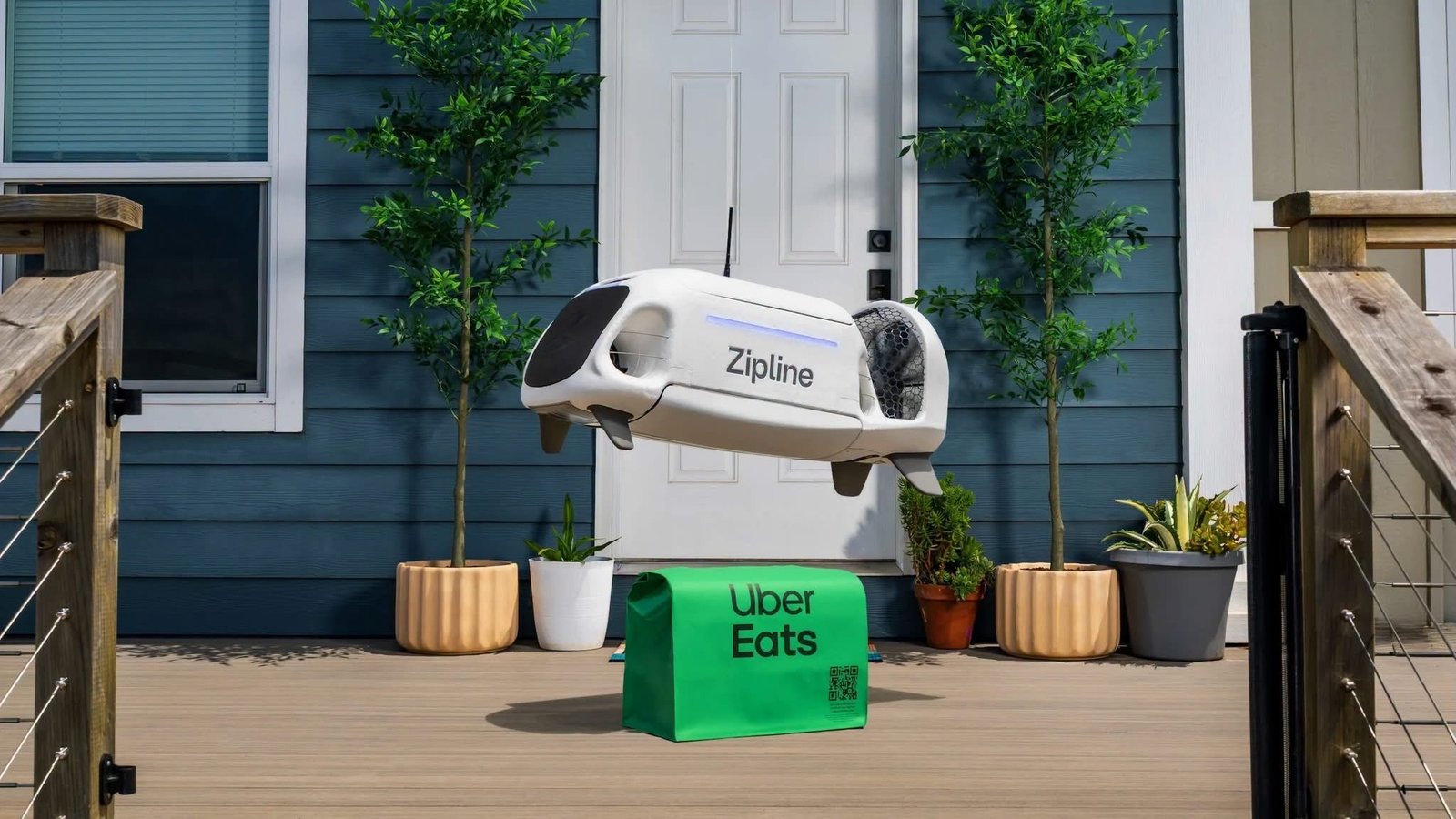
Uber and Zipline Take Food Delivery to the Skies, Target 1 Million Autonomous Drone Orders Daily by 2029!
Uber is deepening its push into autonomous delivery with a new partnership with drone technology company Zipline to bring autonomous aerial deliveries to Uber Eats customers across the United States, in a move that could significantly reshape the country’s last-mile food-delivery market.
The partnership, announced on Monday, August 17, 2026, will combine Uber’s large consumer and logistics platform with Zipline’s autonomous drone network. The companies are targeting an ambitious milestone of one million drone deliveries per day by the end of 2029, underscoring the scale at which both companies believe autonomous aerial logistics could eventually operate.
The initiative is expected to begin in the Dallas and Houston areas before expanding to additional US markets. The partnership also includes an investment by Uber in Zipline, further demonstrating the ride-hailing and delivery company’s growing commitment to autonomous logistics.
Reuters reported that the agreement is designed to improve the speed and efficiency of food deliveries, while Uber seeks to incorporate drones alongside human couriers and other autonomous delivery technologies.
For Uber, the development represents another step in its strategy to transform Uber Eats from a conventional food-delivery service into a multimodal logistics platform capable of selecting the most efficient delivery method for each order.
Uber targets a new era of automated food delivery
The partnership with Zipline reflects Uber’s broader strategy of combining conventional delivery workers with autonomous technologies.
Instead of relying exclusively on cars, motorcycles, bicycles or human couriers, Uber increasingly wants its delivery network to determine whether an order is best completed by a person, sidewalk robot, autonomous vehicle or drone.
The company’s autonomous strategy already includes partnerships with several robotics and autonomous-vehicle companies. Uber’s own description of its autonomous delivery strategy says Uber Eats is being developed to support deliveries involving all-electric sidewalk robots, drones and autonomous cars.
The Zipline agreement takes that strategy into the air.
According to Axios, the companies are targeting one million Uber Eats drone deliveries every day by the end of 2029. The initial rollout is expected in Houston and Dallas before expansion into additional American cities.
That target would represent a dramatic increase from the current scale of commercial drone delivery in the United States.
Zipline brings years of autonomous delivery experience
Zipline is not entering the food-delivery sector as a newcomer to autonomous logistics.
The company began its commercial operations by using drones to deliver medical supplies, including blood and vaccines, in countries where conventional transportation could be slow or difficult.
Its experience in Africa has been particularly significant.
Zipline began operating in Rwanda in 2016, using autonomous aircraft to deliver blood and medical supplies to health facilities. The company’s operations subsequently expanded into other countries and sectors.
In February 2026, Rwanda announced an expansion of its relationship with Zipline that the company described as a move toward nationwide autonomous logistics coverage and Africa’s first urban drone-delivery network.
The company’s technology has since expanded into food, retail and healthcare delivery in the United States.
Zipline said in July 2026 that it had completed more than 2.5 million commercial deliveries, including approximately one million during the preceding year. The company also said its autonomous aircraft had flown more than 135 million commercial autonomous miles.
That operational experience is one of the reasons the Uber partnership is potentially significant.
From medical supplies to burgers and groceries
The transition from medical logistics to consumer delivery reflects the rapid expansion of drone technology.
Zipline has already worked with major American retailers and food companies.
In April 2026, the company reported expanding its restaurant delivery network in North Texas, with customers in Rowlett gaining access to food from 16 brands, including Walmart, Crumbl Cookies, Little Caesars Pizza, Popeyes and Blaze Pizza.
The company has also previously worked with Walmart, Panera Bread, Memorial Hermann Health System and Jet’s Pizza.
In 2024, Zipline announced that its autonomous delivery platform would support food and healthcare deliveries in several US metropolitan areas. At the time, the company said its aircraft could deliver two large Detroit-style pizzas along with sides.
The Uber partnership therefore builds on an existing commercial ecosystem rather than introducing drone food delivery from scratch.
Faster deliveries could change customer expectations
One of the strongest arguments for drone delivery is speed.
Unlike conventional delivery vehicles, drones do not have to travel through congested roads. They can move directly through designated airspace from a restaurant or distribution point toward a customer’s delivery location.
The Wall Street Journal reported that Zipline’s drone deliveries through the Uber Eats partnership could arrive within approximately five to 10 minutes, compared with conventional delivery times that can often be substantially longer.
For customers, the difference could be especially important for smaller orders such as meals, snacks, groceries and other lightweight products.
A customer who previously waited 30 minutes or more for a food order could potentially receive it within minutes if the restaurant and delivery destination are within the drone network.
That could change consumer expectations around what constitutes “fast delivery.”
The human courier will not disappear immediately
Despite the aggressive automation target, Uber’s strategy does not appear to involve eliminating human delivery workers altogether.
Instead, the company is pursuing what it describes as a multimodal model.
Some orders will continue to be handled by human couriers where drones are impractical. Others may be completed using robots or autonomous vehicles.
Drones are particularly suited to lightweight packages and relatively short distances, while human couriers remain more flexible for larger orders, complicated destinations and locations outside autonomous delivery zones.
This hybrid approach could allow Uber to reduce delivery times and potentially lower operational costs without abandoning its existing network of drivers and couriers.
The Wall Street Journal reported that Uber considers collaboration among multiple autonomous delivery technologies essential to achieving scale, while maintaining human couriers as part of the broader delivery system.
Uber’s move follows earlier drone partnership
The Zipline agreement is not Uber’s first major move into aerial delivery.
In September 2025, Uber announced a strategic partnership with Flytrex, another drone-delivery company, and made its first investment in drone delivery technology.
Uber said at the time that it planned to introduce drone delivery through Uber Eats pilot markets in the United States. The company described the partnership as part of its strategy to create a flexible delivery network incorporating autonomous aerial technology.
The latest Zipline agreement therefore suggests that Uber’s interest in drone delivery is becoming a long-term strategic priority rather than a limited technology experiment.
It also demonstrates Uber’s preference for working with multiple autonomous technology companies rather than relying on a single provider.
Competition in autonomous delivery intensifies
Uber’s expansion comes as competition in autonomous delivery continues to grow.
DoorDash, Amazon and other technology and logistics companies are also exploring drones, robots and autonomous vehicles as potential solutions to the cost and complexity of last-mile delivery.
The economic argument is straightforward.
Food delivery often involves relatively small packages travelling short distances in vehicles designed to carry people. If autonomous systems can complete some of those journeys more efficiently, companies could potentially reduce delivery costs and improve speed.
However, the technology still faces regulatory, operational and infrastructure challenges.
Regulation remains a critical factor
Drone delivery requires regulatory approval because commercial aircraft must operate safely alongside other aviation activity.
The Federal Aviation Administration has been working on rules governing expanded commercial drone operations, including flights beyond the visual line of sight of operators.
Such regulations are crucial to the large-scale deployment of autonomous delivery networks.
The ability of drones to operate without direct visual monitoring is particularly important because one million deliveries per day would require a highly automated system capable of managing thousands of flights across multiple metropolitan areas.
Zipline has already developed technology for autonomous operations and said in 2024 that it had received regulatory approvals related to beyond-visual-line-of-sight commercial delivery operations.
Nevertheless, nationwide expansion will require continued regulatory coordination, local approvals, airspace management and public acceptance.
Safety and privacy will remain under scrutiny
As drone deliveries become more common, safety will remain one of the most important issues.
Companies will have to demonstrate that autonomous aircraft can operate reliably around homes, businesses, roads, airports and other aircraft.
There are also privacy concerns.
Drones equipped with navigation and perception systems may operate above residential areas, raising questions about how imagery and other data are collected, processed and stored.
Uber and Zipline will therefore need to address not only delivery speed and cost but also questions surrounding public safety, noise, privacy and accountability.
The companies’ ability to establish public trust could determine how quickly drone delivery expands beyond early-adopter communities.
Environmental benefits could strengthen the business case
Drone delivery could also have environmental implications.
Zipline’s aircraft are electric and designed for autonomous delivery, potentially reducing the fuel consumption associated with conventional delivery vehicles.
The company said its autonomous delivery system had already helped eliminate substantial vehicle travel and associated carbon emissions.
However, the environmental benefit will depend on how drone networks are operated and what types of vehicle journeys they replace.
If drones replace short car or motorcycle trips, the reduction in emissions could be meaningful. If they are used for deliveries that would otherwise have been consolidated into efficient delivery routes, the environmental advantage could be smaller.
Therefore, the environmental case for drone delivery should be evaluated using actual operating data rather than assumptions.
A major test for the future of last-mile logistics
The one-million-deliveries-per-day target is ambitious.
Reaching it would require enormous growth in aircraft production, distribution infrastructure, restaurant integration, airspace coordination and customer adoption.
Zipline has already demonstrated that autonomous delivery can operate commercially at scale, but expanding from millions of cumulative deliveries to one million deliveries every day would represent a completely different level of operations.
The company has been preparing for that growth.
In January 2026, Zipline announced that it had surpassed two million commercial deliveries, raised more than $600 million and expanded operations into Houston and Phoenix. It said the company was valued at $7.6 billion following the funding round.
The company’s subsequent expansion suggests that the infrastructure needed for Uber’s ambitious target is already being developed.
What the partnership means for Uber Eats customers
For consumers, the most immediate change will be the possibility of seeing autonomous drone delivery offered as an option when ordering through Uber Eats.
Rather than downloading a separate drone-delivery application, customers will increasingly interact with the technology through Uber’s existing platform.
Axios reported that the Uber partnership represents Zipline’s first full integration into a retailer’s app, meaning customers can access the service through Uber Eats rather than a separate Zipline application.
That integration could be crucial.
Consumers generally care more about whether their order arrives quickly and reliably than about which company operates the aircraft.
By embedding autonomous delivery directly into Uber Eats, the company can make drones part of an ordinary ordering experience rather than presenting them as a novelty.
The bigger picture
The Uber-Zipline partnership reflects a broader transformation taking place in the global logistics industry.
The traditional model of a person driving a vehicle from a restaurant to a customer’s home is increasingly being supplemented by automated systems.
Sidewalk robots, autonomous cars and drones are gradually becoming part of the delivery ecosystem.
For Uber, the objective is to operate the platform through which customers access these technologies, regardless of which company manufactures the robot, vehicle or drone.
For Zipline, the partnership provides access to Uber’s enormous customer base and established delivery infrastructure.
For consumers, it could eventually mean faster and potentially cheaper deliveries.
But the transition will depend on whether autonomous systems can demonstrate the combination of safety, reliability, affordability and convenience necessary to become mainstream.
The companies’ target of one million drone deliveries every day by 2029 is therefore more than a corporate growth target. It is a test of whether autonomous aerial logistics can move from a specialised service into a routine part of everyday commerce.
For wengglobal, the development represents an important milestone in the global race toward automated logistics.
The initial rollout in Dallas and Houston will provide an early indication of how consumers respond to drone-based food delivery and how effectively Uber and Zipline can integrate autonomous aircraft into existing urban delivery networks.
If the model succeeds, the implications could extend far beyond Uber Eats, potentially accelerating the adoption of autonomous delivery for groceries, medicines, retail products and other essential goods across the United States and, eventually, other markets.
Sources
- Reuters — Report on Uber and Zipline’s US autonomous drone-delivery partnership and Uber’s investment in Zipline.
- Axios — Report on the one-million-drone-deliveries-per-day target and initial rollout in Dallas and Houston.
- The Wall Street Journal — Report on Uber’s drone-delivery strategy and the target of one million daily deliveries by 2029.
- The Verge — Report on the Uber-Zipline partnership, autonomous food delivery and the broader US drone-delivery market.
- Uber — Official information on its autonomous mobility and delivery strategy. Uber Autonomous Delivery
- Zipline — Official information on its US expansion and more than 2.5 million commercial deliveries. Zipline US Expansion Update
- Zipline — Official announcement on surpassing two million commercial deliveries and expanding US operations. Zipline Delivery Milestone
SEO Tags
Meta Description