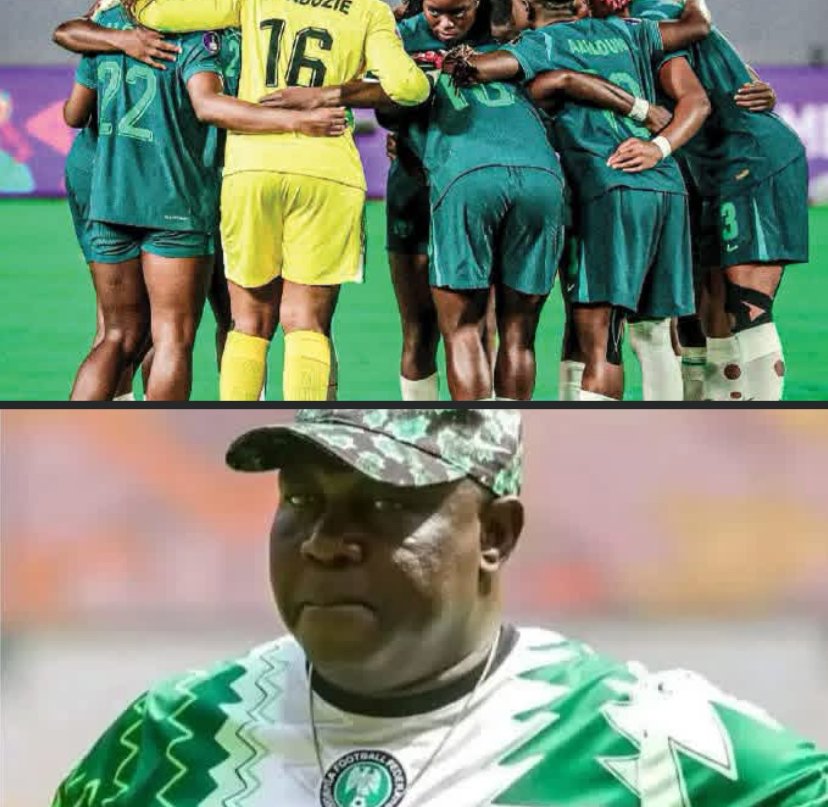
Madugu Apologises as Super Falcons Lose 2027 World Cup Route After WAFCON Setback!
Super Falcons head coach Justine Madugu has apologised to Nigerians following the team’s failure to secure qualification for the 2027 FIFA Women’s World Cup in Brazil, bringing an unexpected setback to the country’s long-standing record of appearing at every edition of the women’s global tournament.
Madugu’s apology comes after Nigeria’s disappointing campaign at the 2026 Women’s Africa Cup of Nations (WAFCON) in Morocco, a tournament that doubled as Africa’s qualifying competition for the 2027 Women’s World Cup.
The development is particularly significant because Nigeria entered the competition as the defending African champions, record 10-time WAFCON winners and one of the continent’s strongest candidates for one of the World Cup places.
Before the tournament began, Madugu had made qualification for Brazil 2027 the Super Falcons’ immediate priority. In comments reported by CAF and Nigerian media, the coach said the team’s first objective was to secure a World Cup place before attempting to retain its continental crown.
That objective has now been missed, leaving the Nigerian women’s national team facing a major disappointment and prompting fresh questions about preparation, tactics, squad selection and the broader administration of women’s football in the country.
World Cup qualification was the primary target
The significance of the setback cannot be separated from the unusual format of WAFCON 2026.
The expanded 16-team tournament served as Africa’s qualification route for the 2027 FIFA Women’s World Cup. The four teams reaching the WAFCON semi-finals would qualify automatically for Brazil, while the teams eliminated in the quarter-finals would receive another opportunity through a playoff route leading to the FIFA inter-confederation playoff tournament.
Nigeria therefore needed to progress deep into the competition to guarantee its place at the World Cup.
The Super Falcons arrived in Morocco carrying considerable expectations. They had won the previous WAFCON title after a remarkable 3-2 comeback against hosts Morocco in the final, securing Nigeria’s 10th continental championship. The achievement reinforced the country’s status as Africa’s most successful women’s football nation.
Madugu, who took charge of the team in 2024 after previously serving as an assistant, had also earned significant credit for that title-winning campaign.
His leadership had consequently been linked closely with expectations that Nigeria would maintain its continental dominance and qualify for another World Cup.
A difficult campaign for the defending champions
The Super Falcons’ journey through the 2026 WAFCON did not unfold as many supporters expected.
Nigeria began the tournament as one of the leading favourites but suffered a shock defeat to debutants Malawi in the group stage, immediately placing additional pressure on the defending champions.
The result exposed some of the concerns surrounding the team’s preparation and consistency ahead of the competition.
Nigeria had entered the tournament following an uneven build-up. The Super Falcons had struggled to secure a sufficiently competitive programme of international friendlies, with several proposed matches reportedly falling through before the federation eventually arranged fixtures against Senegal. Premium Times reported in May that the team had experienced weeks of uncertainty surrounding its preparations.
The preparation issue was significant because WAFCON 2026 carried consequences beyond the continental title.
Every match potentially affected Nigeria’s route to the World Cup, making tactical sharpness, squad cohesion and match readiness particularly important.
Madugu had previously warned of pressure
Before the tournament, Madugu acknowledged that the pressure on Nigeria would be substantial.
The Super Falcons were defending their title, while other African teams had improved considerably.
Madugu told CAF that the team understood the weight of defending the trophy but remained determined to achieve both objectives — retaining the continental title and qualifying for the World Cup.
He also stressed that qualification for Brazil 2027 was the first priority.
The coach’s comments demonstrated that the technical team understood the significance of the tournament.
The failure to achieve that objective therefore represents more than an ordinary competition setback. It is a strategic disappointment for a team that had entered the tournament with a clear mandate.
Nigeria’s World Cup record makes the setback historic
The Super Falcons have been a constant presence at the FIFA Women’s World Cup since the inaugural edition in 1991.
FIFA records Nigeria as having appeared at nine previous Women’s World Cup tournaments, with the team’s best performance coming in 1999, when the Falcons reached the quarter-finals.
That consistency has made Nigeria one of the few African countries with an enduring presence at the global women’s game.
Missing Brazil 2027 therefore represents a significant break with that history.
It also means Nigeria will not have the opportunity to build on its participation at the 2023 Women’s World Cup in Australia and New Zealand, where the Super Falcons reached the round of 16.
The absence will have sporting consequences for the players, coaching staff and the country’s international ranking, while also depriving emerging Nigerian footballers of the experience of competing on the world’s biggest women’s football stage.
Apology reflects accountability
Madugu’s decision to apologise to Nigerians places responsibility for the disappointment directly on the coaching team.
It is a notable response because national-team coaches in Nigeria often face intense public scrutiny after major tournament failures.
The Super Falcons carry particularly high expectations because of their record in African football.
Nigeria has won the WAFCON 10 times, far more than any other country. The team has consequently been expected to compete for the title whenever it enters the tournament.
Madugu’s apology acknowledges that the team’s performance did not meet those expectations.
It also reflects a similar approach he adopted after less damaging setbacks.
In October 2025, following Nigeria’s 1-1 draw against Benin Republic in Abeokuta, Madugu apologised to Nigerians for what he described as a performance below expectations. The result nevertheless secured Nigeria’s qualification for the 2026 WAFCON with a 3-1 aggregate victory.
That earlier apology was followed by a successful tournament campaign in which the Super Falcons won the WAFCON title.
This time, however, the consequences are considerably more serious.
Questions over preparation
The World Cup setback is likely to reignite questions about how Nigeria prepares its women’s national team for major tournaments.
Premium Times reported before WAFCON that the federation had struggled to secure high-level friendly matches, eventually arranging two games against Senegal after several attempts to find suitable opposition.
Preparation is especially important when a team is defending a continental title.
Competitive friendlies provide coaches with opportunities to assess tactical systems, test combinations, integrate new players and identify weaknesses before major matches.
Nigeria’s preparation programme had also been affected by uncertainty surrounding the tournament itself.
CAF postponed the competition from its original March-April window to July-August 2026, creating a different preparation timeline for participating teams.
The changes were part of broader scheduling complications surrounding African women’s football.
Squad selection also under scrutiny
Madugu’s squad selection had generated discussion even before the tournament.
One of the most notable decisions was the omission of experienced defender Ashleigh Plumptre from the final WAFCON squad. Channels Television reported that the Al-Ittihad defender was unavailable as Nigeria prepared to defend its title, while the coach selected a mixture of experienced players and emerging talents.
Nigeria’s 25-player squad included established figures such as captain Rasheedat Ajibade, goalkeeper Chiamaka Nnadozie, Asisat Oshoala, Osinachi Ohale, Michelle Alozie, Toni Payne and Christy Ucheibe, alongside younger players.
The selection reflected an attempt to balance experience with renewal.
However, following the team’s failure to reach the World Cup, technical decisions will inevitably attract renewed scrutiny.
Supporters and analysts are likely to examine whether Nigeria had the right balance of experience, creativity, attacking efficiency and defensive stability to compete against increasingly sophisticated African teams.
The gap in African women’s football is narrowing
Nigeria’s disappointment also reflects a wider change in African women’s football.
The Super Falcons remain the continent’s most decorated team, but the competitive gap between Nigeria and other leading nations has narrowed.
South Africa, Morocco, Zambia, Ghana and Cameroon have developed increasingly competitive women’s programmes.
South Africa won the 2022 WAFCON, while Morocco reached consecutive finals before Nigeria defeated them in the 2024 final. Zambia has also emerged as a significant force, led by players such as Barbra Banda and Racheal Kundananji.
CAF’s decision to expand WAFCON to 16 teams further reflects the growth of the women’s game across the continent.
That expansion creates more opportunities for emerging nations but also makes qualification for the World Cup more competitive.
Nigeria can no longer assume that historical dominance will automatically translate into qualification.
What the failure means for Nigerian football
The consequences extend beyond the Super Falcons’ immediate disappointment.
The FIFA Women’s World Cup is a major platform for player development, international exposure, sponsorship and visibility.
Participation can help players attract attention from major clubs and international scouts, while also providing younger footballers with opportunities to compete against the world’s best.
Nigeria’s absence could therefore affect the development pathway for emerging talents.
It could also reduce international exposure for players who would otherwise have used the World Cup as a stage to establish themselves.
For the Nigeria Football Federation, the setback is likely to raise broader questions about investment in women’s football, coaching structures, player welfare, preparation and long-term planning.
NFF faces difficult questions
The failure should not be viewed solely as a coaching issue.
While Madugu is responsible for technical decisions on the pitch, the wider football administration determines many of the conditions under which the national team operates.
Issues such as scheduling, funding, training camps, friendly matches, player logistics, bonuses and technical support involve several layers of football administration.
Consequently, a serious review of the campaign should examine the entire system rather than assigning responsibility to one individual.
The NFF will also need to decide how best to respond to the disappointment.
Madugu has a contract running until 2027, having received a two-year extension after leading Nigeria to WAFCON qualification in October 2025.
Whether the latest failure changes the federation’s position on his future remains an important question for Nigerian football.
A rebuilding opportunity
Despite the disappointment, the failure could provide an opportunity for Nigerian women’s football to reassess its structures.
The Super Falcons possess a deep pool of talented players, including established internationals competing in Europe, North America and Asia.
Nigeria also has a strong tradition of producing players capable of competing at the highest level.
The challenge is converting that talent into a sustainable national-team system.
That requires better preparation, stronger domestic development, improved scouting, consistent coaching philosophy and greater investment in women’s football infrastructure.
The country must also ensure that younger players are gradually integrated without weakening the competitiveness of the senior side.
Supporters deserve answers
For Nigerian supporters, an apology from the coach may be welcome, but it is unlikely to end the conversation.
Fans will want to understand why a team that had dominated African women’s football for decades failed to secure one of the available routes to Brazil 2027.
They will also expect the football authorities to identify what went wrong and explain how similar failures will be prevented.
The Super Falcons’ reputation has been built on sustained excellence.
That reputation cannot be protected by relying solely on past achievements.
It must be reinforced through preparation, accountability and investment.
Conclusion
Justine Madugu’s apology to Nigerians comes at a difficult moment for the Super Falcons, following their failure to qualify for the 2027 FIFA Women’s World Cup in Brazil.
Nigeria entered the 2026 WAFCON as defending champions and the most successful team in the history of the competition, but the tournament’s dual role as Africa’s World Cup qualifier increased the consequences of every setback.
The failure ends Nigeria’s long-standing sequence of appearances at the Women’s World Cup and represents one of the most significant disappointments in the modern history of the Super Falcons.
Madugu had openly identified World Cup qualification as the team’s first priority before the tournament. His apology now acknowledges that the objective was not achieved.
But accountability should extend beyond the coach.
The NFF must examine the team’s preparation, competitive schedule, squad management, player support and broader development structure.
For Wengglobal, the episode should be viewed not merely as a sporting failure but as a moment for reflection on the direction of Nigerian women’s football.
The Super Falcons remain one of Africa’s most decorated national teams. Their history provides a strong foundation, but the changing landscape of women’s football demands continuous investment and adaptation.
The immediate disappointment of missing Brazil 2027 should therefore become a catalyst for reform rather than simply another cycle of blame.
Nigeria’s next challenge is to ensure that the Super Falcons return stronger, better prepared and capable of reclaiming their position at the summit of African women’s football.
Sources
- PUNCH Newspapers — Coach apologises to Nigerians over Falcons World Cup miss
- FIFA — 2026 Women’s Africa Cup of Nations preview and World Cup qualification format
- CAF — WAFCON Morocco 2026 kick-off times and tournament pathway
- PUNCH Newspapers — 2026 WAFCON will decide Africa’s 2027 World Cup teams
- Channels Television — 2026 WAFCON: Super Falcons eye World Cup qualification
- Premium Times — Super Falcons’ preparations and Senegal friendlies ahead of WAFCON
- PUNCH Newspapers — Madugu confirms two-year contract extension
- The Guardian — How Nigeria won its 10th WAFCON title under Madugu