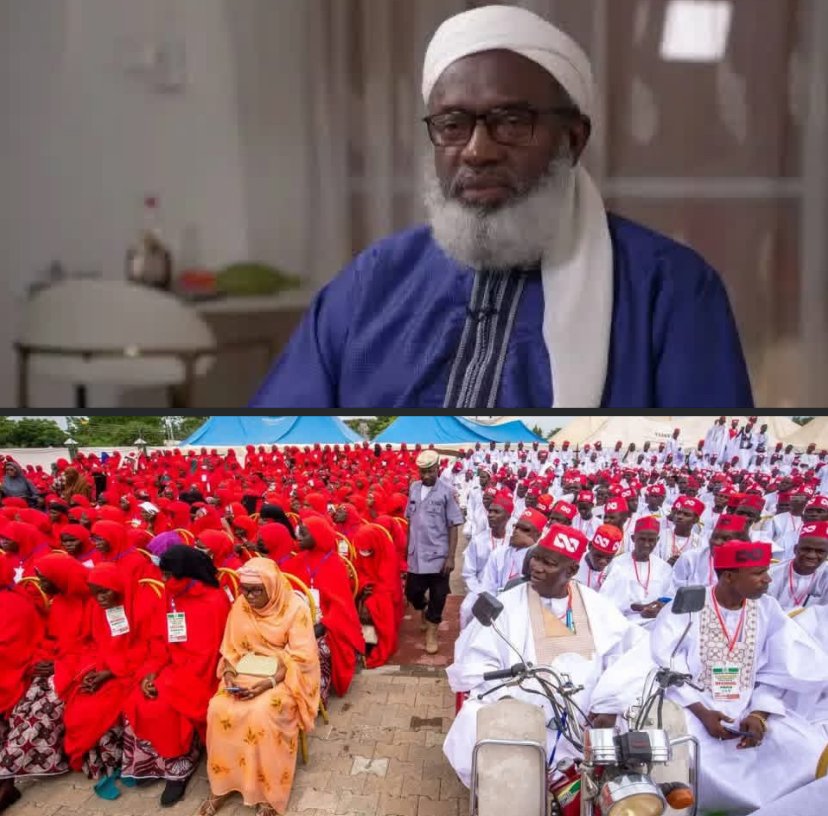
Gumi Defends Public Support for Marriage Under Shariah, Sparks Debate Over Religion, Governance and Use of State Funds!
Sheikh Ahmad Abubakar Gumi, the prominent Kaduna-based Islamic cleric, has defended the use of public resources to support marriage initiatives in communities governed by Islamic principles, arguing that such spending can be legitimate where authorities seek to promote marriage and discourage what he regards as socially harmful alternatives such as promiscuity.
The position has renewed a broader debate in Nigeria over the intersection of religion, public policy and the management of government resources, particularly in states where Shariah-based personal laws operate alongside the country’s constitutional legal framework.
Gumi’s argument is rooted in the Islamic principle that marriage is an important social institution and that governments operating within a Shariah framework can take measures intended to make lawful marriage more accessible. However, the question of whether public funds should be deployed for marriage-related support is ultimately a matter of public policy, budgeting and accountability, and not simply a religious question.
The development is likely to attract attention in northern Nigeria, where high marriage costs, unemployment, poverty and changing social expectations have contributed to growing concern about the ability of young people to establish households.
At the same time, any government expenditure in a religiously diverse country such as Nigeria raises questions about equal treatment, constitutional safeguards, transparency and whether public resources are being used to address clearly defined socioeconomic needs.
Gumi’s Argument on Marriage and Public Policy
Gumi’s position reflects a longstanding argument among some Islamic scholars that governments can support social policies designed to facilitate marriage, particularly where economic hardship is considered a barrier to lawful family formation.
From that perspective, financial assistance for marriage is not necessarily viewed as a private benefit but as a form of social intervention intended to strengthen families and discourage conduct prohibited by Islamic teachings.
The argument becomes particularly relevant in communities where governments already provide social welfare interventions, youth empowerment programmes and other forms of assistance targeted at vulnerable citizens.
However, the use of public money for marriage assistance requires a clear policy framework. Questions arise over eligibility, the size of government allocations, transparency in the selection of beneficiaries and whether assistance should be limited to people who meet specific socioeconomic criteria.
These considerations are important because public funds are ultimately derived from taxpayers and government revenues and are expected to be managed in accordance with applicable laws and approved budgets.
Marriage as a Social Institution
Marriage occupies an important position in Islamic jurisprudence and in Nigerian society more broadly.
For Muslims, marriage is generally regarded as a lawful institution through which families are established and responsibilities between spouses are defined.
Gumi has previously spoken extensively about marriage, divorce and family relations from an Islamic perspective.
In October 2025, for example, he called on Islamic judges and clerics to ensure that women experiencing domestic abuse could obtain divorce without being compelled to pay compensation to abusive husbands. He argued that Islam does not condone oppression within marriage and that both men and women should have access to justice when a marriage becomes harmful.
His earlier interventions demonstrate that his position on marriage extends beyond encouraging people to marry. He has also addressed the responsibilities of husbands, the rights of women and the role of Islamic courts in resolving family disputes.
That broader context is relevant when assessing his latest comments.
Economic Pressure on Young Nigerians
One of the underlying issues in the debate is the rising economic pressure facing young Nigerians.
Marriage often involves significant financial obligations, including housing, food, clothing, healthcare, education and other household expenses. In some communities, families may also face substantial cultural expectations concerning wedding ceremonies and related expenditure.
For young people without stable employment, these costs can delay marriage.
Nigeria’s large youth population makes the issue particularly significant. Youth unemployment, underemployment and the rising cost of living have created difficult conditions for many young adults attempting to establish independent households.
Supporters of government-backed marriage programmes could therefore argue that carefully designed interventions may help economically disadvantaged citizens fulfil their family responsibilities.
Such programmes, however, would need to be designed around measurable socioeconomic objectives rather than religious identity alone.
The Question of Public Funds
The most contentious aspect of the debate is likely to be the use of public funds.
Government resources are finite, and policymakers must balance competing demands involving healthcare, education, security, infrastructure, social protection and employment.
A programme supporting marriage would therefore have to compete for funding with other government priorities.
There is also a distinction between public funding for a social welfare programme and direct government financing of private ceremonies.
A state could, for example, establish a transparent programme offering limited financial assistance to economically vulnerable households without necessarily paying for expensive wedding celebrations.
Such a distinction would be important in determining whether a policy is primarily a welfare intervention or a subsidy for private expenditure.
Nigeria’s public finance framework also requires government spending to be authorised through appropriate budgetary and legal processes.
Consequently, any state considering such a programme would need to explain its legal basis, funding source, eligibility criteria and accountability mechanisms.
Shariah and Nigeria’s Constitutional Framework
The debate also touches on Nigeria’s complex constitutional arrangement.
Several northern states introduced expanded Shariah criminal and civil legal frameworks following the return to democratic rule in 1999. However, Nigeria remains a secular federal republic with constitutional protections for freedom of religion and equal citizenship.
Shariah courts operate within defined areas of jurisdiction, particularly concerning Islamic personal law.
This creates a distinction between applying religious principles within the appropriate legal framework and using public authority in ways that could affect citizens regardless of their religious affiliation.
Any government policy based on religious principles must therefore operate within the Constitution and applicable legislation.
This is particularly important in states with Muslim and Christian communities living alongside followers of traditional beliefs and citizens who do not identify with any religion.
The Need for Inclusive Policy
If public funding for marriage is adopted as a government policy, questions about inclusiveness would become unavoidable.
Would assistance be available only to Muslim couples?
Would non-Muslim residents receive equivalent support?
Would eligibility be determined by religion, income, age, marital status or vulnerability?
These questions matter because government resources belong to the public rather than to a particular religious community.
A policy could potentially be framed as a general social welfare intervention aimed at reducing financial barriers to family formation, while allowing religious communities to conduct their own marriage ceremonies according to their beliefs.
Alternatively, a programme could operate specifically within a Shariah jurisdiction but would still need to comply with constitutional requirements and applicable laws.
The precise structure would therefore determine whether such a policy could command broad public acceptance.
Gumi’s Earlier Criticism of Wasteful Public Spending
Interestingly, Gumi has previously criticised politicians over what he described as wasteful spending of public resources.
In August 2021, following the wedding of former President Muhammadu Buhari’s son, Yusuf Buhari, Gumi criticised politicians who reportedly travelled to the event using private jets.
The cleric questioned the use of public resources for lavish activities while Nigerians faced poverty, insecurity and other socioeconomic difficulties. His comments were reported by The Guardian, Tribune and other Nigerian media organisations.
That history provides an important context for his position on public spending.
His earlier argument was that public resources should be directed towards pressing social needs rather than extravagant personal activities.
The principle could similarly apply to any proposed government marriage programme: public spending would need to demonstrate a clear public benefit and avoid becoming a mechanism for financing private extravagance.
Marriage Assistance Versus Wedding Sponsorship
A key distinction in the current debate is between helping people marry and financing weddings.
The former could involve targeted support for vulnerable people who cannot afford basic requirements associated with establishing a household.
The latter could involve government paying for ceremonies, venues, transportation, entertainment or other expenses associated with wedding celebrations.
The two approaches carry significantly different public-policy implications.
A targeted welfare programme could potentially be justified as an intervention aimed at reducing socioeconomic barriers to marriage.
A programme that finances elaborate ceremonies would face much stronger questions about value for money, fairness and fiscal responsibility.
For this reason, any government considering Gumi’s argument would need to establish clearly what type of marriage-related expenditure is contemplated.
Beyond Religion: The Social Policy Debate
The issue also raises broader questions about the role of government in private life.
Governments routinely intervene in areas traditionally considered private when there is a recognised public interest.
Examples include maternal healthcare, child welfare, housing assistance, education and social protection.
Marriage policy could potentially be viewed through the same lens if government determines that economic barriers to family formation are producing measurable social consequences.
However, the intervention must remain voluntary and respect individual rights.
Government should not pressure adults into marriage or treat marriage as the only acceptable pathway to a fulfilling life.
A modern social policy must also consider women’s rights, protection from forced marriage, domestic violence and the economic independence of spouses.
Protecting Women and Vulnerable People
Any marriage assistance scheme would need safeguards against abuse.
Financial incentives can sometimes create unintended consequences if families or individuals feel pressured to enter marriages for economic reasons.
There would therefore need to be strict requirements around consent and the legal age of marriage.
Protection against forced marriage would also be essential.
Gumi’s own recent comments on abusive marriages demonstrate why marriage policy cannot focus solely on increasing the number of marriages. In his October 2025 intervention, he argued that women trapped in abusive relationships should have access to divorce and protection from oppressive spouses.
That principle would be important if governments were to design marriage-support policies.
Supporting marriage should not mean supporting every marriage regardless of its quality or safety.
Accountability Must Come First
The strongest argument for any publicly funded marriage initiative would ultimately depend on transparency and measurable results.
Governments would need to publish budgets, identify beneficiaries and explain how funds are distributed.
Independent oversight would also be important to prevent political patronage, favouritism or diversion of funds.
Beneficiaries should be selected through clearly established criteria rather than political connections.
Such safeguards would be particularly important in Nigeria, where public expenditure programmes frequently attract scrutiny over accountability and implementation.
A policy intended to strengthen families could lose public confidence if citizens perceive it as another avenue for distributing government patronage.
A Debate That Requires Evidence
Gumi’s intervention has brought religious principles and public policy into direct conversation.
But determining whether government-funded marriage programmes actually reduce promiscuity, delay in marriage or other social problems would require evidence rather than assumptions.
Governments should examine demographic data, household income, marriage trends, youth employment and social welfare outcomes before committing substantial public resources.
Evidence-based policymaking would allow authorities to determine whether marriage assistance produces measurable benefits or whether the same funds could achieve greater social impact through employment, housing or education programmes.
Conclusion
Sheikh Ahmad Gumi’s defence of public funding for marriage under Shariah has opened another chapter in Nigeria’s continuing debate over religion, governance and the use of public resources.
His argument is rooted in the Islamic view that marriage is a legitimate and socially important institution and that governments operating within a Shariah framework may support measures designed to make lawful marriage more accessible and discourage conduct prohibited by Islamic teachings.
But translating that religious principle into public policy requires more than theological justification.
Any government-backed marriage programme would have to address constitutional requirements, fiscal responsibility, equal citizenship, women’s rights, transparency and measurable social outcomes.
The debate should therefore move beyond whether public funding of marriage can be justified religiously and examine the more practical question of how such spending could be structured lawfully, transparently and fairly in a religiously diverse democracy.
Gumi’s previous criticism of extravagant public spending at high-profile weddings also provides an important lesson: if public resources are used to support marriage, the priority should be genuine social welfare rather than political patronage or luxury.
For Wengglobal, the emerging debate underscores the importance of separating religious doctrine from government implementation while giving room for informed discussion about how public policy can respond to Nigeria’s socioeconomic challenges.
Ultimately, the legitimacy of any marriage-support programme will depend not only on its religious rationale but also on the law, the quality of its implementation and whether Nigerians can see a clear and accountable public benefit from the money spent.
Sources
- PUNCH — Reporting on Sheikh Gumi’s position concerning women’s rights to divorce in abusive marriages.
- Peoples Gazette — Report on Gumi’s call for Shariah judges to protect women in abusive marriages.
- The Guardian Nigeria — Previous reporting on Gumi’s criticism of politicians and alleged misuse of public resources at a high-profile wedding.
- Tribune Online — Report on Gumi’s criticism of private-jet spending by politicians attending a presidential family wedding.
- Africa Check — Fact-checking reporting on claims attributed to Gumi concerning Shariah, demonstrating the need to verify statements attributed to the cleric.
- AFP Fact Check — Verification of a manipulated video previously attributed to Sheikh Gumi, highlighting the importance of source verification when reporting his statements.