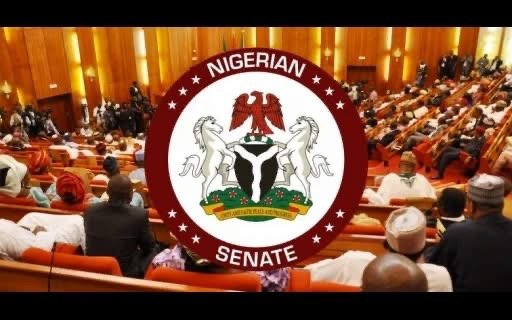
Nigeria’s Senate Steps Up Financial Sector Reforms as Lawmakers Demand Stronger Banks, Better Credit and Tighter Regulation!
Nigeria’s Senate is intensifying efforts to strengthen the country’s financial system, combining closer regulatory oversight with legislative reforms designed to improve banking-sector resilience, expand access to productive credit, protect consumers and modernise the rules governing financial institutions.
The renewed push became more prominent in July 2026 following a statutory engagement between the Senate Committee on Banking, Insurance and Other Financial Institutions and the Governor of the Central Bank of Nigeria (CBN), Olayemi Cardoso. The meeting placed Nigeria’s monetary reforms, banking-sector recapitalisation, foreign-exchange stability, inflation, consumer protection and financial-sector regulation under detailed legislative scrutiny. (The Nation)
The engagement, chaired by Senator Mukhail Adetokunbo Abiru, is part of the Senate’s oversight responsibilities under the CBN Act. Lawmakers acknowledged improvements recorded across several macroeconomic indicators but also pressed the apex bank to ensure that reforms produce tangible benefits for businesses, households and the wider economy.
At the centre of the Senate’s concerns is the need to ensure that stronger banks translate into stronger economic activity.
Senate demands credit for productive sectors
Nigeria’s banking industry has undergone a major recapitalisation programme aimed at strengthening institutions against financial shocks and improving their capacity to support economic growth. According to the CBN, banks raised N4.65 trillion in fresh capital, with domestic investors accounting for 72.55 per cent and foreign investors contributing 27.45 per cent. Thirty-three banks had met the revised capital requirements, according to Cardoso’s July briefing to the Senate. (The Nation)
However, lawmakers have made clear that recapitalisation cannot be judged solely by the size of banks’ balance sheets.
Abiru argued that the ultimate test of a stronger banking sector would be its ability to mobilise savings and channel affordable credit towards productive areas of the economy, including agriculture, manufacturing, infrastructure, technology and small and medium-sized enterprises.
The position reflects a broader economic challenge facing Nigeria. While stronger financial institutions can improve systemic resilience, limited access to affordable credit remains a constraint for many businesses seeking to expand production, invest in equipment or create employment.
The Senate therefore wants the CBN and financial institutions to ensure that the benefits of recapitalisation extend beyond improved capital adequacy and become visible through increased lending to the real sector.
The CBN has similarly stated that its post-recapitalisation priorities include stronger governance, improved risk management and ensuring that additional bank capital supports productive economic activities. (The Nation)
Financial regulation moves beyond traditional banking
The Senate’s reform agenda also extends beyond conventional commercial banking.
Earlier in 2026, lawmakers advanced efforts to amend the Banks and Other Financial Institutions Act (BOFIA), with particular attention to the rapid expansion of fintech and digital financial services.
At a public hearing on the proposed BOFIA amendment, lawmakers rejected calls for the creation of a completely separate regulator for the fintech industry, instead favouring stronger coordination among existing regulators and an expanded role for the CBN in overseeing digital financial institutions. (BusinessDay)
The debate followed concerns over the growth of fraudulent investment platforms and Ponzi schemes, including the collapse of Crypto Bridge Exchange (CBEX). Lawmakers argued that the increasing sophistication of digital finance requires regulators to close supervisory gaps without creating a fragmented regulatory structure.
Under the proposed reforms, qualifying fintech and digital financial institutions could be subjected to stronger risk-based supervision, while measures such as a national registry could improve transparency and regulatory visibility.
The objective is not simply to regulate technology companies more aggressively, but to ensure that innovation does not undermine confidence in Nigeria’s financial system.
Insurance reform forms another pillar
The Senate’s financial-sector agenda has also reached the insurance industry.
In July, the upper chamber passed the Insurance Regulatory Commission Bill, 2025, which seeks to repeal and replace the National Insurance Commission (NAICOM) Act of 1997. The proposed legislation would rename NAICOM as the Insurance Regulatory Commission and strengthen its independence, supervisory authority, corporate governance framework and consumer-protection mechanisms. (The Nation)
The proposed framework is intended to bring insurance regulation closer to contemporary international standards while giving the regulator stronger powers to intervene in distressed institutions and protect policyholders.
The reform is significant because insurance represents an important component of financial-system stability. A well-regulated insurance market can mobilise long-term funds, protect businesses and households against financial shocks and support investment.
The Senate’s move therefore suggests that lawmakers increasingly view financial-system reform as a broad exercise involving banks, insurers, fintech companies, capital markets and other financial institutions rather than banking alone.
CBN highlights progress but acknowledges continuing risks
During the July statutory briefing, Cardoso told lawmakers that Nigeria’s economy had become more resilient despite global uncertainties, including geopolitical tensions, trade fragmentation and supply-chain disruptions. (The Guardian Nigeria)
The CBN has pointed to improvements in foreign-exchange market stability, external reserves, banking-sector resilience and market infrastructure as evidence of progress.
The apex bank reported that external reserves stood at $52.73 billion as of July 9, 2026, compared with $48.88 billion in January. Cardoso also said the CBN was targeting monthly diaspora remittances of $1 billion through official channels before the end of the year. (The Nation)
The bank has also identified implementation of the Payments System Vision 2028, deeper foreign-exchange reforms, post-recapitalisation supervision, cybersecurity and the restoration of price stability as priorities for the second half of 2026. (Central Bank of Nigeria)
These reforms come against the backdrop of efforts to moderate inflation and improve confidence in the naira and financial markets.
Nevertheless, lawmakers have maintained that improvements in headline indicators must be accompanied by greater transparency, stronger consumer protection and easier access to finance.
Oversight remains central to the Senate’s approach
The Senate’s engagement with the CBN also involved scrutiny of the apex bank’s 2025 audited financial statements and questions surrounding liquidity management, Open Market Operations, Ways and Means advances and other financial arrangements.
According to The Nation, lawmakers sought clarification on the increase in outstanding OMO obligations, rising liquidity-management costs and the treatment of Federal Government Ways and Means advances. (The Nation)
Such scrutiny underscores the distinction between supporting economic reforms and providing institutional oversight. While the Senate has commended the CBN for progress in monetary and financial-sector management, lawmakers have also signalled that regulators must remain accountable for the policies and financial decisions that affect the wider economy.
The approach is particularly important in a financial system where monetary policy, banking regulation, fiscal operations and capital-market activity are closely interconnected.
The Senate has also taken steps involving other institutions within the financial architecture. In July, it confirmed Lamido Yuguda as Chairman of the Asset Management Corporation of Nigeria (AMCON), an institution established to help resolve distressed assets and non-performing loans in the banking sector. (National Accord Newspaper)
The confirmation comes as AMCON continues to manage legacy assets and recover outstanding debts, with its statutory lifespan expected to end around 2030.
The challenge ahead
For Nigeria, the success of the Senate’s financial-system reform agenda will ultimately depend on implementation.
Stronger laws and regulatory institutions can improve transparency, reduce systemic risks and strengthen investor confidence, but their effectiveness will depend on consistent enforcement, institutional independence and cooperation between policymakers and regulators.
The financial sector must also respond to changing risks created by digital payments, fintech innovation, cybersecurity threats and increasingly sophisticated financial fraud.
The Senate’s current approach indicates a desire to build a regulatory framework capable of responding to those changes while maintaining financial inclusion and encouraging investment.
For businesses and households, however, the most important measure will remain whether reforms improve access to affordable credit, strengthen confidence in financial institutions and reduce disruptions in financial services.
Nigeria’s financial-system reforms are therefore entering a phase in which stability alone may no longer be sufficient. The next test is whether stronger institutions, improved regulation and increased bank capital can translate into broader economic opportunity.
As the Senate continues its legislative and oversight functions, the direction of the reforms points towards a financial architecture designed to be more resilient, digitally responsive, transparent and capable of supporting sustainable economic growth.
Sources
- The Nation — CBN presents economic outlook to Senate
- The Guardian Nigeria — Nigeria’s economy withstanding global shocks, Cardoso tells Senate
- BusinessDay — Senate expands CBN’s oversight powers to fintech
- TheCable — Senate moves to amend BOFIA, begins probe of Ponzi schemes
- The Guardian Nigeria — Senate passes bill to strengthen insurance regulation
- Central Bank of Nigeria — CBN reforms and initiatives