Reported by Simon yusuph,| Journalist at wengglobal
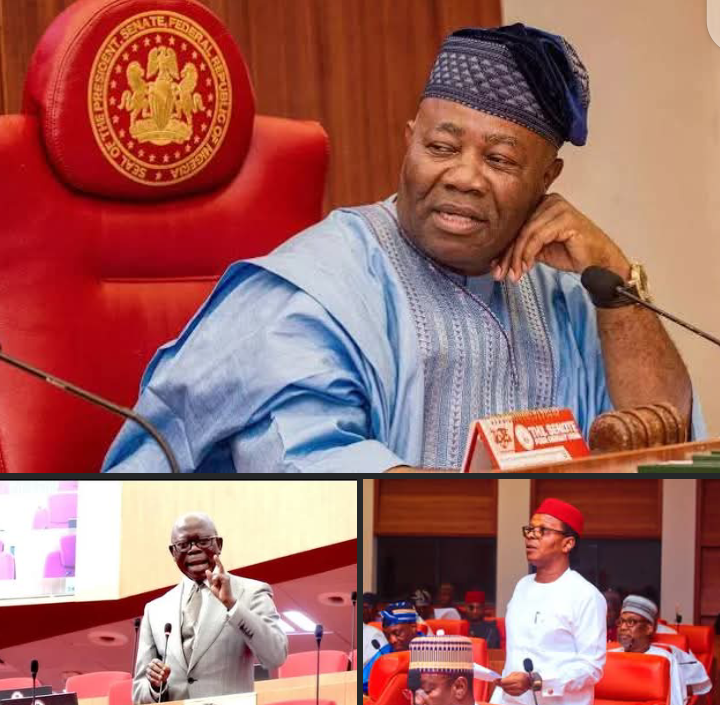
Nigeria’s Senate President, Godswill Akpabio, has publicly cautioned two senior lawmakers Senators Adams Oshiomhole and Patrick Ndubueze over what he described as breaches of the Senate’s Standing Orders during plenary, underscoring the importance of discipline, order, and respect for parliamentary procedures in the nation’s highest legislative chamber.
The intervention, which took place during a recent Senate session, highlighted the leadership’s determination to enforce institutional rules irrespective of the status or influence of individual lawmakers. Akpabio reminded members that the credibility of the National Assembly depends not only on the quality of legislation it produces but also on lawmakers’ commitment to established parliamentary procedures.
Addressing Senator Patrick Ndubueze, Akpabio urged him to familiarize himself with the Senate’s rules and conduct himself in a manner that reflects the standards expected of a federal legislator.
“You must follow the Senate rules and set an example,” Akpabio said during plenary, stressing that members should avoid actions capable of disrupting legislative proceedings or undermining the dignity of the chamber.
The Senate President also directed similar remarks at former Edo State Governor and Senator Adams Oshiomhole, emphasizing that all senators regardless of experience, political standing, or previous public office are equally bound by the Senate’s Standing Orders.
Reinforcing Parliamentary Discipline
The incident occurred during deliberations when procedural disagreements reportedly interrupted proceedings. Akpabio intervened to restore order, reminding lawmakers that parliamentary debates must follow laid-down procedures, including recognition by the presiding officer before contributions are made.
Legislative chambers across democratic systems rely on standing rules to regulate debates, motions, voting procedures, and members’ conduct. These frameworks are designed to ensure fairness, orderly deliberations, and efficient decision-making.
Observers note that enforcing these rules consistently helps preserve public confidence in legislative institutions while preventing disorder that could delay important national business.
Akpabio’s remarks reflected a broader message that leadership within the Senate requires lawmakers to model discipline and respect for institutional processes.
Senate Leadership Stresses Institutional Integrity
Since assuming office as Senate President, Akpabio has repeatedly emphasized the need for lawmakers to prioritize legislative responsibility over personal or partisan disagreements.
His latest intervention reinforces the Senate leadership’s position that adherence to procedure is essential for maintaining the integrity of parliamentary debates and ensuring that legislative decisions are reached transparently and democratically.
Political analysts say moments such as these demonstrate the balancing role of the Senate President facilitating robust debate while ensuring that proceedings remain orderly and compliant with established rules.
Although disagreements are a natural feature of parliamentary democracy, legislative experts argue that adherence to procedural guidelines allows differing viewpoints to be expressed without compromising institutional order.
Importance of Senate Standing Orders
Nigeria’s Senate Standing Orders provide the legal and procedural framework governing debates, motions, committee reports, points of order, and members’ conduct during plenary.
The rules also define how senators may seek recognition to speak, challenge procedural issues, introduce legislation, and participate in debates. Compliance with these procedures helps ensure equal participation among lawmakers while preventing unnecessary disruptions.
Parliamentary experts have long argued that respect for legislative rules strengthens democratic governance by promoting accountability, transparency, and consistency in decision-making.
For newly elected senators, understanding these procedures is considered a critical aspect of effective legislative performance. For more experienced lawmakers, continued compliance reinforces institutional stability and public trust.
Broader Significance for Nigeria’s Democracy
The exchange during plenary comes at a time when public attention remains focused on the performance of Nigeria’s National Assembly, particularly regarding legislative oversight, lawmaking, and governance reforms.
Political observers believe that visible enforcement of parliamentary discipline sends an important message about institutional accountability. By applying the rules uniformly, Senate leadership demonstrates that no member is above established legislative procedures.
Such interventions also contribute to strengthening democratic institutions by reinforcing the principle that governance must be guided by rules rather than personalities.
As Nigeria continues to address complex economic, security, and governance challenges, the effectiveness of the National Assembly remains central to policy development and democratic accountability.
The Senate’s ability to conduct its business efficiently depends significantly on lawmakers’ willingness to observe parliamentary procedures, respect the authority of the presiding officer, and engage constructively during debates.
Looking Ahead
While the exchange between Akpabio, Oshiomhole, and Ndubueze attracted public attention, analysts say it ultimately reflects the routine enforcement of parliamentary standards rather than an extraordinary political dispute.
Maintaining discipline during plenary remains a fundamental responsibility of the Senate President, whose role includes preserving order, ensuring fairness, and protecting the integrity of legislative proceedings.
As the Senate continues deliberations on critical national issues, adherence to institutional rules is expected to remain a key pillar of effective lawmaking and democratic governance.
For Nigerians, the episode serves as a reminder that strong democratic institutions are built not only on legislation but also on respect for procedures, accountability, and the rule of law.
Sources
- Channels Television
- Premium Times Nigeria
- The Punch
- Vanguard Nigeria
- Daily Trust