Reported by Simon yusuph,| Journalist at wengglobal
Unannounced Visit Highlights Attendance Concerns as Jigawa Government Reinforces Commitment to Efficient Civil Service
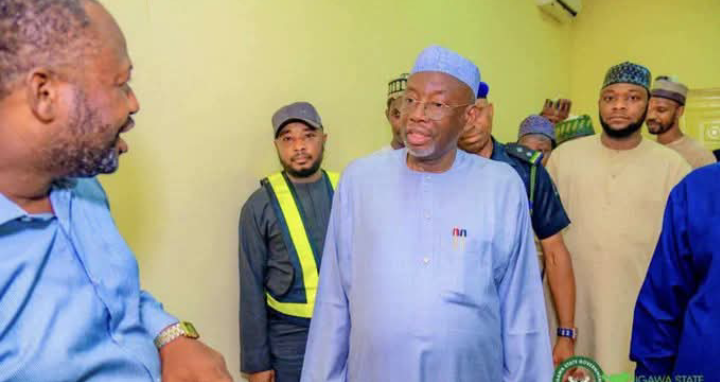
Governor Umar Namadi of Jigawa State has reportedly carried out an unannounced inspection of the State Secretariat, a move that has drawn widespread public attention after reports emerged that several senior government officials were absent from their duty posts during the visit.
The surprise inspection, which has since circulated widely through video clips on social media, underscores the governor’s stated commitment to improving accountability, discipline, and efficiency within the state’s public service. Although the full circumstances surrounding the officials’ absence have yet to be officially clarified, the development has sparked conversations about workplace discipline, public sector reforms, and the importance of effective governance.
The visit forms part of broader efforts by the Jigawa State Government to strengthen institutional performance and ensure that government ministries, departments, and agencies deliver quality services to residents.
Surprise Inspection Sends Strong Administrative Message
According to reports, Governor Namadi arrived at the State Secretariat without prior notice during official working hours. During the inspection, he reportedly visited several offices to assess staff attendance and workplace activities.
Preliminary accounts indicate that a number of senior officials were not present when the governor arrived. While the identities of all those affected have not been officially confirmed, the incident has generated significant public interest and renewed discussions on accountability within government institutions.
The governor’s visit is widely viewed as an administrative exercise intended to reinforce professionalism across the state civil service rather than merely identify absenteeism.
Government officials have yet to release a comprehensive report detailing the outcome of the inspection, possible explanations for the absences, or any administrative actions that may follow.
Commitment to Public Service Reform
Since assuming office, Governor Umar Namadi has consistently emphasized the need for a more productive, transparent, and responsive public service.
Observers note that effective governance depends not only on policy formulation but also on the day-to-day performance of civil servants responsible for implementing government programmes.
Routine monitoring exercises—including unannounced inspections—have increasingly become management tools employed by public administrators across Nigeria to evaluate staff attendance, improve service delivery, and strengthen institutional accountability.
Such inspections are generally intended to identify operational gaps while encouraging greater discipline among public officials entrusted with managing government responsibilities.
Accountability Remains Central to Governance
Public administration experts argue that attendance and punctuality are fundamental components of effective governance.
Government offices serve as the primary point of interaction between citizens and the state. Delays caused by absenteeism can affect the delivery of essential services, including documentation, public approvals, project implementation, financial administration, and policy execution.
Consequently, many state governments have adopted stricter monitoring mechanisms designed to improve productivity within the civil service.
Analysts say surprise inspections can encourage greater compliance with workplace regulations, although they also stress the importance of ensuring that any disciplinary measures follow established civil service rules and provide affected officials with an opportunity to explain legitimate reasons for their absence.
Citizens React to Viral Video
Videos circulating on social media platforms have generated mixed reactions from Nigerians.
Many citizens praised the governor’s decision to personally assess attendance at government offices, describing the exercise as evidence of leadership involvement in administrative oversight.
Others called for similar accountability measures across ministries, departments, and agencies nationwide, arguing that public servants should remain accessible during official working hours.
Some observers, however, urged caution against drawing conclusions solely from short video clips, noting that some officials may have been attending official assignments outside their offices, participating in scheduled meetings, conducting field inspections, or carrying out other government responsibilities.
These perspectives highlight the need for comprehensive official findings before definitive conclusions are reached.
Civil Service Efficiency and Development
Efficient public institutions play a vital role in economic growth, investment confidence, and social development.
International governance experts consistently identify transparency, accountability, punctuality, and institutional efficiency as key indicators of effective government.
For Nigerian states pursuing ambitious development programmes, ensuring that government offices operate efficiently remains essential to achieving policy objectives.
Improved staff attendance can accelerate administrative processes, reduce delays experienced by citizens, and strengthen public confidence in government institutions.
Administrative Oversight Becoming More Common
Across Nigeria, governors and public sector administrators have increasingly adopted performance-monitoring strategies to improve service delivery.
These include digital attendance systems, performance evaluations, monitoring visits, public service reforms, and workplace inspections.
Such measures are intended not only to improve accountability but also to enhance institutional effectiveness by ensuring that public resources are utilized efficiently.
Governance specialists note that successful reforms require both accountability mechanisms and continuous capacity building, enabling civil servants to perform their responsibilities effectively while maintaining professional standards.
Awaiting Official Government Position
As of the time of publication, the Jigawa State Government has not released a detailed official statement outlining the complete findings of the inspection or confirming whether any disciplinary procedures will be initiated.
Further clarification is expected regarding the reasons behind the reported absences, the identities of affected officials where appropriate, and any administrative recommendations arising from the visit.
Wengglobal will continue to monitor developments and provide verified updates as more official information becomes available.
The incident has nevertheless renewed national discussions about accountability in public administration and the importance of maintaining an efficient civil service capable of delivering timely services to citizens.
As governments across Africa continue implementing governance reforms, initiatives aimed at improving transparency, workplace discipline, and institutional performance remain central to strengthening public trust and achieving sustainable development.
Sources
- Jigawa State Government official communications (where available)
- Daily Trust
- Premium Times Nigeria
- Channels Television
- The Punch
- Leadership Newspaper
- Nigerian Television Authority (NTA)