Reported by Simon Daniel Yusuph l Journalist at Weng Global
Flour Mills of Nigeria (FMN), through its agricultural subsidiary, Great Agri Input Limited (GAIL), has launched a programme targeting the cultivation of 10,000 hectares of wheat across approximately 13 states during the 2026/2027 planting season, as the company intensifies efforts to strengthen domestic production and reduce Nigeria’s dependence on imported wheat.
The programme is being implemented in collaboration with the Bank of Agriculture (BOA), which is serving as its financial partner, while the Flour Millers Association of Nigeria (FMAN) is also supporting the initiative.
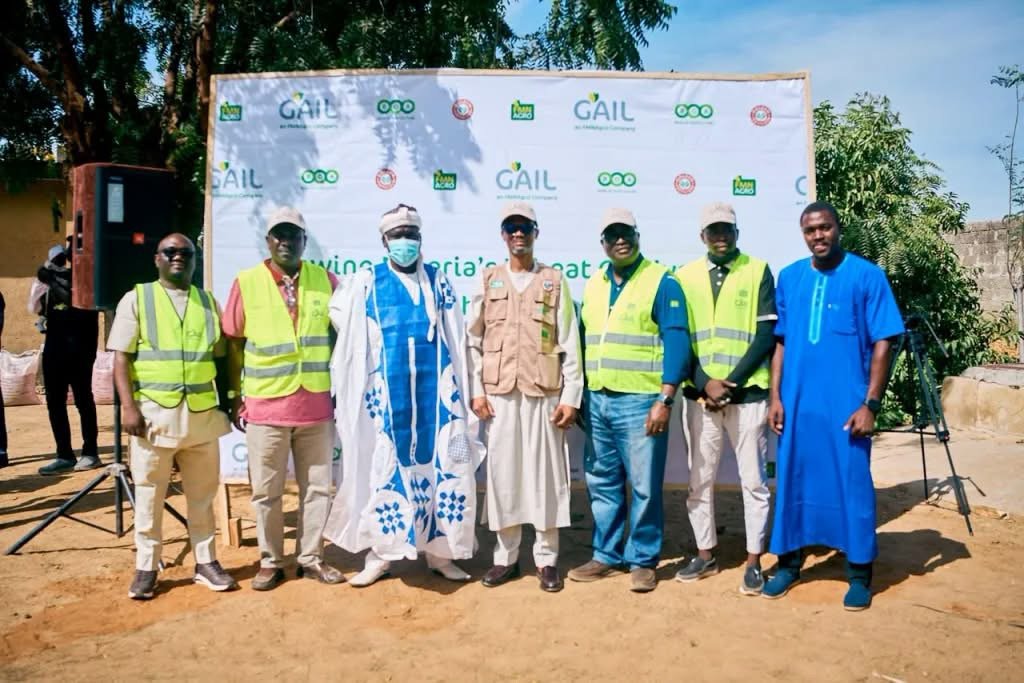
The planting season was officially launched in Taura Maje, Jigawa State, on November 10, 2026, with farmers receiving agricultural inputs to support cultivation.
The initiative is designed to expand the participation of smallholder farmers, improve access to quality seeds and fertilisers, and strengthen the local wheat supply chain.
Although the programme has a target of supporting cultivation across 10,000 hectares, the figure represents an intended area for the season, not a confirmed record of land already cultivated or wheat harvested.
Jigawa launch marks expansion of wheat cultivation programme
The flag-off ceremony in Taura Maje brought together farmers, community leaders, agricultural cooperatives, representatives of FMN and the Bank of Agriculture, as well as other stakeholders in the agricultural sector.
The distribution of agricultural inputs marked the beginning of the new planting season and formed part of efforts to provide participating farmers with resources needed to establish their farms.
The programme is expected to operate across about 13 states, building on existing agricultural partnerships and farmer-support arrangements developed by FMN through GAIL.
Speaking on the initiative, Sadiq Usman, Managing Director of FMN Agro and Group Director for Strategic Engagement and Partnership, said the company was continuing its efforts to strengthen Nigeria’s agricultural production capacity.
He explained that FMN’s local-content strategy extended beyond wheat to other agricultural commodities, including maize, soybeans, sugar cane, cassava and palm products.
According to him, wheat remains an important raw material for the company’s manufacturing operations, making increased domestic production a significant part of its agricultural investment strategy.
Through GAIL, the company provides improved seeds, agronomic support, partnerships and market access intended to encourage farmers to cultivate wheat locally.
The programme is also designed to connect agricultural production with industrial demand, ensuring that farmers have access to buyers for their harvests.
Bank of Agriculture provides financial partnership
Access to finance remains one of the major challenges facing smallholder farmers in Nigeria, particularly those seeking to expand production or adopt improved agricultural methods.
The partnership with the Bank of Agriculture is intended to address part of this challenge by supporting farmers and strengthening the financial arrangements required to expand wheat cultivation.
Speaking on behalf of the bank’s Managing Director and Chief Executive Officer, Ayo Sotinrin, the North-West Zonal Manager, Abdulrazaq Datti Salihi, said the institution was committed to supporting domestic wheat production.
He explained that the bank’s financing interventions were intended to improve farmers’ access to essential resources and support the development of local agricultural value chains.
The collaboration brings together FMN’s agricultural expertise and market connections with the Bank of Agriculture’s financing role.
This arrangement is particularly important because farmers require more than seeds and fertilisers to achieve successful harvests. They also need access to working capital, machinery, technical guidance, storage facilities and reliable buyers.
The extent to which the partnership can deliver these services across the targeted states will be an important factor in determining the programme’s results.
More than 170,000 farmers reached through previous interventions
FMN said its wheat development efforts have recorded progress over the past five years, with more than 170,000 farmers benefiting from training, agricultural input support, extension services and produce off-take arrangements.
The company also attributed more than 300,000 direct and indirect youth jobs to its wider agricultural support activities.
These figures were provided as part of the company’s account of its agricultural development programme and were not independently audited figures presented in the announcement.
A central component of the strategy is the outgrower model, which connects smallholder farmers with agricultural inputs, training, technical assistance and market opportunities.
Under this arrangement, farmers receive support to improve production while gaining access to a structured market for their harvested crops.
The model is intended to reduce some of the difficulties associated with producing wheat independently, particularly the uncertainty surrounding access to buyers and the cost of essential farm resources.
For local millers, the arrangement could also help improve the reliability of domestic wheat supplies.
However, the long-term success of the model will depend on consistent financing, effective extension services, competitive farm-gate prices and the ability of farmers to achieve profitable yields.
Local wheat seed production records significant growth
Another area highlighted by FMN is the expansion of local wheat seed production.
The company reported that domestic seed production under its programme increased from 572 metric tonnes during the 2021/2022 season to 6,500 metric tonnes in 2025/2026.
The increase is significant because access to suitable, high-quality seeds is essential to improving agricultural productivity.
Farmers require varieties that can perform under local growing conditions and produce grain that meets the quality requirements of processors.
FMN also reported that more than 30 mechanisation partners have supported cultivation activities covering over 8,000 hectares during the last three years.
Mechanisation can help farmers reduce the time and labour required for land preparation, planting and other farm operations.
The company further highlighted the adoption of the Borlaug wheat variety and the introduction of three additional high-yielding varieties suited to Nigeria’s climatic conditions.
The use of improved varieties, combined with appropriate fertiliser application, irrigation and agronomic practices, could contribute to better yields.
Nevertheless, seed availability alone cannot guarantee increased production. Farmers must also have access to reliable water supplies, suitable land, extension services and affordable production inputs.
Nigeria’s dependence on imported wheat remains a major challenge
The expansion of domestic wheat production comes against the background of Nigeria’s substantial dependence on imported grain.
Wheat is an important raw material for the country’s food-processing industry. It is used in producing bread, pasta, noodles, biscuits, cakes and other widely consumed products.
Nigeria’s demand for wheat has remained significantly higher than domestic production, leaving flour millers dependent on international suppliers.
In October 2026, Minister of State for Industry, Trade and Investment, John Enoh, said Nigeria consumed approximately six million metric tonnes of wheat annually.
He also stated that the country’s flour mills were operating at about half of their production capacity, identifying inadequate domestic wheat supply and other operating costs as challenges facing the wheat-based food industry.
The United States Department of Agriculture’s Foreign Agricultural Service has also projected substantial wheat imports for Nigeria in the 2026/2027 marketing year, reflecting the continuing gap between domestic production and national consumption.
This dependence exposes Nigeria’s food-processing industry to international price movements, exchange-rate pressures, shipping costs and disruptions in global grain supply.
When imported wheat becomes more expensive, local millers may face higher production costs, which can eventually affect the prices of flour and wheat-based food products.
Expanding domestic production could help reduce some of these pressures by increasing the availability of locally sourced raw materials.
However, the proposed 10,000-hectare programme is only one part of the wider production challenge. Its contribution must be considered alongside national production levels, consumption requirements and the scale of imports.
Wheat cultivation offers opportunities for northern farming communities
The 2026/2027 programme also has implications for farming communities in northern Nigeria, where dry-season wheat cultivation has become an important part of agricultural development efforts.
States with suitable climatic conditions and access to irrigation can support wheat production during the dry season.
Jigawa, where the programme was launched, is among the northern states with established agricultural activity and opportunities for expanding irrigated farming.
The Central Bank of Nigeria has previously identified several states with potential for wheat cultivation, including Plateau, Taraba and Cross River for highland rain-fed production.
The CBN’s wheat intervention strategy has also emphasised improved seeds, expanded cultivated land, farmer training and collaboration with relevant stakeholders.
These efforts reflect the importance of adapting wheat production to Nigeria’s different ecological conditions rather than relying on a single farming model.
For farmers, the availability of improved inputs and reliable markets could create opportunities to diversify their crops and earn additional income.
For young people, the expansion of production could also support employment in farm mechanisation, input distribution, aggregation, transportation, storage and processing.
However, the economic benefits will depend on whether farmers can make sufficient returns after accounting for land preparation, irrigation, fertiliser, labour, machinery and transportation costs.
Why the programme matters to Nigeria’s food security
Nigeria’s food security depends not only on the availability of food but also on the country’s capacity to produce, process, distribute and afford essential commodities.
Wheat is particularly important because of its role in the country’s food-processing industry and the widespread consumption of products made from wheat flour.
Increasing local production could strengthen the connection between farmers and domestic processors, creating a more integrated agricultural value chain.
It could also provide a market for locally produced seeds, fertilisers and agricultural machinery while supporting businesses involved in storage and distribution.
For the government, stronger domestic production could contribute to efforts to reduce exposure to imported food commodities and international supply disruptions.
Nevertheless, local production should not be viewed as an immediate replacement for imports. Nigeria’s annual wheat requirements remain considerably larger than the output that a single private-sector programme can deliver.
The wider objective must therefore include sustained improvements in productivity, irrigation infrastructure, seed development, agricultural financing and market access.
Challenges that could affect the 10,000-hectare target
Despite the opportunities, the programme will face several practical challenges common to agricultural production in Nigeria.
Access to irrigation is one of the most important considerations for dry-season wheat farming. Farmers need dependable water supplies to maintain crop development, particularly in areas where rainfall is limited during the planting period.
The cost and availability of fertilisers, improved seeds, pesticides and machinery can also affect the size of land farmers are able to cultivate.
In addition, post-harvest storage and transportation remain important concerns. Poor handling and inadequate storage can reduce grain quality and increase losses before produce reaches processors.
Market access is another critical factor. Farmers are more likely to expand production when they have confidence that their harvests will attract competitive prices and reliable buyers.
The involvement of FMN and the Bank of Agriculture could help address some of these constraints through technical support, financing and produce off-take arrangements.
However, the effectiveness of the intervention will depend on how consistently these services reach farmers across all participating states.
What happens next?
With the 2026/2027 planting season formally launched, GAIL and its partners are expected to continue distributing agricultural inputs and supporting farmers across the targeted locations.
The immediate priority is to translate the 10,000-hectare ambition into actual cultivation, while ensuring that participating farmers receive the technical and financial assistance required throughout the production cycle.
The next important measure of progress will be the amount of land successfully cultivated, the quantity of wheat harvested and the proportion of the produce that enters Nigeria’s domestic supply chain.
The programme’s results will also help determine whether the existing farmer-support model can be expanded in subsequent planting seasons.
For Nigeria, the wider challenge is to move beyond seasonal cultivation targets towards a sustainable domestic wheat industry capable of supplying a greater share of the country’s demand.
FMN’s latest initiative represents another private-sector effort in that direction. Its long-term significance, however, will be determined by measurable improvements in production, farmer incomes and the availability of locally grown wheat for Nigerian processors.
Weng Global – stories beyond borders
Sources
- The Guardian Nigeria – Report on FMN’s 10,000-hectare wheat cultivation target, November 10, 2026.
- Vanguard – Report on GAIL’s 2026/2027 wheat planting season launch, November 10, 2026.
- ThisDay – Report on the wheat cultivation programme across approximately 13 states, November 10, 2026.
- Central Bank of Nigeria – Wheat Value Chain Intervention Strategy.
- United States Department of Agriculture, Foreign Agricultural Service – Nigeria Grain and Feed Annual Report, 2026.
- The Sun Nigeria – Report on Nigeria’s wheat demand and flour milling capacity, October 15, 2026.
- African Development Bank – Report on wheat production and farmer support in Nigeria.