Reported by Simon Daniel Yusuph l Journalist at Weng Global
The Chief of the Naval Staff, Vice Admiral Idi Abbas, has commended Abia State Governor Alex Otti for supporting infrastructure development at the Nigerian Navy College of Accounts and Finance in Owerrinta, saying the improvements will strengthen training, accessibility and the welfare of personnel.
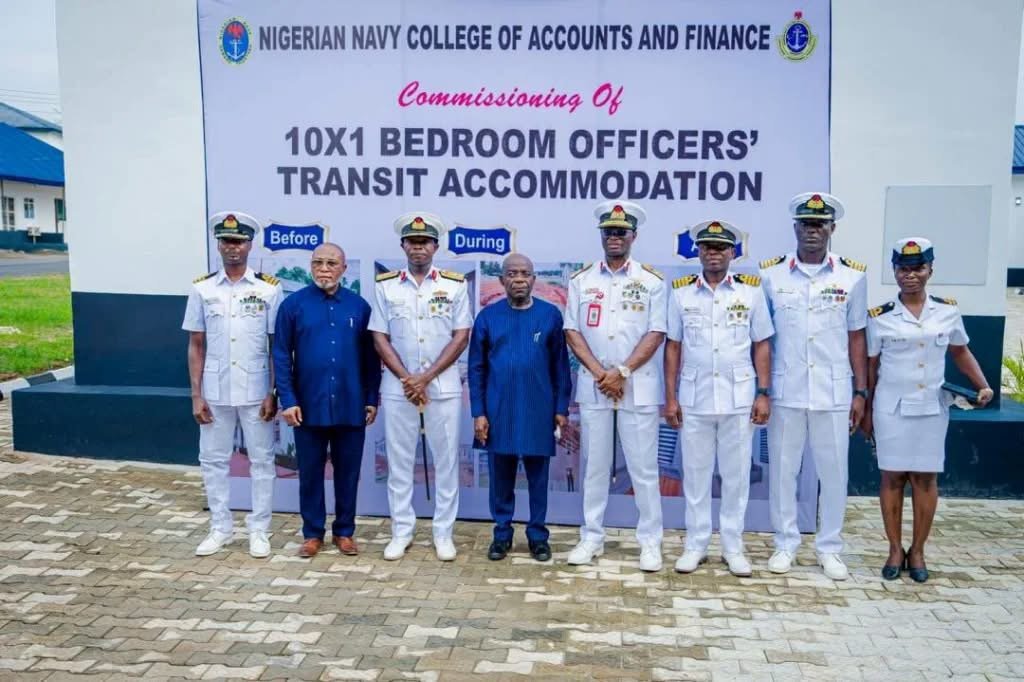
The commendation followed the commissioning of four infrastructure projects at the naval institution on Monday, October 26, 2026. The projects include resurfaced parade grounds and paved internal roads funded by the Abia State Government, alongside a reconstructed swimming pool and a 10-unit accommodation building for junior officers undertaken by the Nigerian Navy.
Abbas, who was represented at the event by the Flag Officer Commanding, Naval Training Command, Rear Admiral Ebiobowei Zipele, acknowledged the importance of cooperation between the state government and the military in improving the facilities needed for professional training and effective service delivery.
The development highlights a growing area of cooperation between state governments and federal security institutions, particularly in providing infrastructure and logistical support intended to strengthen security operations and improve personnel welfare.
The event also provided an opportunity for discussions about the proposed establishment of a naval base at Azumini in Abia State, which the state government sees as a potential security component of its planned seaport project.
Four Infrastructure Projects Unveiled at Naval College
The projects commissioned at the Nigerian Navy College of Accounts and Finance, Owerrinta, comprise improvements intended to support the institution’s training activities, internal movement and accommodation needs.
According to reports on the commissioning, the Abia State Government funded the paving of previously unpaved sections of the college’s internal roads and provided equipment and technical personnel for resurfacing its parade ground.
The Nigerian Navy undertook the reconstruction of the swimming pool and the construction of a 10-unit, one-bedroom transit accommodation building for junior officers.
The improvements address different aspects of the institution’s operations. Better internal roads can improve movement within the college, while a properly maintained parade ground provides a more suitable environment for military drills, ceremonies and other organised activities.
The accommodation building is intended to provide transit housing for junior officers, while the reconstructed swimming pool is expected to support swimming proficiency tests and related training requirements.
The Nigerian Navy has not publicly detailed the full financial value of the projects in the reports available for this article. Consequently, the total expenditure and the relative contributions of the state government and the Navy cannot be independently established from the available information.
Nevertheless, the division of responsibilities reflects a practical form of collaboration: the state government supported selected infrastructure works, while the Navy provided other facilities linked to its institutional needs.
Naval Chief Emphasises Maintenance and Effective Use
Representing the Chief of the Naval Staff, Rear Admiral Zipele urged the management of the college to ensure that the new and improved facilities were properly maintained and put to effective use.
His message places responsibility on the institution to preserve the value of the investments beyond the commissioning ceremony.
Infrastructure projects require regular maintenance to remain useful. Roads can deteriorate, buildings need routine repairs, and specialised training facilities require appropriate management and safety procedures.
For a military training institution, these responsibilities are especially important because facilities must remain suitable for repeated use by personnel and trainees.
Zipele also reaffirmed the Nigerian Navy’s readiness to work with the Abia State Government within applicable legal and operational frameworks to promote peace, stability and security.
The statement points to the importance of cooperation between federal security agencies and state authorities while recognising that military operations remain subject to the relevant institutional responsibilities and legal requirements.
Although infrastructure support can improve working conditions, its broader value depends on how effectively the facilities are integrated into the college’s training and administrative activities.
College Management Says Facilities Will Improve Training
The Commandant of the Nigerian Navy College of Accounts and Finance, Commodore Babatunde Quadri, commended the Abia State Government for supporting the improvements to the college’s internal roads and parade ground.
Quadri described the intervention as evidence of the state government’s willingness to strengthen its relationship with the Nigerian Navy and support infrastructure development at the institution.
The college’s Training Commander, Navy Captain Mohammed Umar, also outlined the practical benefits expected from the projects.
According to reports of his remarks, the improved roads and parade ground would support training and movement within the college, while the reconstructed swimming pool would assist swimming proficiency assessments. The new transit accommodation is expected to improve welfare arrangements for junior officers.
These functions are relevant to the college’s role in developing personnel for specialised duties within the Navy.
Military institutions depend on more than classrooms and instructors. Their effectiveness also relies on appropriate accommodation, training grounds, internal transport routes and facilities that allow personnel to undertake the activities required by their service.
The extent to which the improvements produce lasting benefits will depend on their maintenance, availability and integration into the college’s regular training programme.
Otti Reaffirms Support for Federal Institutions in Abia
Governor Otti used the event to reaffirm his administration’s commitment to supporting federal institutions and security agencies operating in Abia State.
He explained that the government’s intervention at the naval college followed the institution’s identification of infrastructure needs. The administration viewed the support as part of a wider approach to cooperation with public institutions serving residents of the state.
Otti’s position is that the ownership of a facility should not prevent the state government from considering assistance when an intervention can benefit the public.
Federal agencies, including security institutions, operate across Nigeria’s states but may depend on cooperation with state authorities for certain infrastructure, logistics and local coordination needs.
Such partnerships can help address gaps that might otherwise affect the delivery of public services. However, they also require clarity about responsibilities, funding arrangements and the long-term maintenance of facilities.
The governor’s remarks reflected the administration’s stated intention to continue supporting federal institutions when necessary, irrespective of whether they are owned or managed by the state or federal government.
He also commended the Navy for its cooperation with the state government’s efforts to tackle insecurity and encouraged security agencies to sustain their work to protect lives and property.
The available reports do not provide a comprehensive account of all federal institutions that have received support from the Abia State Government or the total expenditure involved in such interventions.
Proposed Naval Base at Azumini Linked to Planned Seaport
Beyond the infrastructure projects at Owerrinta, the event featured discussions about a proposed naval base at Azumini, which the state government considers important to the security of its planned seaport.
Otti said the feasibility studies for the proposed seaport were encouraging and expressed confidence that the project could become a reality. He accepted the Navy’s proposal for a base in Azumini to help strengthen security around the planned maritime facility.
The Chief of the Naval Staff, through his representative, expressed the Navy’s interest in supporting the proposed seaport through a naval presence in the area.
According to reports of the event, the proposed base could form part of efforts to secure the seaport and associated transport infrastructure. However, the proposal would require further assessment of operational requirements, the security environment, logistics, personnel, infrastructure and funding.
The proposed base should therefore be understood as a development under consideration, rather than an operational naval facility already established at Azumini.
A final implementation timeline, confirmed construction budget and detailed operational plan were not established in the reports available for this article.
The proposal nevertheless connects the state government’s infrastructure agenda with a wider question: how security arrangements would support a major maritime project if the planned seaport proceeds.
Why Security Infrastructure Matters to Economic Development
Seaports can support economic activity by facilitating the movement of goods, connecting businesses to markets and creating demand for transport, logistics and related services. Their success, however, depends on more than the construction of physical facilities.
A port also requires dependable transport connections, efficient administration, appropriate maritime security arrangements and the capacity to manage the risks associated with commercial activity.
A naval base near a proposed seaport could, subject to operational planning and approval, contribute to security arrangements around maritime and inland-waterway activities. The precise role of such a facility would depend on the Navy’s assessment of local risks and its wider operational priorities.
For Abia State, the proposal is significant because it links security planning with a potential infrastructure project that could affect trade and investment.
However, the economic benefits of the planned seaport cannot yet be treated as guaranteed. They would depend on the project’s feasibility, financing, construction, transport connections, commercial demand and eventual operations.
The establishment of a naval base would also require resources for personnel, equipment, accommodation, logistics and ongoing operations. Those costs would need to be considered alongside the wider public benefits expected from the proposed port.
The commissioning of facilities at Owerrinta does not itself confirm that the Azumini base or seaport has received all necessary approvals or secured the funding required for implementation.
Collaboration Between State Governments and Security Agencies
The Owerrinta event illustrates how state governments and federal security institutions can cooperate on infrastructure and public safety.
State governments are not substitutes for federal military authorities, but their decisions on local infrastructure, logistics and coordination can affect the working environment of federal institutions operating within their boundaries.
When such assistance addresses clearly identified needs, it can improve facilities and support the delivery of services. At the same time, public accountability requires transparency about the use of state funds, the objectives of projects and the arrangements for maintaining completed infrastructure.
The same principles apply to proposals involving new military facilities. Decisions should be guided by operational requirements, relevant approvals, funding capacity and a clear understanding of the responsibilities of the institutions involved.
For residents, the key issue is whether cooperation produces measurable improvements in safety, service delivery and the effective use of public resources.
The Nigerian Navy’s acknowledgement of Abia’s support indicates that the partnership is valued by the service. The longer-term results will depend on how the facilities are used and whether the proposed security and infrastructure initiatives advance beyond their current stages.
What Happens Next?
The immediate priority at the Nigerian Navy College of Accounts and Finance is to maintain and use the improved facilities effectively.
The college’s management is expected to ensure that the roads, parade ground, accommodation building and swimming pool remain fit for their intended purposes. Their contribution to training and personnel welfare will depend on regular maintenance and integration into the institution’s activities.
For the proposed naval base at Azumini, further planning would be necessary to establish its operational requirements, funding arrangements, infrastructure needs and implementation timetable.
The planned seaport also remains a separate development that would require the necessary feasibility assessments, financing and project decisions before construction and operations could be confirmed.
Neither the commissioning of the Owerrinta projects nor the Navy’s expression of interest in Azumini should be interpreted as proof that every stage of the proposed seaport and base has been approved or completed.
The developments nonetheless demonstrate the potential for cooperation between the Abia State Government and the Nigerian Navy in supporting institutional infrastructure and considering future security needs.
For now, the central outcome is the completion and commissioning of four projects at the naval college, accompanied by renewed commitments to cooperation and further discussion of security arrangements for a proposed seaport.
Weng Global – stories beyond borders
Sources
- Broadcasting Corporation of Abia State (BCA)
- Nigerian Navy officials’ remarks as reported at the commissioning
- Abia State Government
- National Ambassador Nigeria