Reported by Weng Patrick Atokor l Journalist at Weng Global
Nigeria and the United States have signed a framework agreement aimed at deepening cooperation and attracting greater American investment into Nigeria’s solid minerals and mining sector.
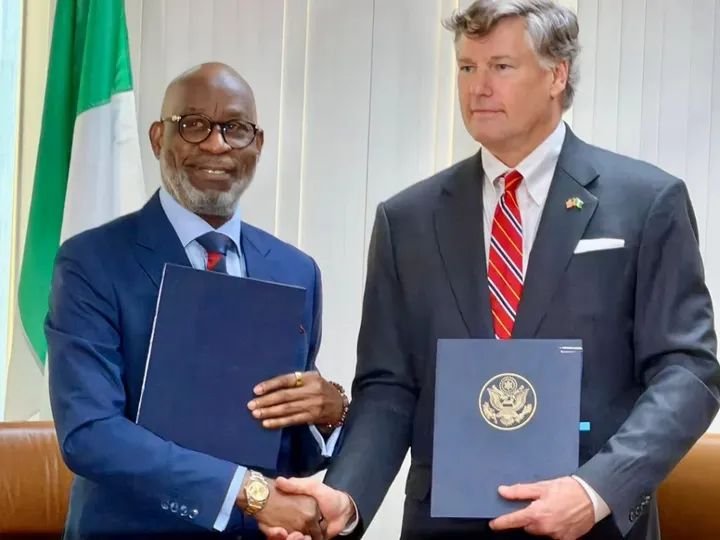
The agreement was signed on the sidelines of the 81st United Nations General Assembly in New York by Nigeria’s Minister of Solid Minerals Development, Dele Alake, and US Deputy Secretary of State Christopher Landau.
The pact comes as Nigeria seeks to expand the contribution of its mineral resources to economic diversification, industrial development, job creation and local value addition.
The Nigerian government has estimated the country’s mineral resources at about $700 billion, although that figure represents an estimate of the potential value of the country’s mineral wealth rather than a confirmed investment commitment under the new agreement.
What the Nigeria-US agreement covers
According to details released after the signing, the framework is designed to support cooperation across several areas of Nigeria’s mineral value chain.
These include geological data, mineral exploration, mineral development and processing, infrastructure and technical capacity building.
The agreement is also intended to create opportunities for business-to-business partnerships and encourage greater investment in the development and processing of Nigeria’s mineral resources.
Alake described the framework as a future-focused agreement and said Nigeria’s objective was to move beyond exporting raw minerals and instead develop greater value within the country.
He said the government wants stronger local processing, improved technical skills, quality employment and increased opportunities for Nigerian businesses.
The minister also said the framework would support the economic diversification objectives of President Bola Tinubu’s administration and contribute to industrial growth.
US signals deeper engagement with Nigeria’s minerals sector
Landau said the United States viewed Nigeria as an important regional partner and expressed Washington’s willingness to support Nigeria’s economic development.
The US official said the agreement demonstrated that Nigeria and the United States were partners and indicated that both countries intended to build on their recent cooperation.
The agreement therefore places Nigeria’s mineral resources within a broader area of economic and strategic cooperation between the two countries.
However, the signing itself does not establish a specific dollar amount of American investment in Nigerian mining. Reports on the agreement indicate that no individual mining project or specific investment value was announced alongside the pact.
Why local processing matters
Nigeria has large deposits of various minerals, but developing the sector involves more than extracting resources from the ground.
A major objective of the government’s current mining strategy is to increase local processing so that more economic value is created within Nigeria rather than through the export of unprocessed materials.
This approach could potentially create demand for technical workers, processing facilities, transportation infrastructure, engineering services and Nigerian businesses involved in the mining supply chain.
For the United States, cooperation in critical minerals also provides an opportunity to strengthen mineral supply chains and develop partnerships around resources considered strategically important to modern industries.
The agreement’s emphasis on geological information, exploration, processing and infrastructure suggests that cooperation is intended to cover several stages of the mineral-development process rather than extraction alone.
Nigeria seeks investment beyond raw mineral exports
Alake has repeatedly argued that African countries should move away from a model in which the continent primarily exports raw minerals while higher-value processing takes place elsewhere.
At an Africa Minerals Strategy Group meeting in New York earlier this week, he advocated greater investment in mineral corridors, safety systems and the formalisation of artisanal mining.
President Bola Tinubu has also called for African countries to increase local processing and manufacturing around critical minerals rather than remaining primarily exporters of raw materials.
The latest Nigeria-US framework fits into that wider policy direction.
What the agreement could mean for Nigeria
If implemented effectively, deeper cooperation could provide opportunities for additional exploration, mining infrastructure, processing facilities and technical expertise.
Greater investment could also support employment and expand the role of Nigerian companies in the mining value chain.
However, the agreement is a framework for cooperation rather than evidence that the estimated $700 billion value of Nigeria’s mineral resources will immediately translate into investment.
The actual economic impact will depend on subsequent projects, financing, regulatory implementation, infrastructure development and the ability to establish commercially viable mining and processing operations.
Nigeria will also need to maintain effective environmental, community and safety standards as mining activity expands.
What happens next
The next stage will be implementation of the framework and the development of specific areas of cooperation between Nigerian and US institutions and businesses.
The agreement provides a basis for collaboration in geological data, exploration, processing, infrastructure and technical capacity, but individual investments and projects will need to be developed separately.
The signing therefore marks the beginning of a deeper framework for Nigeria-US cooperation in the minerals sector rather than the completion of a single $700 billion investment deal.
For Nigeria, the central test will be whether the partnership can help turn the country’s estimated mineral wealth into productive domestic industries, skilled employment, stronger businesses and greater value retained within the economy.
Weng Global – Stories beyond borders
Sources
- Channels Television — Nigeria-US mineral investment pact and details of the framework.
- Radio Nigeria — Report on the Nigeria-US agreement and the estimated $700 billion mineral sector.
- The Sun Nigeria — Report on the framework agreement and Nigeria’s estimated mineral resources.
- Federal Ministry of Information and National Orientation — Recent statements on Nigeria’s minerals strategy.
- Voice of Nigeria — Report on Nigeria’s push for local mineral processing and value addition.