Reported by Weng Patrick Atokor l Journalist at Weng Global
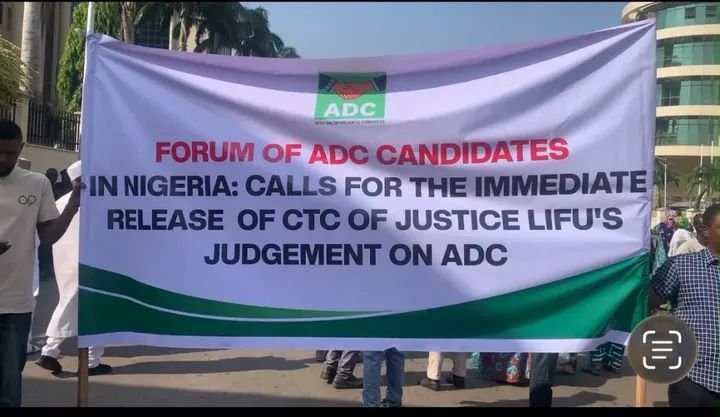
Members of the African Democratic Congress (ADC) have protested at the Federal High Court in Abuja over the delayed release of the certified true copy (CTC) of a judgment that nullified the party’s David Mark-led leadership, intensifying tensions surrounding the opposition party’s ongoing leadership dispute.
The protest comes amid growing disagreement over the November 5, 2026, judgment delivered by Justice Peter Lifu, which removed the Mark-led caretaker leadership and invalidated decisions taken by the disputed committee, including the process that produced former Vice-President Atiku Abubakar as the party’s presidential candidate.
The protesting members are demanding access to the full judgment, arguing that the document is necessary for the affected parties to understand the court’s orders and pursue appropriate legal remedies.
Protesters Submit Petition, Seek Intervention
According to Channels Television’s report on Wednesday, November 11, the protesters gathered at the Federal High Court in Abuja to demand the immediate release of the certified judgment.
They alleged that the delay was preventing Atiku Abubakar’s legal team from fully exercising his right to challenge the ruling.
The protesters also submitted a petition at the Federal High Court, calling attention to what they considered an unacceptable delay in providing the official court document.
Beyond the court, the demonstrators indicated plans to submit the same petition to the United States Embassy in Nigeria and the United Nations, seeking their intervention in the controversy.
The proposed international appeal adds another dimension to the dispute, which has increasingly attracted attention because of its potential implications for Nigeria’s opposition politics ahead of the 2027 general elections. Channels Television +1
How the Leadership Dispute Reached the Court
The controversy stems from a leadership dispute within the ADC following the emergence of former Senate President David Mark as the party’s national chairman.
The dispute was brought before the Federal High Court by Nafiu Bala Gombe, a former National Deputy Chairman of the party.
Gombe challenged the process through which Mark and his associates assumed control of the party, arguing that the transition violated the ADC constitution and relevant provisions of the Electoral Act.
The suit, marked FHC/ABJ/CS/1819/2025, listed the ADC, the Independent National Electoral Commission (INEC), David Mark, Rauf Aregbesola and former national chairman Ralph Nwosu among the defendants.
Gombe maintained that following Nwosu’s resignation, he was constitutionally entitled to assume the party’s leadership.
Justice Peter Lifu ruled in favour of the plaintiff on November 5, granting the reliefs sought and invalidating the Mark-led caretaker leadership and its actions.
The decision affected the political arrangements made by the disputed leadership, including the presidential primary that produced Atiku Abubakar as the ADC’s candidate for the 2027 presidential election. Channels Television +1
ADC Challenges the Judgment
The ADC has rejected the ruling and initiated steps to challenge it through the judicial system.
On November 6, the party disclosed that it had filed a notice of appeal and an application seeking a stay of execution of the judgment pending the determination of the appeal.
Its lawyers also formally notified INEC of the legal action, urging the electoral commission to avoid taking steps that could prejudice the pending proceedings.
The party’s position is that the appellate court should be allowed to examine the dispute before consequential decisions are taken.
However, filing an appeal does not automatically establish that the judgment has been suspended. The application for a stay must be determined by the appropriate court.
The delayed release of the certified true copy has therefore become an additional source of tension between the party and the court process. THISDAYLIVE +1
Why the Certified Judgment Matters
A certified true copy of a court judgment is an important legal document because it provides the official record of the court’s decision, including the specific orders made by the judge and the reasoning behind them.
For the ADC, obtaining the document is particularly important because the party intends to challenge the ruling.
Without access to the certified judgment, the affected parties face difficulties in examining the precise scope of the court’s decision and preparing their legal arguments.
The ADC Presidential Campaign Council had earlier complained that its lawyers applied for the document and paid the prescribed fees but had not received it.
Phrank Shaibu, the council’s Director of Strategic Communication, said counsel representing the first defendant submitted an application on November 6, while counsel for the third defendant applied on November 5, the day the judgment was delivered.
According to the council, both applications carried the Federal High Court’s official payment stamp.
The party also questioned why the document remained unavailable despite the alleged completion of the necessary administrative requirements.
These are allegations made by the party. There has been no independently established finding in the reports reviewed that the court deliberately withheld the judgment to frustrate the ADC’s appeal. TheCable +1
Earlier Court Decision Adds to the Controversy
The leadership dispute has also raised questions about an earlier Federal High Court judgment concerning the ADC.
On July 2, 2026, Justice Musa Liman delivered a judgment in a separate case involving House of Representatives member Leke Abejide.
The court struck out the suit and directed INEC to recognise the David Mark-led National Working Committee as the party’s duly elected leadership.
The decision was welcomed by the ADC, which maintained that it had established the legitimacy of its leadership structure.
The November 5 judgment delivered by Justice Peter Lifu has now introduced another legal development into the dispute.
The ADC has argued that the two decisions raise important questions about the handling of internal party leadership disputes by courts of coordinate jurisdiction.
However, the precise legal relationship between the two judgments and their respective implications will require examination of the full court documents and any subsequent appellate decisions.
The disagreement illustrates the complicated legal and political challenges facing the opposition party. African Democratic Congress +2
Implications for Nigeria’s 2027 Elections
The dispute has implications beyond the internal administration of the ADC.
With Nigeria’s 2027 general elections approaching, uncertainty surrounding the party’s leadership and presidential nomination could affect its preparations, political alliances and ability to organise effectively.
Atiku Abubakar’s emergence as the party’s presidential candidate had placed the ADC at the centre of discussions about opposition cooperation and the contest against the ruling All Progressives Congress.
The judgment has consequently created uncertainty around the party’s presidential ticket and the authority of the leadership that organised its primary election.
For opposition supporters, the dispute also raises questions about the ability of political parties to resolve internal disagreements without prolonged legal battles.
The controversy comes at a time when political parties are expected to strengthen their organisational structures, prepare for electoral activities and build public confidence ahead of the next general election.
The outcome of the legal proceedings could therefore influence the ADC’s political direction and its preparations for 2027.
It is important, however, to distinguish the Federal High Court’s ruling from the final outcome of the dispute. The ADC has announced an appeal, and the appellate process remains a significant part of the unfolding situation.
What Happens Next?
The immediate issues include the release of the certified true copy of Justice Lifu’s judgment and the determination of the legal applications filed by the ADC.
The Court of Appeal will have an opportunity to examine the issues raised in the party’s challenge, while the Federal High Court will also have to consider the application seeking a stay of execution.
The protesters’ decision to approach the United States Embassy and the United Nations could generate further public attention, although any international intervention would not replace the Nigerian judicial process.
As of November 11, 2026, the latest available reporting confirms that protesters have taken their demands to the Federal High Court and submitted a petition. However, no official response from the court concerning the protest or a confirmed release of the certified judgment was established in the reports reviewed.
The central issue remains whether the affected parties will obtain the official judgment in time to pursue their legal challenges without further uncertainty.
For the ADC, the outcome could prove significant in determining the future of its leadership structure and its position in Nigeria’s preparations for the 2027 presidential election.
Weng Global – Stories beyond borders
Sources
- Channels Television – Atiku’s Supporters Protest in Abuja Over Court Judgment Voiding Candidacy (November 11, 2026).
- TheCable – ADC: Court Yet to Release Judgment Sacking Mark-Led Leadership Despite Payment (November 9, 2026).
- ThisDay – ADC Appeals Judgment Sacking David Mark-Led Leadership, Seeks Stay, Writes INEC.
- Court Judgment Report – Federal High Court Decision on ADC Leadership Dispute.
- African Democratic Congress – Federal High Court Affirms ADC Leadership, Orders INEC to Recognise David Mark-Led NWC (July 2, 2026).