Reported by Simon Daniel Yusuph l Journalist at Weng Global
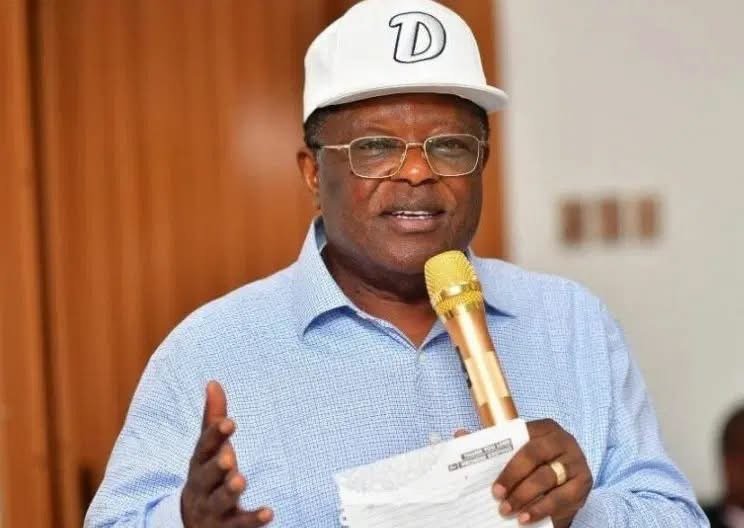
Nigeria’s Minister of Works, David Umahi, has defended the Federal Government’s decision to alter the route of the Lagos-Calabar Coastal Highway through Ondo State, citing difficult terrain, deep ground depressions and the high cost of constructing the road along its original alignment.
Umahi said the decision followed engineering considerations and was intended to make construction more practical, insisting that the government had no regrets over the changes despite petitions and criticism from stakeholders who want the highway to pass through coastal communities in Ondo State.
The minister’s defence comes amid growing calls for transparency over the route adjustment, with community representatives questioning whether the revised alignment adequately serves the coastal populations the project was expected to benefit.
The dispute has placed renewed attention on the Federal Government’s approach to delivering one of Nigeria’s major road infrastructure projects, particularly the balance between engineering requirements, construction costs, community interests and public accountability.
Umahi Explains Why the Route Was Changed
Speaking in Abuja while providing an update on the Federal Government’s major road projects, Umahi said the original alignment in Ondo State presented serious construction difficulties.
According to the minister, sections of the proposed route crossed terrain containing pits more than 100 metres deep. He also said suitable sharp sand was unavailable in some areas for distances extending up to 300 metres, creating additional challenges for construction.
The minister argued that these conditions would make the cost of building each kilometre significantly different from the cost of constructing a road across more conventional terrain.
He said the ministry therefore took what he described as a major engineering decision to redesign the route and avoid the most difficult sections.
Umahi maintained that the change was not arbitrary but was informed by the physical conditions encountered during the planning and execution of the project.
He also said filling work involving more than 10 metres of material had been undertaken along the redesigned alignment and was nearing completion when he provided the update.
The explanation represents the Federal Government’s stated justification for the realignment. However, the publication of detailed engineering assessments, comparative route costs and technical findings would help the public independently evaluate the decision.
Tinubu Directs Highway to Use Existing East-West Road
The route dispute also involves the planned continuation of the Lagos-Calabar Coastal Highway from Ondo State into Edo State.
According to reports of Umahi’s briefing, President Bola Tinubu directed the Ministry of Works to use the existing East-West Road corridor rather than construct an entirely new alignment along the affected section.
Umahi said the President instructed the ministry to route the highway through the existing road from Ondo into Edo State.
The decision introduces a further consideration into the project: how to connect the coastal highway to existing transport infrastructure while addressing the condition of the East-West Road.
Umahi also identified flooding as a concern, particularly around the Ughelli axis in Delta State. He said the existing road faced flooding challenges and that parts of the corridor would need to be raised to improve its resilience.
The minister indicated that the government planned to raise some sections by approximately two metres above existing levels and anticipated flood levels.
Such work would require careful engineering to ensure that improvements to the road do not worsen drainage conditions or transfer flood risks to neighbouring communities.
The use of an existing road corridor could reduce the need for a completely new alignment in some areas. Nevertheless, the overall benefits and costs would depend on the final design, the condition of the existing road, the required upgrades and the route’s ability to serve its intended transport purpose.
How Much of the Highway Is Affected?
The Ondo dispute forms part of the wider Lagos-Calabar Coastal Highway project, which is intended to improve road connectivity across Nigeria’s southern coastal region.
Umahi said the realignment affects Sections 4A and 4B, covering a combined 67 kilometres across Ogun and Ondo states. The sections comprise approximately 27 kilometres in Ogun State and 40 kilometres in Ondo State.
The minister’s comments indicate that the route adjustment is a substantial part of the project rather than a minor change to a short stretch of road.
He has maintained that the redesign was necessary because of the terrain and the expected construction challenges along the original alignment.
For communities in the affected areas, however, the central issue extends beyond the technical difficulty of building the road. Residents and community representatives also want to know how the revised route will affect access, local economic activity and the distribution of the project’s expected benefits.
Those questions are particularly significant in coastal areas where transport access can influence fishing, trade, movement of goods and access to public services.
Ilaje Community Group Calls for Investigation
The Federal Government’s explanation has not ended opposition to the route change.
Ilaje Omuro Community Connect, a group representing people of Ilaje origin, has called on the Federal Government to investigate the alleged diversion of the highway away from coastal communities in Ondo State.
In a report published by TheCable on October 11, 2026, the group said it wanted the circumstances surrounding the reported route change examined by the appropriate authorities.
The group also called for the National Assembly and relevant anti-corruption agencies to examine the decision. Its demands included an independent engineering assessment, a public explanation of the route change and an audit of the financial implications.
The group challenged the ministry to provide technical reasons for rejecting the proposed alignment through the Ilaje coastal axis.
Its position reflects a wider concern among affected stakeholders that infrastructure decisions should be transparent and that the communities originally expected to benefit should not be overlooked.
The demands are allegations and requests for investigation; they do not, by themselves, establish that the route decision was improper or that public funds were mismanaged.
Umahi, for his part, has defended the decision on engineering grounds and said he welcomes petitions and public scrutiny.
A detailed technical explanation addressing the concerns raised by the community group would help clarify the basis for the decision and allow the public to assess the competing claims.
Coastal Stakeholders Question the Alternative Route
The concerns are not limited to one community organisation.
In September, leaders and stakeholders from Ilaje communities in Ondo State and Itsekiri communities in Delta State criticised the proposed inland realignment and called for the highway to retain its original coastal route.
A report published by Vanguard on September 22, 2026, said the stakeholders argued that the highway should pass through coastal communities rather than be redirected inland.
The stakeholders also questioned the financial implications of the change. They disputed the suggestion that the coastal alignment would necessarily be more expensive, arguing that the alternative route could involve greater distances and additional construction requirements.
Their position differs from the minister’s defence, which centres on difficult ground conditions and the cost of constructing the original alignment.
Resolving the disagreement requires more than competing assertions. A credible assessment would need to compare the proposed routes using consistent criteria, including construction costs, distance, soil conditions, bridges and other structures, environmental considerations, flood exposure, maintenance requirements and the communities served.
The assessment should also explain whether the routes being compared perform the same transport function. A shorter route may not necessarily be cheaper if it requires extensive ground treatment, while a longer route may bring additional costs through land acquisition, structures or road upgrades.
Without published technical evidence and comparable cost estimates, members of the public may find it difficult to determine which option offers the best long-term value.
Why the Dispute Matters to Ondo Communities
The Lagos-Calabar Coastal Highway is a major infrastructure undertaking, but its importance cannot be measured solely by the number of kilometres constructed.
Road projects can influence local economies by improving access to markets, reducing travel times and connecting communities to employment, education and healthcare. The distribution of those benefits depends partly on the route selected and the quality of connections to surrounding settlements.
For communities along the Ondo coastline, the route question is therefore also a question of economic inclusion.
If the final alignment bypasses settlements that expected to benefit, residents may seek clarity on how they will connect to the highway and whether alternative infrastructure will address their transport needs.
At the same time, the government must ensure that the chosen route can be built safely, withstand local environmental conditions and remain financially sustainable.
These objectives are not necessarily incompatible. However, they require transparent planning, meaningful consultation and evidence that the selected route offers a reasonable balance between engineering feasibility and public benefit.
Environmental conditions also deserve attention. Coastal and riverine areas can present challenges involving unstable soil, flooding, drainage and the long-term effects of infrastructure construction. A route decision should account for these risks rather than focus exclusively on initial construction costs.
The Federal Government’s explanation identifies the difficult terrain as a central consideration. Making the supporting assessments publicly available would allow independent experts and affected communities to better understand how those challenges influenced the final design.
Public Accountability and the Cost of Infrastructure
The controversy highlights a broader question facing public infrastructure projects in Nigeria: how government decisions can be explained and evaluated when technical considerations affect the distribution of public benefits.
Umahi has said he welcomes petitions against him, acknowledging that public officials are subject to scrutiny. That position makes transparency particularly important as the project advances.
Public accountability does not require the government to retain an original design when engineering evidence shows that changes are necessary. It does, however, require a clear explanation of why the change was made, what alternatives were considered and how the decision affects project costs and communities.
For the Ondo section, relevant information would include the engineering reports supporting the revised alignment, the comparative estimated costs of the original and alternative routes, the work required to prepare the ground, and the reasons for selecting the final corridor.
A transparent comparison would also help address concerns about whether the route change increases or reduces the overall cost of delivering the highway.
The same information could help government officials respond to criticism with verifiable evidence rather than relying solely on public statements.
For affected communities, disclosure would provide a clearer basis for assessing the decision and raising specific concerns about access, environmental impacts and local development.
What Happens Next?
The immediate issue is whether the Ministry of Works will provide further technical information to address the questions raised by community representatives.
The government’s stated position is that the route adjustment was driven by engineering challenges and the need to avoid difficult terrain. Community stakeholders, meanwhile, are seeking an investigation, an independent assessment and greater transparency over the decision’s financial implications.
A published technical assessment comparing the original and revised alignments could help narrow the disagreement. It would also allow the public to examine whether the route offers an appropriate balance between construction feasibility, cost, environmental resilience and community access.
The government will also need to demonstrate that the planned connection to the existing East-West Road can address flooding risks along vulnerable sections. Raising road levels may form part of the response, but its effectiveness will depend on detailed drainage design, construction quality and long-term maintenance.
As the project progresses, important measures of success will include completion timelines, construction standards, resilience to flooding, transport efficiency and the extent to which communities along the corridor benefit.
No final resolution of the dispute can be established from the statements currently reported. The route decision remains defended by the minister and contested by some community stakeholders.
For now, the key question is whether the Federal Government can substantiate its engineering and cost arguments with sufficiently detailed evidence while addressing the concerns of people who say the revised route may leave coastal communities behind.
The outcome will matter not only to Ondo State but also to public confidence in how major infrastructure projects are planned, redesigned and delivered across Nigeria.
Weng Global – stories beyond borders
Sources
- TheCable — report on Ilaje Omuro Community Connect’s call for an investigation into the proposed route change, October 11, 2026.
- Vanguard — report on Ilaje and Itsekiri stakeholders’ opposition to the coastal highway diversion, September 22, 2026.
- TheCable — report on Umahi’s explanation of the highway’s rerouting through the existing East-West Road, October 12, 2026.
- Vanguard — report on Umahi’s defence of the Ondo section’s realignment, October 11, 2026.