Reported by Simon Daniel Yusuph l Journalist at Weng Global
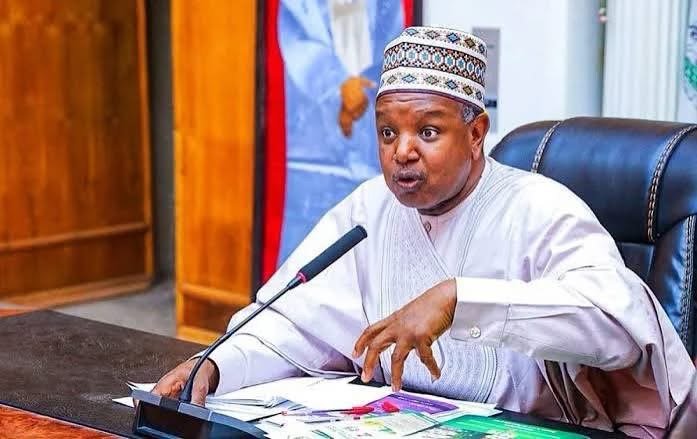
Nigeria’s Minister of Budget and Economic Planning, Senator Abubakar Atiku Bagudu, has said the country’s budget remains too small relative to its population and development needs, arguing that weak revenue mobilisation has constrained the government’s capacity to finance public services and infrastructure.
Bagudu made the remarks on Monday, September 28, 2026, in Abuja during a capacity-building workshop organised by the Senate Press Corps on safeguarding the national budget from unlawful insertions.
The minister said Nigeria had the smallest national budget among the world’s 10 most populous countries, using the comparison to highlight what he described as the limited size of the Nigerian economy and its fiscal capacity.
Nigeria’s 2026 budget currently stands at N68.32 trillion, equivalent to about $49 billion based on the comparison cited at the workshop. The figure followed changes to the initial budget proposal and represents the country’s largest federal budget in nominal naira terms.
Nigeria’s Population Creates Larger Spending Demands
Nigeria is estimated to have more than 240 million people, making it Africa’s most populous country and the sixth most populous country globally.
The U.S. Census Bureau’s July 2026 estimate placed Nigeria’s population at about 250.2 million, while other 2026 population estimates put the figure at approximately 242.4 million. The differences reflect the fact that Nigeria has not conducted a nationwide population census since 2006 and that current figures are therefore based largely on demographic estimates.
The other countries in the global top 10 include India, China, the United States, Indonesia, Pakistan, Brazil, Bangladesh, Russia and Ethiopia.
Bagudu argued that Nigeria’s fiscal capacity should be considered against the scale of its population and the responsibilities placed on government, including security, education, healthcare, infrastructure and social services.
He described Nigeria as a relatively small economy and said the country would continue to struggle to meet public expectations unless it makes choices that expand its economic and revenue base.
Revenue Mobilisation at the Centre of the Challenge
A major part of Bagudu’s argument was Nigeria’s low revenue capacity.
The International Monetary Fund has also identified revenue mobilisation as an important issue for Nigeria, noting that the country continues to have a low revenue-collection ratio and that stronger domestic revenue mobilisation could create additional fiscal space for development spending.
In its 2026 Article IV assessment, the IMF projected Nigeria’s consolidated government revenues and grants at about 10.8 per cent of GDP for 2026, compared with total expenditure and net lending of about 15.5 per cent of GDP.
The figures illustrate the gap between the resources available to government and its spending requirements. The IMF also projected that interest payments would consume about 53.7 per cent of Federal Government revenue in 2026.
That fiscal pressure limits the amount of government revenue that can be directed towards new development programmes.
Bagudu Compares Nigeria With Pakistan and Brazil
Bagudu used Pakistan as a closer comparison because of its relatively large population.
According to the minister, Pakistan’s annual budget was approximately $67 billion, compared with Nigeria’s roughly $49 billion budget.
He said, however, that Pakistan should not necessarily be Nigeria’s long-term benchmark. Instead, he pointed to Brazil, another large federal country with a population of a broadly comparable scale.
Bagudu said Brazil’s federal budget was many times larger than Nigeria’s and questioned whether Nigeria could reasonably expect similar levels of public service delivery and development outcomes while operating with substantially fewer fiscal resources.
The comparison was presented by the minister as an argument for expanding Nigeria’s economic base and mobilising more public revenue, rather than simply increasing expenditure without corresponding improvements in revenue.
Nigeria’s 2026 Budget Has Expanded Significantly
The minister’s comments come against the backdrop of a substantial increase in Nigeria’s federal budget over recent years.
The Budget Office of the Federation lists the 2026 Appropriation Act among the government’s current budget documents and records its publication in August 2026.
The approved 2026 budget is significantly larger than the original proposal. Fiscal reporting has put the initial proposal at about N58.18 trillion, before the National Assembly increased the figure to N68.32 trillion.
The increase, however, does not mean that all of the additional spending automatically translates into development projects.
Nigeria faces substantial recurrent obligations, including salaries, security expenditure and debt servicing. The size of debt-service commitments has become an important factor in determining how much fiscal space remains for infrastructure and social investment.
The IMF’s latest assessment projected Federal Government interest payments at more than half of federal revenue in 2026.
The Debate Is Also About Budget Quality
Bagudu’s remarks were made at a workshop specifically focused on legislative oversight and alleged unlawful insertions into the national budget.
He urged the media and lawmakers to scrutinise questionable budget items but cautioned against automatically describing unfamiliar projects as unlawful insertions without establishing their purpose and location.
The minister gave examples of projects that could appear unusual without their local context being understood. He argued that some spending proposals may reflect genuine community needs.
At the same time, he acknowledged the need for vigilance, saying errors can occur in the budget process and that journalists and lawmakers have a responsibility to examine questionable provisions.
The discussion therefore extends beyond the size of the budget to the quality, transparency and effectiveness of public spending.
Calls for Stronger Legislative and Media Oversight
Senator Yemi Adaramodu, Chairman of the Senate Committee on Media and Public Affairs, represented Senate President Godswill Akpabio at the event and stressed the media’s role in scrutinising budget implementation.
He warned against misinformation surrounding public finances and called for balanced reporting that can help sustain public understanding of government spending.
Civil society representatives also raised concerns about the need for budget provisions to be properly justified, costed and measurable.
A representative of the Civil Society Legislative and Advocacy Centre cited previous findings concerning inserted and duplicated projects in Nigeria’s budget process, while BudgIT representatives called for stronger scrutiny of budget performance before new allocations are approved.
Why the Budget Debate Matters
The size of Nigeria’s budget matters because government spending affects virtually every major public service, from security and education to healthcare, infrastructure and social programmes.
However, a larger budget in naira terms does not necessarily mean that government has proportionately greater purchasing power or fiscal capacity. Exchange rates, inflation, revenue collection, debt obligations and the structure of government expenditure all affect what the budget can actually finance.
Nigeria’s economic size also matters. The World Bank estimated Nigeria’s 2025 gross domestic product at about $290.79 billion, while the IMF projected nominal GDP at about N529 trillion for 2026.
This means that the debate is not simply about whether Nigeria should spend more. It is also about whether the country can sustainably generate enough revenue to finance development without creating excessive debt pressures.
Bagudu’s argument is that Nigeria needs a significantly stronger economic and revenue base if it wants to meet the demands of a rapidly growing population.
What Happens Next
The Federal Government is pursuing economic reforms aimed at increasing revenue mobilisation, improving tax administration and expanding the size of the economy.
Bagudu said the administration was working towards a $1 trillion economy, in line with longer-term national development ambitions. Achieving that target would require sustained economic growth, investment, stronger revenue collection and continued reforms.
For the National Assembly and the media, the immediate challenge remains monitoring how approved funds are allocated and spent.
The broader fiscal question is whether Nigeria can expand revenue faster than its expenditure obligations while maintaining debt sustainability and funding essential public services.
For citizens, the practical test will ultimately be whether increased budgetary allocations translate into measurable improvements in infrastructure, security, healthcare, education and other public services.
Nigeria’s population is continuing to grow, while its government faces competing demands for limited resources. The debate highlighted by Bagudu therefore centres not only on the size of the annual budget, but on the capacity of the Nigerian economy to generate the revenue required to meet the needs of more than 240 million people.
Weng Global – stories beyond borders
Sources
- Ministry of Budget and Economic Planning
- Budget Office of the Federation
- International Monetary Fund
- World Bank
- Tribune Online