Reported by Weng Patrick Atokor l Journalist at Weng Global
Kenyan President William Ruto has said his government is fast-tracking administrative processes for the proposed Dangote East Africa Refinery in Lamu, as Nigerian industrialist Aliko Dangote says the Kenyan facility will be bigger than his existing refinery in Lagos.
The development comes days before the planned September 30, 2026 groundbreaking ceremony for the Lamu refinery, a multibillion-dollar project that Kenya and its partners are positioning as a major investment in petroleum refining, industrialisation and regional energy supply.
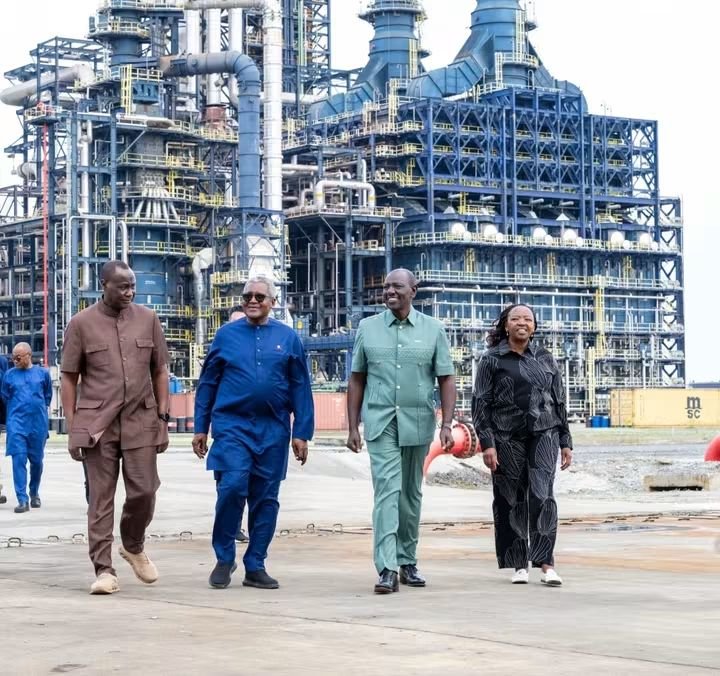
Ruto made the remarks on September 25 during a visit to the Dangote Petroleum Refinery in Lekki, Lagos, where he toured the Nigerian facility alongside First Lady Rachel Ruto and senior Kenyan officials.
According to reports from The Punch and The Star, Ruto said Kenya had already secured the land required for the proposed Lamu project and was working to remove administrative and bureaucratic obstacles that could delay its implementation.
Dangote says Kenyan refinery will be bigger
During the Lagos tour, Dangote told Ruto that the refinery planned for Kenya would be bigger than the Nigerian facility.
Dangote explained that the Kenyan plant would incorporate equipment and processing systems adapted to the characteristics of the crude expected to be used there.
He specifically referred to heavier equipment, including a fluid catalytic cracking unit, as well as a coker and vacuum distillation unit that are not part of the existing configuration at the Lagos refinery.
“The refinery whose construction we launch in Kenya next week will be bigger,” Ruto also said while describing the planned project during the visit.
The precise meaning of “bigger” requires some qualification. Public descriptions of the proposed Lamu refinery currently put its planned crude-processing capacity at about 700,000 barrels per day, while the Lagos refinery is commonly described as having a design capacity of about 650,000 barrels per day, although Ruto referred to the Nigerian facility as having a 700,000-barrel-per-day capacity during his visit.
The available reporting therefore supports the description of the Lamu project as a very large refinery, but the final size, configuration and technical specifications will depend on the project as construction and engineering work progresses.
Lamu project set for September 30 groundbreaking
The Kenyan government has scheduled the groundbreaking ceremony for September 30 in Lamu.
Deputy President Kithure Kindiki has said preparations for the event are being finalised, including security, logistics and protocol arrangements. The ceremony is expected to attract regional leaders and other stakeholders.
Ruto had earlier met Dangote and Africa Finance Corporation President and Chief Executive Officer Samaila Zubairu on the sidelines of the United Nations General Assembly in New York on September 21.
The discussions focused on financing and preparations for the refinery project.
After the meeting, Ruto said Kenya was ready to break ground on the refinery and described it as a project intended to strengthen regional energy security, increase local value addition and support industrialisation.
The proposed refinery is expected to be developed with Dangote Industries and the Africa Finance Corporation playing major roles.
Reports have placed the estimated investment at between about $15 billion and $17 billion, with several Kenyan reports putting the figure around Sh2.2 trillion.
First construction cargo arrives at Lamu Port
Preparations for the project have already moved beyond planning.
On September 26, a vessel carrying about 2,930 metric tonnes of construction machinery arrived at Lamu Port. The arrival was reported as the first major shipment of project cargo linked to construction of the planned refinery.
The shipment provides a tangible sign of activity around the project ahead of the scheduled groundbreaking.
The development also places greater importance on Lamu Port and the wider LAPSSET corridor, which Kenya has identified as a strategic route for connecting its coast with northern Kenya and neighbouring landlocked countries.
The refinery is expected to create additional demand for transport, logistics, storage, engineering, construction and other services connected to the petroleum industry.
Proposed 700,000-barrel-per-day capacity
Current project descriptions put the planned Lamu refinery at approximately 700,000 barrels of crude oil per day.
If built at that capacity, the facility would rank among Africa’s largest refining projects and would be significantly larger than most existing refineries in East Africa.
Kenyan authorities have presented the refinery as part of a broader effort to increase domestic refining capacity and reduce dependence on imported petroleum products.
The facility is also intended to serve a regional market rather than Kenya alone.
Earlier statements from Ruto indicated that the refinery could supply petroleum products to countries including Ethiopia, South Sudan, Uganda, Tanzania, Rwanda, Burundi and the Democratic Republic of Congo.
That regional focus is central to the project’s economic proposition because Kenya’s domestic petroleum market alone would represent only part of the potential demand for a refinery of such scale.
Jobs and industrial development
The Kenyan government has highlighted employment and industrial development as major expected benefits of the investment.
Ruto has said the refinery could create about 60,000 jobs and stimulate additional industries after completion.
He said downstream businesses could emerge around areas such as fertiliser production, chemicals and packaging.
The expected employment figure, however, remains a government projection rather than an independently verified number of jobs already created.
The project’s wider economic impact will depend on whether the refinery is completed as planned, how quickly supporting infrastructure develops and whether associated industries establish operations around the facility.
For Lamu and the wider Coast region, the investment could also increase demand for local services and infrastructure.
The project is consequently being viewed not simply as an oil refinery but as a potential industrial hub connected to the LAPSSET corridor and Lamu Port.
Crude supply remains a major challenge
Despite the scale of the investment, the refinery also faces significant questions that will need to be addressed as the project moves towards construction and eventual operation.
Reuters reported earlier in September that securing sufficient crude oil supplies could be one of the project’s major challenges because Kenya does not yet have established commercial crude production at the scale required for a 700,000-barrel-per-day refinery.
Potential crude sources include Kenya, South Sudan and Uganda, but infrastructure, logistics and geopolitical considerations could affect the availability and cost of supplies.
Kenya is simultaneously preparing for commercial oil production from its Turkana fields, while discussions have also emerged around a possible crude-oil pipeline linking the Turkana oilfields to Lamu.
Ruto has previously said the government was discussing such infrastructure with Dangote because a reliable pipeline could support the refinery’s long-term crude supply requirements.
The availability of crude will therefore be an important factor in determining how the refinery eventually operates.
Financing and infrastructure questions
Financing is another significant component of the project.
Ruto’s September 21 meeting with Dangote and the Africa Finance Corporation included discussions on financing and final preparations for the project.
Reuters previously reported that Dangote planned to finance the proposed Kenyan refinery through a combination of internal cash, bonds and a planned initial public offering, reflecting the scale of capital required for the development.
The project will also require extensive supporting infrastructure, including transport links, storage, pipelines, power and other industrial facilities.
Lamu Port is expected to play an important role in the movement of equipment, crude oil and petroleum products.
The arrival of the first construction cargo at the port demonstrates how closely the refinery project is becoming linked to the port’s future development.
What Ruto’s Lagos visit means for Kenya
Ruto’s visit to the Lagos refinery offered the Kenyan president a direct view of the industrial model Dangote is seeking to replicate and expand in East Africa.
The Nigerian refinery is an integrated petroleum and petrochemicals complex with extensive infrastructure for crude handling and refined-product production.
Ruto said the Lagos facility demonstrated what governments, investors and financial institutions could achieve through cooperation.
He also linked the planned Kenyan refinery to energy security and industrialisation, arguing that it could strengthen fuel supply and support the development of related industries.
The visit therefore came at a significant moment, just days before Kenya’s planned groundbreaking ceremony in Lamu.
Environmental and community considerations
The scale of the proposed refinery also means that environmental and community issues will remain important as the project progresses.
Lamu is an ecologically sensitive coastal region with important marine, fishing and tourism activities. The area also contains the historic Lamu Old Town, a UNESCO World Heritage Site.
Reuters has previously reported that environmental considerations and the proximity of the project to sensitive areas are among the issues requiring attention as the development moves forward.
Local residents have also called for greater involvement in decisions surrounding the refinery and associated infrastructure.
The Daily Nation reported that some Lamu residents had raised concerns about pending issues and called for local communities to be involved as the refinery and proposed crude pipeline plans advance.
For the project to deliver its projected economic benefits, these concerns will have to be addressed alongside financing, infrastructure, crude supply and construction requirements.
What happens next
The immediate milestone is the planned September 30 groundbreaking ceremony in Lamu.
Following the groundbreaking, attention will shift towards detailed construction, financing, infrastructure development and the establishment of reliable crude supply arrangements.
The Kenyan government has indicated that it wants to move quickly by reducing administrative delays.
Construction progress will ultimately determine whether the project’s ambitious timetable, employment projections and regional energy objectives can be achieved.
For Dangote, the Lamu refinery would represent a major expansion of the group’s refining ambitions beyond Nigeria.
For Kenya, the project represents an attempt to position Lamu as an important petroleum and industrial centre serving both domestic and regional markets.
The success of the investment will depend not only on the refinery itself but also on the infrastructure, crude supply, financing, environmental safeguards and regional market connections that support it.
With construction preparations already under way and heavy project cargo arriving at Lamu Port, the September 30 groundbreaking is expected to mark an important transition from planning towards implementation.
The central questions for the months and years ahead will be how quickly construction advances, how the project secures its crude supply, how financing is sustained and whether the promised regional economic benefits materialise.
For Kenya and East Africa, the Lamu refinery is therefore more than a single energy project. Its development could have implications for petroleum supply, industrial activity, regional trade and the future role of Lamu as a strategic economic gateway.
Weng Global – Stories beyond borders
Sources
- Reuters — Reporting on the proposed Dangote refinery’s crude-supply, financing, infrastructure and environmental challenges.
- The Punch — Reporting on Ruto’s Lagos visit, the Lamu refinery and Dangote’s statement that the Kenyan facility would be bigger.
- The Star — Reporting on Ruto’s commitment to the Lamu project and the arrival of construction machinery at Lamu Port.
- Daily Nation — Reporting on the arrival of project cargo and concerns raised by Lamu residents.
- Nairametrics — Reporting on the September 30 groundbreaking preparations, project financing and proposed capacity.
- Anadolu Agency — Reporting on the proposed refinery’s regional market and employment projections.