Reported by Weng Patrick Atokor l Journalist at Weng Global
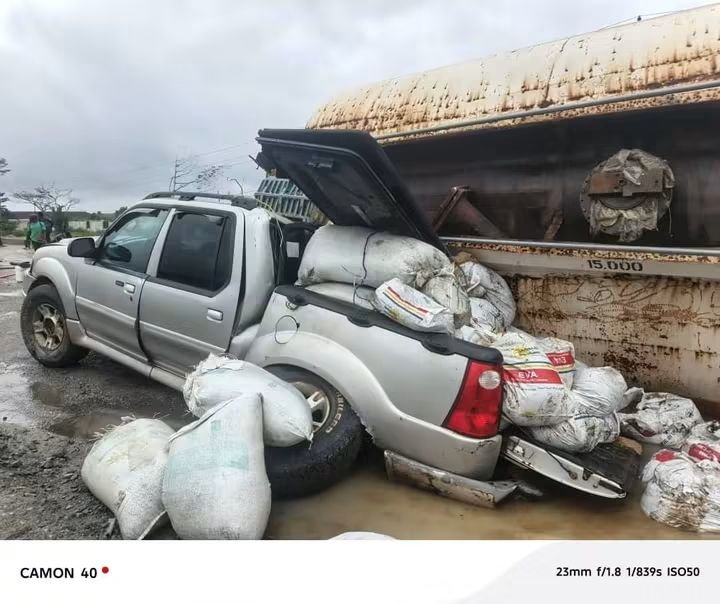
A tanker carrying 45,000 litres of Premium Motor Spirit (PMS) overturned on Ijako Road, inward Oke Oso, along the Ajah Expressway in Epe, Lagos State, highlighting the potentially serious risks surrounding petroleum transportation on busy roads.
The incident occurred on Friday, September 4, 2026, while the Mack tanker was ascending Ijako Hill. According to the Lagos State Emergency Management Agency (LASEMA), preliminary findings indicated that the vehicle suffered a mechanical failure after its propeller detached from its joint, causing it to lose momentum and overturn.
Despite the quantity of petrol being transported and the subsequent leakage from one of the tanker’s compartments, LASEMA reported no fatalities or injuries.
That outcome was significant because an overturned petrol tanker presents a risk that extends beyond the vehicle itself. A fuel leak can create the possibility of fire, environmental contamination and secondary accidents, particularly when the incident occurs on a road used by motorists and other road users.
A potentially dangerous situation contained
LASEMA said it received a distress alert at about 11:32 a.m. and deployed its Whales Team from the Epe Base. The emergency team arrived approximately four minutes after dispatch.
By the time responders reached the scene, the Lagos State Fire and Rescue Service, Oke Oso Station, had already begun containment measures.
The immediate priority was to prevent the leaked petroleum product from creating a larger emergency.
LASEMA said the response involved several agencies, including the Lagos State Fire and Rescue Service, the Lagos State Traffic Management Authority (LASTMA), the Lagos State Neighbourhood Safety Corps and representatives of the National Union of Petroleum and Natural Gas Workers.
The multi-agency operation was coordinated under the Incident Command System, with traffic management forming part of the effort to protect motorists and prevent secondary incidents.
Why 45,000 litres matters
A tanker carrying tens of thousands of litres of petrol is not an ordinary road vehicle.
Premium Motor Spirit is highly flammable, meaning that a major spill can rapidly become a wider public-safety emergency if an ignition source is introduced.
This is why the response to a tanker accident involves more than simply removing the damaged truck from the road.
Emergency responders must secure the area, control traffic, manage the spilled product, prevent ignition and ensure that the tanker can be recovered safely.
In the Epe incident, LASEMA said one compartment of the tanker was leaking. An empty tanker was therefore mobilised to transfer the petroleum product before recovery of the overturned vehicle could begin.
The procedure illustrates an important point about tanker accidents: recovery cannot always begin immediately. Responders may first need to make the scene safe and transfer the hazardous product to another vehicle.
The mechanical-failure question
The preliminary explanation provided by LASEMA points to a mechanical problem rather than a reported collision.
According to the agency, the tanker’s propeller detached from its joint while it was climbing Ijako Hill. The resulting loss of momentum caused the vehicle to overturn.
That detail is important because it shifts attention toward vehicle condition and preventive maintenance.
A tanker transporting petroleum products operates under conditions where mechanical failure can have consequences beyond the driver and vehicle. A failure involving a heavy tanker on a slope, bridge, junction or congested road can potentially expose other road users to danger.
The Epe incident therefore also underscores the importance of regular inspection, proper maintenance and the safe operation of heavy petroleum-carrying vehicles.
However, the available report from LASEMA described the mechanical explanation as a preliminary finding. It should not automatically be treated as a final determination of responsibility or cause.
Emergency response prevented escalation
The absence of reported casualties does not mean the incident was insignificant.
Rather, it demonstrates why rapid emergency intervention matters when petroleum products are involved.
LASEMA said its team arrived four minutes after dispatch, while the Lagos State Fire and Rescue Service had already begun containment measures.
The coordinated presence of emergency, traffic and safety personnel helped secure the affected area while arrangements were made to transfer the petrol from the overturned tanker.
This type of response is particularly important because a tanker accident can quickly become more complicated if motorists approach the scene, traffic builds up around the affected vehicle or the spilled product comes into contact with an ignition source.
A wider road-safety lesson
The Epe incident also raises a broader question about how Nigeria manages the movement of petroleum products by road.
Fuel tankers remain an important part of petroleum distribution, particularly where products must be transported between terminals, depots and filling stations.
At the same time, the combination of heavy vehicles, mechanical risks, road conditions, traffic and highly flammable cargo creates a distinctive road-safety challenge.
Every tanker incident therefore provides an opportunity for authorities, transport operators and other stakeholders to examine whether existing safety measures are working effectively.
The lesson from Epe is not simply that a tanker overturned.
It is that an incident involving a large quantity of petrol can remain relatively contained only when emergency agencies respond quickly, the area is secured and the hazardous product is handled carefully.
What motorists should know
LASEMA advised motorists to cooperate with traffic officials and avoid the immediate area while emergency operations were underway.
That instruction is important during tanker incidents because unnecessary movement around the scene can interfere with emergency operations and expose motorists to avoidable danger.
Members of the public should also avoid approaching spilled petroleum products or attempting to collect fuel from an accident scene.
LASEMA reminded residents that emergencies can be reported through the agency’s toll-free numbers, 112 and 767.
What happens next
LASEMA said an empty tanker had been mobilised to safely transfer the petroleum product before recovery of the fallen vehicle.
Further recovery operations would follow the transloading process.
The agency also said additional updates would be provided as the situation developed.
For Weng Global, the wider significance of the Epe incident lies in the narrow line between a road accident and a potentially much larger emergency.
The tanker carried 45,000 litres of petrol, one of its compartments was leaking, and the vehicle had overturned on a public road. Yet no fatalities or injuries were reported.
That outcome reinforces the importance of rapid emergency response, effective traffic control, proper tanker maintenance and responsible behaviour around hazardous-material incidents.
The incident is therefore not only a story about a fallen tanker. It is also a reminder that preventing a disaster often begins with how quickly and professionally an emergency is contained.
Weng Global – Stories beyond borders
Sources
- Lagos State Emergency Management Agency (LASEMA), as reported in its statement cited by Punch Newspapers.
- Punch Newspapers, “Fuel tanker overturns on Lagos road,” September 4, 2026.
- The Star, “45,000-litre fuel tanker overturns on Lagos road,” September 4, 2026.
- Lagos Panorama, “LASEMA contains 45,000-litre petrol tanker accident in EPE.”