Mokwa-Bida Highway Blockade: Niger Residents Protest Abductions as Travellers Remain Stranded!
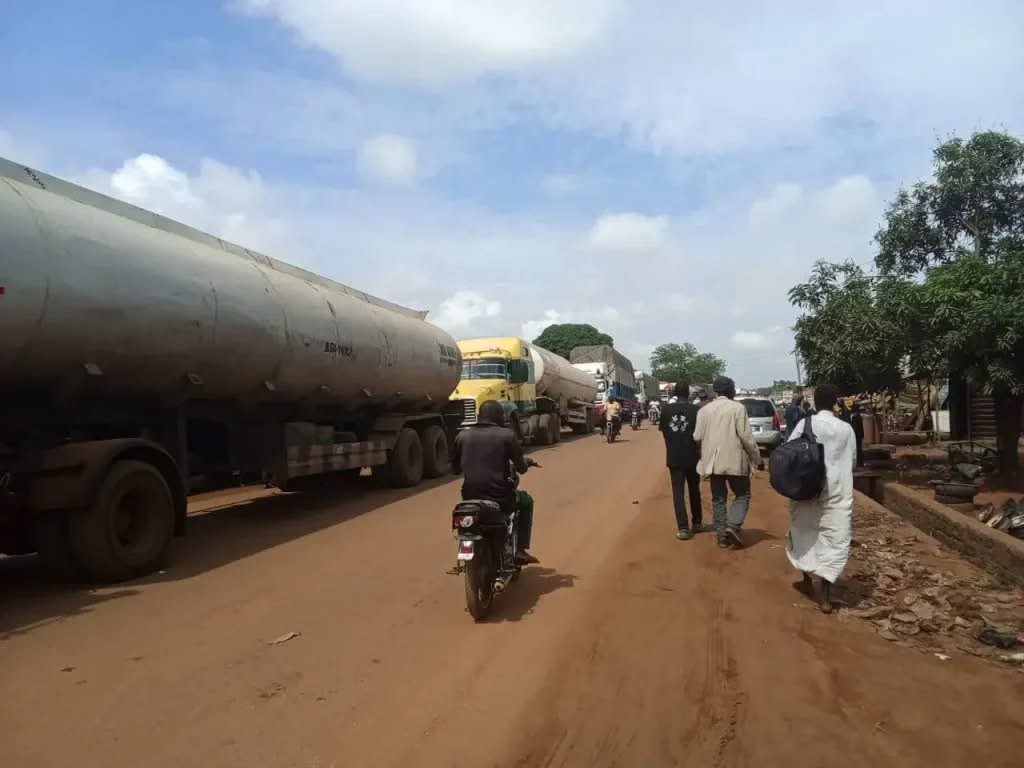
MOKWA, Niger State — Commercial and private travellers were left stranded along the busy Mokwa-Bida highway on Sunday after residents of Mokwa, Niger State, blocked major entry points into the town in protest against persistent insecurity and alleged abductions in the area.
The protest, which disrupted movement along one of Niger State’s important transportation corridors, was driven by growing anger among residents over what they described as continued attacks by suspected bandits and the alleged failure of security agencies to secure the release of recently abducted residents.
The development was reported by The Punch and The Sun Nigeria, both citing reports from the News Agency of Nigeria (NAN). According to the reports, protesters barricaded all major entry points into Mokwa, leaving travellers unable to continue their journeys. (Punch Newspapers)
The blockade reportedly began before Sunday and had already caused significant disruption by the morning of August 9. NAN reported that several travellers had been stranded since Saturday night, while commuters arriving in Mokwa on Sunday were unable to proceed because of the continuing demonstration. (Punch Newspapers)
Residents demand action over alleged abductions
The immediate trigger for the demonstration was residents’ concern over alleged kidnappings attributed to suspected bandits operating in and around the community.
One of the protesters, identified as Saliu Mohammed, claimed that 15 residents had recently been abducted and alleged that security agencies had yet to rescue the victims.
That figure, however, could not be independently verified by NAN or the media organisations reporting the protest. The claim should therefore be treated as an allegation pending confirmation from the relevant security authorities or other independently verifiable sources. (Punch Newspapers)
Mohammed reportedly said the protesters would maintain the blockade until the alleged victims were rescued, underscoring the depth of frustration within the community.
The protest reflects a familiar pattern in parts of Nigeria where residents, faced with prolonged insecurity and fears over kidnapping, have resorted to road demonstrations and blockades to draw attention to their concerns.
For communities affected by repeated attacks, the security crisis is not simply an abstract national issue. It directly affects freedom of movement, local commerce, agricultural activity, education and the ability of families to travel safely between communities.
Travellers caught in the disruption
While residents used the highway blockade to press their demands, motorists and passengers became unintended victims of the disruption.
A traveller identified as Joy Amaechi, who was travelling from Ilorin to Abuja, told NAN that she had spent about five hours in Mokwa without being able to continue her journey. She appealed to the government to intervene urgently, particularly to address the security concerns responsible for the protest. (Punch Newspapers)
A commercial bus driver, Henry Nwachuckwu, also said he arrived in Mokwa at about 7 a.m. on Sunday but was still unable to proceed several hours later. NAN reported that the highway remained blocked as of approximately 10:30 a.m. (Punch Newspapers)
The situation highlights the wider economic consequences of insecurity along major transportation routes.
When highways are blocked either because of attacks or protests against insecurity, commuters face delays, transport operators lose operating time, traders may be unable to move goods and businesses dependent on road connectivity suffer additional costs.
The Mokwa-Bida route is particularly significant because it connects communities within Niger State and forms part of the wider road network linking the South-West with northern Nigeria.
A strategically important transport corridor
The Mokwa-Bida highway is described by NAN as a critical federal road corridor extending for more than 100 kilometres and serving motorists travelling between the South-West and the northern part of the country. (Punch Newspapers)
Its importance means prolonged disruption could have consequences beyond Mokwa itself.
Mokwa serves as an important transit point for road users travelling between different parts of the country. Any sustained obstruction along the route can affect passenger buses, trucks transporting agricultural produce and other commercial vehicles.
The security concerns raised by residents therefore have implications for both public safety and economic activity.
The protest also comes at a time when Nigeria continues to face persistent kidnapping and banditry in several parts of the North-Central region.
Security concerns extend beyond Mokwa
The latest protest should also be viewed against a broader security backdrop in Niger State.
In June, suspected Lakurawa terrorists attacked security installations along the Mokwa-New Bussa road in Niger State. The Cable reported that the attackers blocked the highway at Zugurma in Mashegu Local Government Area before attacking a Nigeria Immigration Service checkpoint and a police outpost. A firearm belonging to an immigration officer was reportedly taken during the attack. Police said no kidnapping was recorded in that particular incident and that security forces subsequently brought the situation under control. (The Cable)
The incident demonstrated the vulnerability of road corridors in the state and the challenges confronting security agencies responsible for protecting travellers and communities.
Separately, in July, the Niger State Police Command announced the arrest of five suspects over alleged livestock theft along the Mokwa Bypass Road. According to reports citing the police, the suspects were intercepted during a routine patrol while allegedly transporting stolen goats from Mokwa towards Bida. (The Guardian Nigeria)
Although the livestock theft case is unrelated to the present protest, the police operation illustrates the security and criminal-activity pressures that authorities must manage along the wider Mokwa-Bida corridor.
Government intervention urgently required
The immediate priority arising from Sunday’s protest is the restoration of safe and orderly movement while addressing the concerns that prompted residents to take to the highway.
A lasting solution, however, will require more than simply reopening the road.
Residents want credible assurances that security agencies are capable of protecting communities and responding rapidly when abductions occur. Where kidnapping allegations are confirmed, families and communities need timely information about rescue operations and the status of victims.
At the same time, security agencies must ensure that responses to protests remain measured and focused on protecting lives, preventing violence and maintaining access along critical transportation routes.
The government also faces the challenge of rebuilding public confidence. Where residents believe that security threats are not being adequately addressed, frustration can quickly translate into protests, road blockades and other forms of civil action.
The federal government’s recent security operations demonstrate that authorities are capable of conducting large-scale rescue missions. On August 6, President Bola Tinubu announced that Nigerian security forces had rescued 308 kidnapped people in Niger and Kwara states in what was described as the country’s largest single-day rescue operation. Reuters, the Associated Press and The Guardian reported the operation, with victims recovered from forest areas in the two states. (Reuters)
That operation offers evidence of intensified security coordination, but the continuing concerns expressed by communities such as Mokwa indicate that residents expect sustained protection rather than isolated rescue successes.
Protecting communities and keeping highways open
The Mokwa protest ultimately exposes two connected challenges: the need to protect citizens from banditry and kidnapping, and the need to preserve uninterrupted access along vital national transport routes.
Residents have a legitimate interest in demanding security and accountability, while travellers and transport operators also have a legitimate need to move safely without being caught in prolonged road blockades.
The solution must therefore combine effective security operations with meaningful engagement between government authorities and affected communities.
Authorities should establish clear channels for residents to report suspected criminal activity, strengthen intelligence gathering and improve rapid-response capabilities around vulnerable communities and highways.
Equally important is the need for accurate public communication. Unverified reports of mass abductions can increase fear and complicate an already tense security environment. Authorities should provide timely confirmation or clarification whenever major incidents occur.
As of the latest reports, the alleged abduction of 15 residents in Mokwa remains unverified, while the road blockade and resulting disruption to travellers have been independently reported by multiple media outlets. (Punch Newspapers)
The immediate focus is now on resolving the standoff, restoring movement along the Mokwa-Bida highway and addressing the security concerns that brought residents onto the road in the first place.
For Wengglobal, the development underscores a wider national reality: insecurity is measured not only by the number of attacks or victims, but also by its impact on everyday life, commerce, transportation and public confidence.
The Mokwa protest is therefore more than a temporary traffic disruption. It is a public expression of frustration from a community demanding protection, accountability and urgent government action against criminal networks operating in its environment.
Until credible authorities provide further details, claims surrounding the number of abducted residents and their current whereabouts should remain appropriately attributed and treated with caution.
Wengglobal will continue to monitor developments and provide updates as verified information emerges.
Sources
- The Punch — “Banditry: Travellers stranded as Niger residents protest abductions, block highway,” August 9, 2026. The report, based on NAN’s account, details the Mokwa blockade, stranded travellers and the allegation involving 15 abducted residents. (Punch Newspapers)
- The Sun Nigeria — “Niger: Protesters block Mokwa entry points over insecurity,” August 9, 2026. The report independently corroborates the road blockade, traveller disruption and residents’ security demands. (The Sun Nigeria)
- The Cable — “Terrorists attack police, immigration checkpoints in Niger state,” June 23, 2026. The report provides recent context on insecurity affecting road corridors in Niger State. (The Cable)
- The Guardian Nigeria — “Police arrest five over goat theft in Niger, 135 cultists in Lagos,” July 10, 2026. The report includes details of a police operation along the Mokwa Bypass Road. (The Guardian Nigeria)
- Reuters — “Nigerian forces rescue 308 kidnap victims, presidency says,” August 6, 2026. The report provides broader national context on recent anti-kidnapping operations in Niger and Kwara states. (Reuters)
- Associated Press — “Nigerian president hails ‘largest ever’ single-day rescue as 308 abductees freed in country’s north,” August 6, 2026. The report provides additional international coverage of the large-scale rescue operation. (AP News)
- The Guardian (UK) — Report on Nigerian security forces freeing more than 300 hostages in August 2026, providing international context on the country’s continuing kidnapping crisis. (The Guardian)