Reported by Simon Daniel Yusuph l Journalist at Weng Global
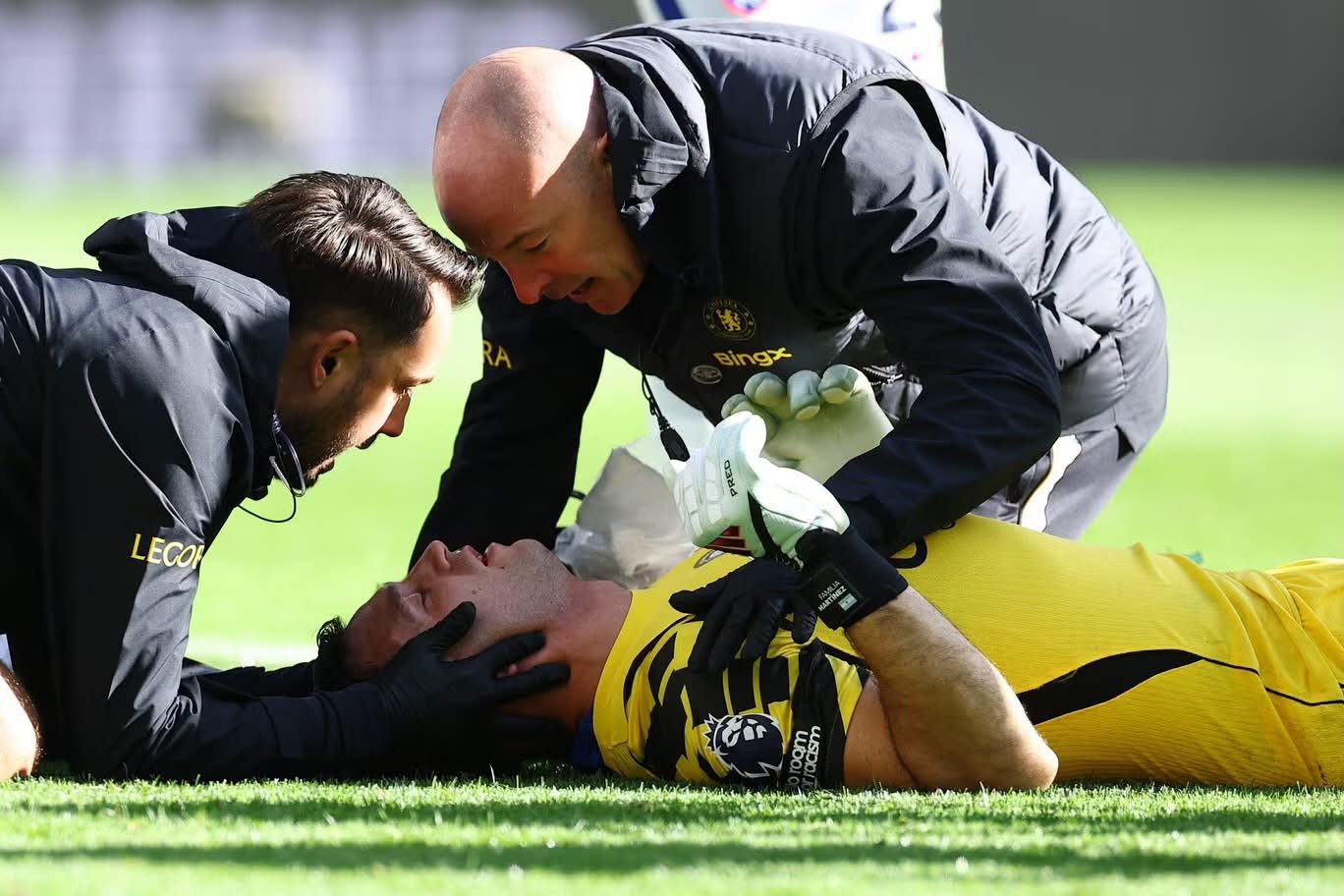
Chelsea goalkeeper Emiliano Martínez was taken to hospital for further medical assessment after suffering a head injury in a collision with Everton defender Jarrad Branthwaite during their English Premier League encounter at Hill Dickinson Stadium on Saturday, October 17, 2026.
The incident occurred in the second half of the match when Martínez came off his line to deal with an Everton free-kick. The Argentine goalkeeper collided with Branthwaite as both players attempted to reach the ball, prompting an extended stoppage while medical personnel attended to them.
Martínez received treatment on the pitch before being carried off on a stretcher. He was subsequently taken to hospital for further assessment, according to reports published after the incident.
The collision raised concerns among players, supporters and members of both teams, with the medical response delaying the match for several minutes.
Chelsea eventually secured a 2-0 victory, with Portuguese winger Pedro Neto scoring both goals. However, the result was overshadowed by the concern surrounding Martínez’s condition.
Martínez Receives Treatment After Collision
The incident happened midway through the second half when Everton delivered a free-kick into Chelsea’s penalty area.
Everton midfielder Kiernan Dewsbury-Hall sent the ball towards the goal, prompting Martínez to move forward and attempt to clear the danger. Branthwaite also challenged for the delivery, and the two players collided.
Both players went to ground following the contact, but Martínez required more extensive medical attention.
Medical staff entered the pitch to assess the goalkeeper, while players from both sides waited as treatment continued.
The stoppage lasted approximately 10 minutes, according to reports from the match. Martínez was eventually removed from the field on a stretcher, with medical staff taking precautions following the head collision.
Chelsea introduced Belgian goalkeeper Mike Penders in his place.
The substitution marked Penders’ Premier League debut, placing additional responsibility on the young goalkeeper during a closely contested away fixture.
Reports indicated that Martínez was responsive as he was taken from the pitch. However, further details about his medical condition and the results of his hospital assessment were not immediately established in the available reports.
Branthwaite Also Assessed by Medical Staff
Everton defender Branthwaite was also assessed following the collision.
Although the incident appeared serious, the defender was able to return to his feet and continue after receiving medical attention and undergoing checks.
The contrasting outcomes for the two players highlighted the need for caution when assessing head injuries in professional football.
A player appearing able to stand or continue playing does not, by itself, establish that a head injury is harmless. Medical professionals must assess the circumstances and determine whether it is safe for a player to return to action.
In Martínez’s case, the decision to remove him from the match and arrange further medical assessment meant Chelsea had to complete the fixture with a replacement goalkeeper.
The incident also drew attention to the responsibilities of clubs and medical teams when responding to potentially serious injuries during high-intensity matches.
Chelsea Secure Victory Through Pedro Neto’s Goals
Despite the disruption, Chelsea maintained their advantage and completed a 2-0 victory over Everton.
Neto opened the scoring shortly after the interval, converting an opportunity created by Jorrel Hato. The goal gave Chelsea the lead in a match that had featured a competitive first half.
The winger then scored again in the closing stages to secure the points for the visitors.
Chelsea’s official match report confirmed the result and recorded Martínez’s replacement by Penders following the lengthy period of treatment.
The victory strengthened Chelsea’s position in the early Premier League standings, while Everton suffered their first league defeat of the season, according to match reports published on Saturday.
However, the injury to Martínez became the principal talking point after the final whistle.
For Chelsea, the result represented a successful away performance, but the circumstances surrounding their goalkeeper created uncertainty about his availability for upcoming matches.
Mike Penders Makes Premier League Debut
Martínez’s forced departure provided Penders with an unexpected opportunity to make his Premier League debut.
The young Belgian goalkeeper entered the match during a difficult moment, with Chelsea leading and Everton still seeking a way back into the contest.
Replacing an established goalkeeper following a potentially serious injury can be challenging, particularly when the incoming player has limited time to prepare for the circumstances of the match.
Penders was required to settle quickly, communicate with Chelsea’s defenders and help the team protect its advantage.
Chelsea managed to preserve their lead and recorded a clean sheet, completing a positive defensive performance despite the disruption.
The appearance also gave Penders valuable experience at the highest level of English domestic football.
Nevertheless, his introduction was prompted by circumstances that Chelsea would have preferred to avoid, with the club’s immediate priority likely to include establishing the full extent of Martínez’s injury.
Medical Assessment Remains Central to Martínez’s Recovery
The decision to take Martínez to hospital for further assessment was an important development following the collision.
Head injuries in football can vary significantly in severity, and the immediate appearance of a player does not always provide a complete picture of the injury.
Medical evaluation is therefore essential when a collision raises concerns about possible head or neck trauma.
Injuries of this nature can also affect a player’s ability to train or compete while further checks are completed. Any return to football depends on the player’s condition and the medical guidance provided by the responsible professionals.
At the time of the reports available for this article, detailed findings from Martínez’s hospital assessment had not been established.
It would therefore be premature to assign a specific diagnosis or predict a recovery period without confirmation from Chelsea or the relevant medical team.
The goalkeeper’s condition will be particularly important for Chelsea as the club prepares for its next fixtures.
An absence could require the coaching staff to adjust their goalkeeping arrangements, depending on the results of the assessment and the player’s recovery.
What the Injury Could Mean for Chelsea
Martínez’s condition is significant because goalkeepers occupy a specialised role that requires consistency, communication and a strong understanding of the defensive system.
A change in goal can affect defensive coordination, particularly when a replacement must enter a match without the usual preparation.
Chelsea managed to finish the Everton fixture with Penders in goal, but the longer-term implications depend on whether Martínez is available for subsequent matches.
The club will also need to consider the player’s recovery carefully rather than rushing him back into competitive action.
For professional football teams, injuries involving the head require particular attention because the consequences may extend beyond the immediate match.
The medical assessment, any recommended recovery period and the player’s response to treatment will help determine the next steps.
Until the club provides a confirmed update, questions about Martínez’s availability should be treated as unresolved.
Wider Implications for Football Safety
The incident also highlights the physical risks associated with aerial challenges in football.
Goalkeepers frequently leave their goal lines to intercept crosses, corners and free-kicks, while defenders and attackers move into the same space in an attempt to reach the ball.
These situations can produce accidental collisions, especially when several players challenge simultaneously.
Although physical contact is an established part of the game, head injuries require a careful and immediate response from referees, medical personnel and clubs.
The extended stoppage during the Chelsea-Everton match demonstrated the importance of allowing medical teams sufficient time to assess injured players.
It also reinforced the need to avoid making assumptions about an injury based solely on television footage or a player’s movements immediately after a collision.
The priority must remain the player’s health and the medical team’s assessment.
For supporters, the incident served as a reminder that injuries can overshadow even an important result. While Chelsea collected three points, Martínez’s condition remained a major concern following the final whistle.
What Happens Next?
The next significant development will be an official update on Martínez’s condition and the outcome of his hospital assessment.
Any statement from Chelsea concerning his recovery, possible diagnosis or availability for upcoming fixtures will help clarify the situation.
Until such information is confirmed, the goalkeeper’s precise injury status and expected return date remain uncertain.
Chelsea will also assess its goalkeeping options ahead of its next match, with Penders having made his Premier League debut against Everton.
For now, the immediate concern is Martínez’s health and recovery following the collision.
Sources
- Chelsea Football Club — Official match report, Everton 0-2 Chelsea.
- Reuters — Match report on Chelsea’s victory and Martínez’s injury.
- The Guardian — Coverage of the Everton-Chelsea Premier League match.