Reported by Simon Daniel Yusuph l Journalist at Weng Global
The General Officer Commanding (GOC), 2 Division of the Nigerian Army, Major-General Auwalu Mahmuda, has urged journalists to verify information concerning military and security operations before publication, warning that unconfirmed reports can cause serious damage and worsen already sensitive situations.
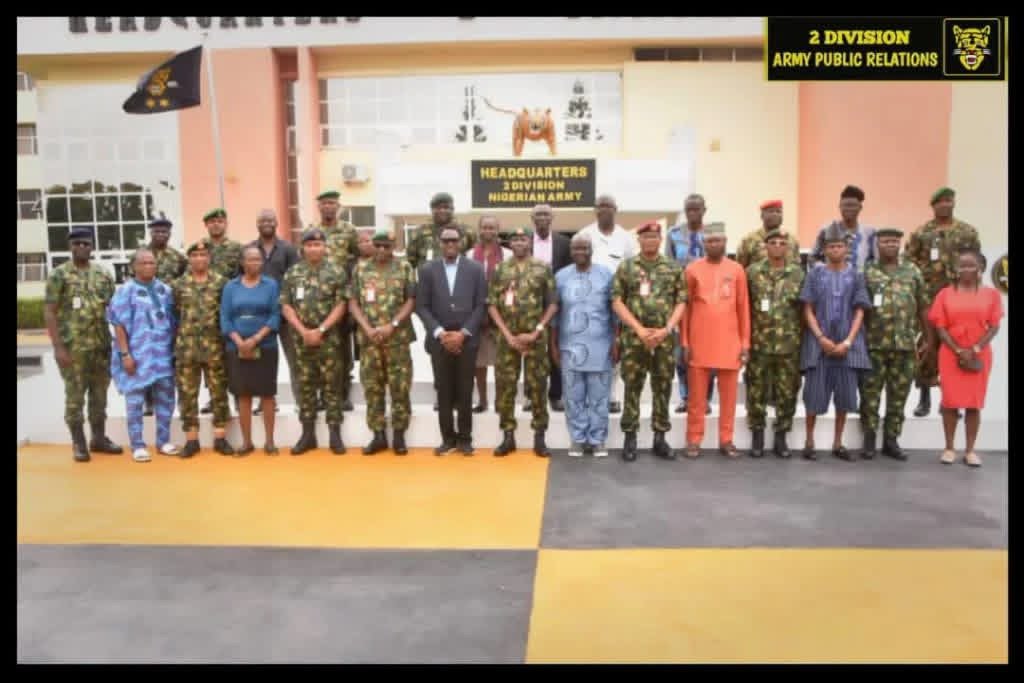
Mahmuda made the call on Wednesday, October 7, 2026, while receiving members of the Correspondents’ Chapel of the Nigeria Union of Journalists (NUJ), Oyo State Council, during a courtesy visit to the headquarters of 2 Division in Odogbo, Ibadan.
The GOC said the military and the media need stronger cooperation to counter misinformation and fake news, particularly in reporting national security matters. He also described journalists as important partners in national development while acknowledging the risks they face when reporting from dangerous environments.
Main Development
Mahmuda’s remarks came amid renewed attention to security reporting in Oyo State and across Nigeria, where kidnapping and other criminal activities continue to pose challenges to communities and security agencies.
The Army commander specifically appealed to journalists not to publish information about military operations without first establishing its accuracy through appropriate channels.
He warned that misinformation can spread quickly and may create consequences that are difficult to reverse.
The GOC’s position was that responsible reporting of military activities requires journalists to establish the exact nature of information before making it public, particularly where the information concerns security operations, intelligence or ongoing military activities.
The appeal does not remove the media’s responsibility to independently scrutinise official claims. Rather, it highlights the need for careful verification in a field where inaccurate information can affect military operations, public safety and the confidence of communities.
For journalists covering security, this means checking information through multiple credible channels, distinguishing confirmed developments from preliminary reports and avoiding the publication of claims that cannot be independently established.
Why the Army Is Calling for Verification
Security reporting presents particular challenges because information can change rapidly during military operations.
Reports of attacks, arrests, rescues, casualties or movements of security personnel may emerge from different sources at different times. In such circumstances, journalists must establish what is confirmed before presenting information as fact.
Mahmuda argued that closer cooperation between the media and security agencies would help reduce misinformation.
He said the Nigerian Army regarded journalists as partners and urged them to play their part in maintaining responsible communication with the public.
The emphasis on verification is particularly relevant in Nigeria, where insecurity has made security reporting an important part of the national news cycle.
However, verification should not be understood as relying exclusively on one institution’s version of events. Professional journalism requires reporters to assess information critically, seek corroboration and provide the public with an accurate account based on available evidence.
That distinction is important because the media’s role extends beyond repeating official statements. Journalists are also expected to ask questions, examine competing claims and report developments in the public interest.
Army and Media Face Different Responsibilities
The meeting also highlighted the different but connected responsibilities of the military and the media.
The Army is responsible for national defence and security operations within its constitutional mandate, while journalists are responsible for informing the public accurately and independently.
Mahmuda acknowledged that journalists often operate in difficult and dangerous circumstances to obtain information.
He said he had seen reporters enter locations where ordinary civilians would be reluctant to go in order to gather information for the public.
His acknowledgement underscores the risks associated with reporting insecurity.
Journalists covering terrorism, kidnapping, communal violence, military operations and other security matters can face physical danger, restrictions on movement and difficulties obtaining reliable information.
At the same time, the consequences of inaccurate reporting can extend beyond the journalist and news organisation. Incorrect reports can alarm communities, undermine confidence in security agencies, interfere with investigations or operations and contribute to the spread of false information.
That is why verification remains central to responsible security journalism.
Old Oyo National Park Becomes Part of the Security Response
Mahmuda’s meeting with journalists also came as the 2 Division announced a significant operational development involving the Old Oyo National Park.
According to the GOC, the Nigerian Army has taken over the entire stretch of the park as a military training site following the abduction and subsequent rescue of victims in the Oriire area of Oyo State.
He said the Chief of Army Staff, Lieutenant-General Waidi Shuaibu, directed the 2 Division to use the park for military training after the Oriire kidnapping.
The stated objective is to make the forest more difficult for kidnappers and other criminal elements to use as a hideout or base for criminal activity.
The development places the park at the centre of the Army’s response to security concerns in the area.
The Old Oyo National Park covers a large forested area, making terrain and access important considerations for security operations. The Army’s decision to use the area for training is therefore intended to increase its operational familiarity with the environment while maintaining a security presence.
The move follows the rescue of victims abducted in Oriire Local Government Area.
The Oriire Kidnapping and Rescue
The Oriire abduction has become an important reference point in the Army’s latest security measures in Oyo State.
Members of the Oyo State NUJ Correspondents’ Chapel praised the 2 Division for its role in the rescue operation.
According to reporting on the incident, pupils and teachers abducted from the Oriire area were eventually rescued after spending weeks in captivity. The rescue involved security and intelligence efforts involving multiple agencies and local security actors.
The incident demonstrated the security challenges associated with large forested areas that can provide criminals with concealment and difficult terrain for conventional security patrols.
By turning the Old Oyo National Park into a military training site, the Army says it intends to increase its ability to operate in the environment and reduce the opportunity for criminal groups to exploit the forest.
The announcement is therefore not simply about military training. It is part of a broader effort to prevent a repeat of a major kidnapping incident and strengthen the security architecture around vulnerable communities.
A Broader Push for Stronger Military Presence
The development also comes against the background of an expansion of military formations in parts of Oyo and Osun states.
Mahmuda recently inspected newly established military formations, including the headquarters of 7 Brigade in Oyo town and 137 Battalion in Ile-Ife.
During that visit, he urged troops to remain disciplined, professional and proactive while carrying out their constitutional responsibilities.
He also warned personnel to protect the reputation of the Nigerian Army through their conduct.
The establishment and strengthening of formations in the two states suggests an effort to improve the Army’s operational reach in the South-West.
For communities facing kidnapping and other security threats, the effectiveness of that expansion will ultimately depend on whether increased military presence translates into improved prevention, faster response and better protection of civilians.
The Importance of Independent Security Reporting
The GOC’s appeal raises an important question for Nigeria’s media industry: how can journalists maintain independence while ensuring that security information is accurate?
The answer lies in rigorous verification.
Journalists should seek information from official military and police sources where appropriate, but should also examine independent evidence, speak to credible witnesses when safe and ethical, review official records and clearly state when facts remain unconfirmed.
This approach allows news organisations to avoid two opposite problems.
The first is publishing unverified information that later proves false.
The second is relying too heavily on official claims without sufficient scrutiny.
Both can undermine public trust.
For a professional newsroom, the standard should be accuracy rather than speed alone.
Breaking a story first has little long-term value if the information is subsequently found to be incorrect.
The Role of the Media in National Security
Mahmuda described the media as an important partner in national development and called for stronger cooperation between journalists, the Army and other security agencies.
The argument reflects the reality that security agencies depend partly on public communication to explain operations, while the public depends on independent journalism to understand what is happening.
That relationship can become difficult when military operations involve sensitive information.
Journalists may encounter information that security agencies cannot immediately disclose for operational reasons. Conversely, security agencies may have information that the public needs to know but that must be carefully handled.
The challenge is therefore to maintain communication without compromising legitimate operational security or journalistic independence.
The media’s responsibility is to inform citizens while protecting sources, avoiding unnecessary exposure of sensitive operational details and ensuring that published information is accurate.
Security agencies, for their part, have a responsibility to provide timely and credible information where disclosure is possible and to recognise the legitimate role of independent journalism.
Reactions From the Oyo NUJ Correspondents’ Chapel
The Chairman of the Correspondents’ Chapel, Yinka Adeniran, commended the 2 Division for what he described as its efforts to maintain security in Oyo State and other areas under its operational responsibility.
Adeniran specifically highlighted the rescue of the Oriire kidnapping victims.
He also requested the Army’s support for the chapel’s forthcoming Press Week, particularly in areas including lectures and medical outreach for members.
The exchange between the GOC and the journalists indicates an effort to strengthen institutional engagement between the military and media practitioners in Oyo State.
Such engagement can help journalists understand the military’s operations and provide security authorities with a clearer understanding of the information needs of the public.
However, professional boundaries remain important.
A working relationship between the military and journalists should not prevent independent scrutiny, and media organisations should retain editorial control over what they publish.
Why the Development Matters
The Army’s call for verification matters because misinformation surrounding security incidents can have consequences beyond inaccurate headlines.
Nigeria’s security environment includes terrorism, kidnapping, banditry, communal violence and other forms of criminal activity. Information about these incidents can spread rapidly through social media before authorities have established what happened.
In such an environment, professional journalism can serve as an important filter between unverified claims and the public.
Accurate reporting can help citizens understand risks, distinguish official warnings from rumours and follow legitimate developments in security operations.
At the same time, independent reporting can provide accountability by asking difficult questions about security failures, government responses and the experiences of affected communities.
The two responsibilities are not contradictory.
A journalist can scrutinise security agencies while still verifying information carefully.
Indeed, strong verification strengthens accountability because criticism based on established facts is more credible than criticism built on rumours.
What Happens Next
The immediate next step will be the implementation of the Army’s decision to use the Old Oyo National Park as a training site.
The effectiveness of the move will depend on how the military uses the area, the level of sustained security presence and whether the strategy reduces the ability of criminal groups to operate from the forest.
The Army is also expected to continue its engagement with media organisations as security operations develop in Oyo and surrounding areas.
For journalists, Mahmuda’s appeal places renewed emphasis on verification, particularly when reporting sensitive security information.
The media will continue to face the challenge of balancing speed, public interest, operational sensitivity and accuracy.
For residents of communities affected by insecurity, the most important measure will ultimately be whether the combination of military operations, intelligence gathering, community cooperation and responsible public communication produces safer conditions.
What’s next?
Major-General Auwalu Mahmuda’s call for journalists to verify military and security information before publication comes at a time when misinformation can spread rapidly and security developments remain highly sensitive.
His message to the media was accompanied by a wider announcement that the Nigerian Army’s 2 Division has taken over the Old Oyo National Park as a training ground following the Oriire kidnapping and rescue operation.
The two developments are connected by a common concern: improving the security response while ensuring that the public receives reliable information.
For the media, the responsibility is to report quickly without sacrificing accuracy, independently scrutinise official claims and clearly distinguish confirmed facts from information that remains unverified.
For the military, maintaining open and credible communication with journalists can help the public better understand legitimate security operations.
Ultimately, the public interest is best served when both institutions recognise their different responsibilities and work within them: the military to protect lives and national security, and the media to provide accurate, independent and accountable journalism.
Weng Global – stories beyond borders
Sources
- Nigerian Army, 2 Division
- Independent Newspaper Nigeria
- Vanguard
- Leadership Newspaper
- Westng
- The Next Edition
- Premium Times
- Nigerian Tribune