Reported by Simon Daniel Yusuph l Journalist at Weng Global
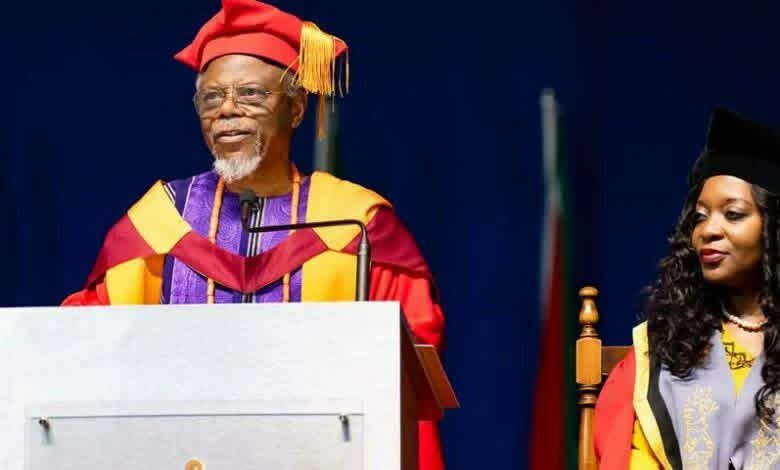
Professor Toyin Falola and the Olowu of Owu Kingdom, Oba Saka Matemilola, have raised concerns over the growing monetisation of traditional titles in Nigeria, warning that the practice risks weakening the cultural and moral values historically associated with chieftaincy.
The two prominent figures expressed their concerns during a recent discussion involving Falola and the Owu monarch, where issues surrounding traditional institutions, culture, leadership and the changing meaning of chieftaincy titles were examined.
Their comments come amid wider debates in Nigeria about the commercialisation and politicisation of traditional institutions, with scholars and observers pointing to concerns that money and political influence can increasingly shape access to traditional honours and positions.
Falola Raises Concern Over Changing Meaning of Traditional Titles
Falola, a distinguished Nigerian historian and professor, has written extensively on Nigerian history, political institutions, culture and the evolution of traditional authority.
His concerns about the changing relationship between money, status and traditional institutions reflect a broader historical question about how Nigeria’s traditional systems have adapted to social and economic changes.
Traditional titles have historically served different purposes across Nigeria’s diverse communities. They have been used to recognise individuals for contributions to their communities, leadership, achievement, service and other forms of social distinction.
However, scholars have documented concerns over the increasing influence of wealth in the conferment of honorary and traditional titles.
Research on Nigerian chieftaincy institutions has described the growing commercialisation of traditional titles as part of wider changes affecting traditional authority. One academic study notes that the increasing politicisation and commercialisation of chieftaincy appointments has generated concerns about the stability and legitimacy of traditional institutions.
Olowu Highlights Importance of Traditional Institutions
The Olowu of Owu Kingdom, Oba Saka Matemilola, is among Nigeria’s prominent traditional rulers and has participated in public discussions concerning culture, leadership and national development.
The monarch’s involvement in the conversation with Falola provides a traditional-institution perspective to the debate over the changing nature of chieftaincy in contemporary Nigeria.
Traditional rulers continue to occupy an important cultural and community role across the country, although their constitutional and political powers vary considerably between states and communities.
In many communities, traditional institutions remain responsible for preserving customs, supporting community cohesion, settling certain local disputes and providing cultural leadership.
The monetisation of titles therefore raises questions not only about money but also about the criteria used to recognise individuals within traditional institutions.
Money and Chieftaincy Have a Long History
The relationship between money and traditional titles is not entirely new.
Academic research on Nigeria has documented the emergence of what critics have described as the “monetisation” or “commoditisation” of chieftaincy, particularly where individuals are expected to make substantial financial contributions in connection with the conferment of honorary titles and associated ceremonies.
Research published in the American Anthropologist examined how money, social status and honorary chieftaincy titles have become interconnected in parts of Nigeria. The study noted that some Nigerians have criticised the practice because titles perceived to be available to those who can afford them may undermine the prestige traditionally associated with achievement and community recognition.
At the same time, the financial dimension of chieftaincy ceremonies can have different meanings across communities.
Traditional title ceremonies may involve significant expenditure on clothing, food, entertainment, community contributions and other activities. Such expenditure does not necessarily mean that a title itself has been formally sold.
This distinction is important because traditional institutions operate under different customary systems, and practices surrounding honorary titles are not uniform across Nigeria.
Commercialisation and Politicisation
The debate over monetisation also intersects with concerns about political influence.
Research on traditional authority in contemporary Nigeria has identified the politicisation, commercialisation and judicialisation of traditional leadership as developments that can generate disputes and undermine confidence in traditional institutions.
In some parts of the country, governments have formal roles in recognising or grading traditional rulers, while customary institutions and ruling families may determine succession according to applicable laws and traditions.
The legal framework governing chieftaincy also varies by jurisdiction.
For example, historical chieftaincy declarations in the former Western Region established detailed procedures for the selection of traditional rulers, including the Olowu of Owu. The documented process involved recognised ruling houses and kingmakers rather than simply the ability of an individual to pay for a title.
This distinction illustrates why the debate surrounding the monetisation of honorary titles should not automatically be applied to every traditional succession process.
Why the Debate Matters
The controversy over monetised chieftaincy titles goes beyond ceremonies and individual honours.
Traditional institutions remain important symbols of identity and cultural continuity in many Nigerian communities. Their legitimacy depends partly on public confidence that titles and positions reflect accepted customary principles and meaningful contributions.
Where communities perceive titles as being primarily determined by financial capacity, questions can arise about merit, fairness and the cultural value of the institution.
There are also concerns about the possibility of wealthy individuals using traditional honours to strengthen social status, influence or networks.
Academic literature has similarly identified the commercialisation of traditional authority as one of several developments that can contribute to disputes around leadership selection and weaken confidence in traditional institutions.
However, the existence of financial contributions associated with a chieftaincy ceremony does not by itself establish that a particular title was improperly sold. Each case depends on the customary rules of the community, the nature of the title and the circumstances surrounding its conferment.
Preserving Cultural Value
The concerns raised by Falola and the Olowu come at a time when traditional institutions are adapting to changing social and economic realities.
Nigeria’s traditional rulers increasingly operate in an environment shaped by modern government, democratic institutions, business interests, social media and changing expectations among younger generations.
For traditional institutions, one challenge is how to preserve cultural authority while adapting to contemporary society.
That includes maintaining transparent and credible processes for the conferment of titles, preserving customary values and ensuring that recognition remains connected to meaningful service or achievement where that is the accepted tradition.
It also requires distinguishing legitimate community contributions from arrangements that could create the perception that traditional honours are simply available to the highest bidder.
A Broader Nigerian Conversation
The discussion involving Falola and Oba Matemilola reflects a wider national conversation about the future of traditional institutions in Nigeria.
Traditional rulers retain considerable influence in many communities even though they do not exercise the same formal governmental powers as elected officials.
Their roles can include mediation, cultural preservation, community mobilisation and support for development initiatives.
At the same time, scholars have argued that traditional institutions face challenges arising from political interference, commercialisation and changing relationships with state governments.
The debate therefore involves competing pressures: preserving traditional authority and cultural identity while ensuring that institutions remain credible in a modern society.
What Happens Next
The concerns expressed by Falola and the Olowu add to an ongoing public discussion rather than announcing a specific government policy or regulatory change.
Any meaningful response to the issue would likely involve traditional institutions, community leaders, scholars, civil society organisations and relevant state authorities examining how traditional titles are conferred and how customary standards can be preserved.
For Nigeria, the wider question is how traditional institutions can retain their cultural significance while responding to contemporary economic and social realities.
The debate also highlights the importance of distinguishing between legitimate financial contributions connected with traditional ceremonies and the improper commercialisation of cultural honours.
As discussions continue, greater transparency around the criteria and processes for conferring titles could help strengthen public understanding and confidence in traditional institutions.
Weng Global – stories beyond borders
Sources
- Toyin Falola Interviews
- Research literature on traditional authority and chieftaincy in contemporary Nigeria
- American Anthropological Association research on money, status and chieftaincy in Nigeria
- National Library of Nigeria historical chieftaincy records
- Boiling Point