Reported by Simon Daniel Yusuph l Journalist at Weng Global
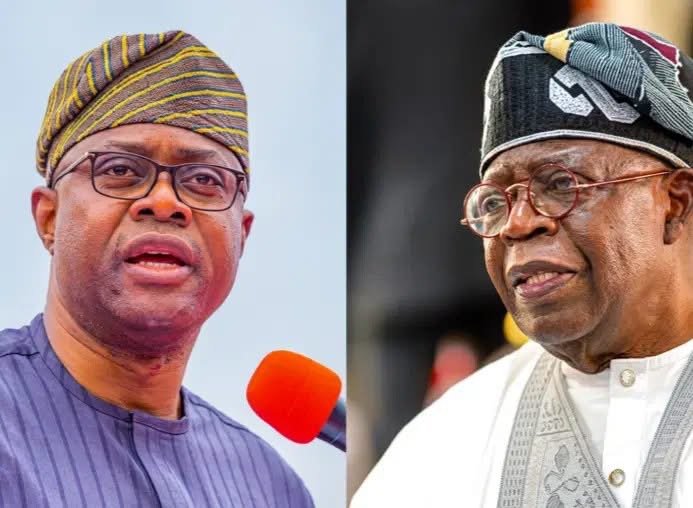
Oyo State Governor and presidential candidate of the Allied Peoples Movement (APM), Seyi Makinde, has ruled out including President Bola Ahmed Tinubu in his proposed government of national unity if elected president in the 2027 general election, while expressing willingness to appoint capable individuals from the ruling All Progressives Congress (APC).
Makinde made the declaration during an interview on The Rooftop Podcast, where he was asked whether prominent Nigerian political figures, including Tinubu, former Vice-President Atiku Abubakar and former Labour Party presidential candidate Peter Obi, would be considered for positions in his proposed administration.
Responding to the question, the governor indicated that Tinubu would probably not be included but maintained that political affiliation would not prevent qualified Nigerians from serving in his government.
“Perhaps not President Tinubu, but there are still decent people in APC as well. I’ll tap them and they are Nigerians,” Makinde said.
His comments introduce a significant political dimension to his proposed national unity government, which he has repeatedly presented as an alternative to what he considers an overly partisan approach to governance under the current administration.
The governor’s position also highlights the distinction he makes between working with individuals across political parties and entering into political cooperation with particular leaders.
Makinde Accuses Tinubu of Failing to Honour 2023 Agreement
Explaining why he would not consider Tinubu for his proposed government, Makinde referred to an alleged agreement reached ahead of the 2023 presidential election.
According to the Oyo governor, he supported Tinubu during the last presidential election because he believed the arrangement would produce a government of national unity rather than an administration dominated exclusively by the APC.
Makinde said the understanding was connected to the position adopted by the PDP G5 governors, a group of five governors who disagreed with the leadership of the Peoples Democratic Party (PDP) before the 2023 election.
The group, which included Makinde, opposed the party’s presidential campaign arrangement and called for greater political balance and inclusiveness.
Makinde said the G5 governors supported the idea of bringing competent Nigerians from different political backgrounds into government, irrespective of party affiliation.
Recalling the understanding, he said: “Well, not in that context. I mean, I worked for him in 2023. We agreed on a government of national unity. He did not fulfil it.”
The governor argued that his support for Tinubu was based partly on the expectation that the president would use his political experience and relationships to establish an inclusive administration.
However, he maintained that the arrangement did not produce the outcome he expected.
Makinde’s statement represents his account of the political understanding reached before the 2023 election. The claim that Tinubu failed to honour the agreement remains an allegation attributed to the governor.
G5 Governors and the Politics Behind the 2023 Election
The disagreement involving the PDP G5 governors was one of the significant political developments preceding Nigeria’s 2023 presidential election.
The group emerged from disagreements within the PDP, particularly over the party’s leadership structure and the demand for greater regional balance following the emergence of Atiku Abubakar as its presidential candidate.
The governors argued that the party’s national chairman, Iyorchia Ayu, should step down following the emergence of a presidential candidate from the North.
Their position was closely connected to concerns about fairness, political representation and the distribution of power within the party.
Although the G5 governors remained members of the PDP, their political positions weakened the party’s ability to present a united front during the presidential campaign.
Makinde subsequently supported Tinubu of the APC, while other political actors within the opposition pursued different political arrangements.
The Oyo governor now says his decision to support Tinubu was influenced by the expectation that the incoming administration would accommodate competent Nigerians across political divisions.
His latest comments suggest that the disagreement has continued to influence his assessment of the president and his approach to political cooperation ahead of the 2027 election.
Makinde Cites Abacha-Era Appointments as an Example of National Inclusion
During the podcast interview, Makinde also referred to Nigeria’s political history to explain what he believes a government of national unity should look like.
He cited the administration of former military Head of State, General Sani Abacha, as an example of efforts to bring prominent Nigerians from different backgrounds into government during a period of political tension.
Makinde specifically mentioned the appointments of former Lagos State governor Lateef Jakande and businessman Alex Ibru.
The appointments came after the annulment of the June 12, 1993 presidential election, an event that triggered widespread political opposition and a prolonged national crisis.
According to Makinde, bringing individuals from different backgrounds into government was intended to reduce political tensions and accommodate aggrieved sections of the country.
He argued that similar thinking should guide the formation of an inclusive administration in a democratic Nigeria.
However, the historical comparison also requires context. Abacha’s administration was a military government that came to power in 1993 and ruled without an electoral mandate. Its appointments cannot be equated directly with the formation of an elected democratic government.
Makinde’s reference was therefore focused on the political idea of accommodating different interests rather than suggesting that military rule should serve as a model for democratic governance.
Governor Criticises Tinubu’s Political Appointments
Makinde also criticised what he described as the concentration of political appointments within Tinubu’s political circle.
He alleged that the president had not sufficiently embraced the principle of national inclusion that informed the political understanding ahead of the 2023 election.
“Tinubu didn’t do that at all. All his appointees are from Bourdillon,” the governor said.
Bourdillon is associated with Tinubu’s political base in Lagos and has long been connected to his political network.
Makinde’s criticism suggests that he believes political appointments should be determined primarily by competence, national representation and the ability to contribute to governance rather than loyalty to a particular political organisation or leader.
However, his assessment represents his political position, and the broader composition of federal appointments would require an independent examination to establish the extent of regional and political representation within the administration.
He maintained that his proposed administration would seek capable Nigerians from different parts of the country and political backgrounds.
Under the arrangement he described, individuals would be considered based on their ability to contribute to addressing the country’s economic, security and development challenges.
APM Candidate Promises a Four-Year Transitional Government
Makinde’s latest comments are connected to his broader presidential campaign, which is built around what he calls the Reset Nigeria Agenda.
The governor has repeatedly promised that, if elected president in 2027, he would establish a transitional government of national unity that would not remain in office beyond four years.
He has also pledged to serve only one presidential term.
Speaking at the APM North-East 2027 Town Hall Meeting in Yola, Adamawa State, in October, Makinde said his proposed administration would be inclusive and focused on establishing a new direction for Nigeria.
He said the government would prioritise national unity, economic recovery, security reforms and sustainable development.
Makinde explained that the proposed arrangement would bring together individuals capable of contributing to national development, regardless of their political affiliations.
He also argued that Nigeria needed a government that would listen to citizens and address the concerns of different regions rather than concentrate political power within a limited circle.
In his October presentation, he described the proposed administration as a transitional government intended to demonstrate that a different approach to governance could produce measurable results within four years.
The proposal forms an important part of his attempt to distinguish his presidential campaign from the political direction of the current administration.
Makinde’s Wider Criticism of the Tinubu Administration
The governor’s decision to exclude Tinubu from his proposed government also follows his increasingly critical assessment of the president’s administration.
In a statement published on his Reset Nigeria platform on November 12, 2026, Makinde explained why he had withdrawn his political support for Tinubu ahead of the 2027 presidential election.
He said his decision was not motivated by a personal disagreement or simply by his ambition to occupy the presidency.
Instead, he identified concerns about economic development, governance, political alliances and the implementation of economic reforms.
Makinde acknowledged improvements in some macroeconomic indicators under the Tinubu administration but argued that those developments had not sufficiently translated into better living conditions for ordinary Nigerians.
He maintained that economic stabilisation should produce tangible benefits, including employment opportunities, stronger businesses, improved incomes and better living standards.
He also criticised the administration’s handling of economic reforms, particularly the removal of the petrol subsidy and changes to the foreign exchange system.
While acknowledging the need for reforms, he argued that adequate preparations and protective measures should have been introduced to reduce the hardship experienced by vulnerable Nigerians.
On national unity, he expressed concern that political alliances were being used more to consolidate political power than to promote a shared national interest.
These criticisms provide additional context for his decision to challenge Tinubu in the 2027 presidential election.
Political Implications for the 2027 Presidential Election
Makinde’s remarks could become an important issue in the political debate surrounding the 2027 presidential election, particularly as political parties and candidates begin presenting their positions on national unity, coalition-building and governance.
By ruling out Tinubu while remaining open to appointing APC members, the governor is attempting to communicate that his proposed administration would distinguish between political leadership and individual competence.
The position could appeal to Nigerians who support a government that draws expertise from different political parties.
It also raises questions about how such an administration would operate in practice, particularly regarding political appointments, relationships with the National Assembly and cooperation with state governments controlled by opposing parties.
A government of national unity would require more than appointing individuals from different political backgrounds. It would also depend on clear policy priorities, institutional independence, transparent appointment procedures and accountability mechanisms.
For the proposal to achieve its stated objectives, the administration would need to demonstrate how political inclusion would translate into measurable improvements in security, education, healthcare, employment and economic development.
The question of whether a four-year transitional government could deliver such changes would also remain central to public scrutiny.
What Happens Next?
With the 2027 presidential election approaching, Makinde is expected to continue presenting the Reset Nigeria Agenda as the central policy framework of his campaign.
His comments about Tinubu are likely to attract further political debate, particularly regarding the alleged 2023 agreement and the kind of relationships he intends to maintain with leaders across Nigeria’s political parties.
The governor has indicated that his proposed government would remain open to capable Nigerians from different political backgrounds.
However, he has not, in the remarks reported from the Rooftop Podcast, provided a complete list of individuals he would consider for appointments or detailed criteria for selecting members of the proposed government.
The success of his national unity proposal will ultimately depend on the policies, institutional arrangements and leadership decisions he presents to Nigerians.
For now, Makinde’s position is clear: he is willing to work with competent Nigerians from the APC but does not intend to include President Tinubu in his proposed government if he wins the 2027 presidential election.
As political activities intensify, voters will have the opportunity to assess the competing proposals of presidential candidates and determine which approach offers the most credible response to Nigeria’s challenges.
Weng Global – stories beyond borders
Sources
- Vanguard — Interview report on Makinde’s position regarding Tinubu and the proposed national unity government, November 23, 2026.
- TheCable — Makinde’s explanation of his withdrawal of support for Tinubu, November 12, 2026.
- Premium Times — Report on Makinde’s reasons for challenging Tinubu in the 2027 presidential election, November 12, 2026.
- Premium Times — Report on Makinde’s proposed four-year transitional Government of National Unity, October 10, 2026.
- ARISE News — Report on Makinde’s allegations concerning the 2023 national unity government agreement, November 13, 2026.
.